
How 76th Makerere University Graduation Unfolded
A key highlight of the 76th graduation ceremony was a record number of PhD graduates. A total of 213 candidates were awarded doctorates, the highest number in the university’s history, according to Nawangwe.
University dons honour Reeta Roy, Matercard Foundation president during the fourth day of the 76-graduation ceremony at Makerere University on February 27 2026. (Credit: Juliet Kasirye)
KAMPALA - Freedom Square was filled with excitement for four days, from February 24 to 27, 2026, as more than 9,200 students graduated with various academic qualifications from Makerere University.
In his opening remarks, the vice chancellor, Prof Barnabas Nawangwe, announced that a total of 9,295 graduates were awarded degrees and diplomas. Of these, 4,262 were female, representing 46 per cent, while 5,033 were male, representing 54 per cent.
A key highlight of the 76th graduation ceremony was a record number of PhD graduates. A total of 213 candidates were awarded doctorates, the highest number in the university’s history, according to Nawangwe.
In addition, 2,503 graduates received master’s degrees, 6,343 were awarded bachelor’s degrees, 206 received postgraduate diplomas, and 30 were awarded diplomas. Graduates expressed visible excitement as they celebrated attaining qualifications at various levels.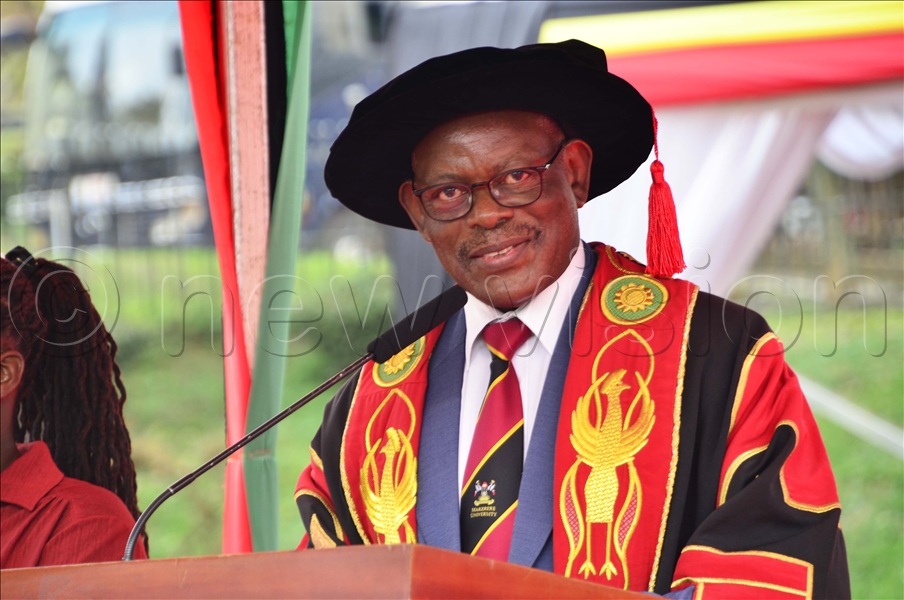
Prof Barnabas Nawangwe addresses graduands during the fourth day of the 76-graduation ceremony at Makerere University on February 27 2026. (Credit: Juliet Kasirye)
Among the notable graduates was the founder of King Ceasor University, Augustus Mulenga, who was awarded a Master of Science in Marketing. “So, it is very important in one's life to improve your knowledge consistently.
I also want to thank all Ugandans, because they have been really aware of the value of education. If you see the kind of numbers that are graduating here in one university, it is amazing; now you can imagine how many are graduating in all universities,” he said.
Dr Godfrey Mugisha Masereka, former Manager for Planning, Monitoring and Evaluation at the former National Agricultural Advisory Services secretariat, was also among those celebrating after earning his doctorate. His PhD research was titled “Non-Farm Household Enterprises in Uganda: Participation, Survival and Effect on Agriculture Commercialisation.”
Using nationally representative cross-sectional household survey and panel data, Masereka analysed the socio-economic, demographic and institutional factors influencing engagement in non-farm enterprises.
His findings showed that participation is significantly influenced by education, access to finance and regional location. The study also revealed that non-farm household enterprises face high exit rates in their early years, with female-owned and agriculture-related enterprises being more vulnerable.
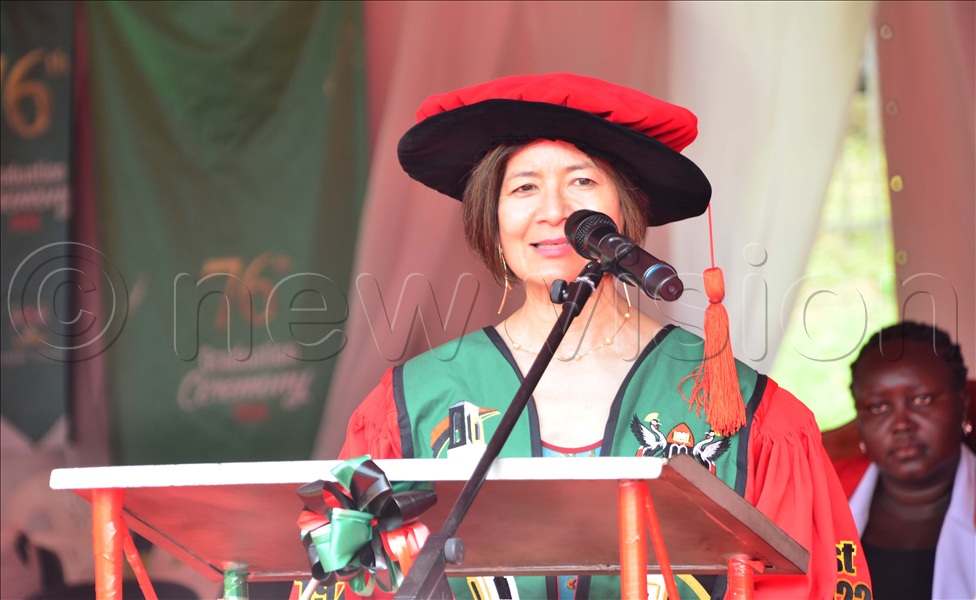
Reeta Roy, Matercard Foundation president addresses graduands after receiving a PHD during the fourth day of the 76-graduation ceremony at Makerere University on February 27 2026. (Credit: Juliet Kasirye)
He further found that households earning income from non-farm enterprises were less likely to commercialise agricultural production, indicating a trade-off between income diversification and farm market participation.
Masereka recommended strengthening access to affordable finance, enterprise skills development and targeted survival support interventions, particularly for women-owned enterprises, while aligning non-farm enterprise promotion with agricultural commercialisation policies.
Dr Shamirah Najjinda also celebrated her academic achievement after earning a doctorate. Her research was titled “Family Support, Entrepreneurial Resources, Entrepreneurial Resilience and Entrepreneurial Wellbeing of Women Entrepreneurs in Hospitality and Tourism Industry in Uganda.”
Najjinda examined the contribution of family support, entrepreneurial resources and entrepreneurial resilience in promoting the well-being of women entrepreneurs. The study revealed that entrepreneurial resources and entrepreneurial resilience significantly contribute to well-being.
However, she found that family support insignificantly contributed to entrepreneurial well-being. The study defined entrepreneurial wellbeing in terms of meeting basic needs, financial stability, social recognition, knowledge accumulation, self-improvement, autonomy, work-life balance and business growth.
She recommended that the Government offer resilience training to women and establish regional and business support hubs to enhance the well-being of women entrepreneurs in Uganda.
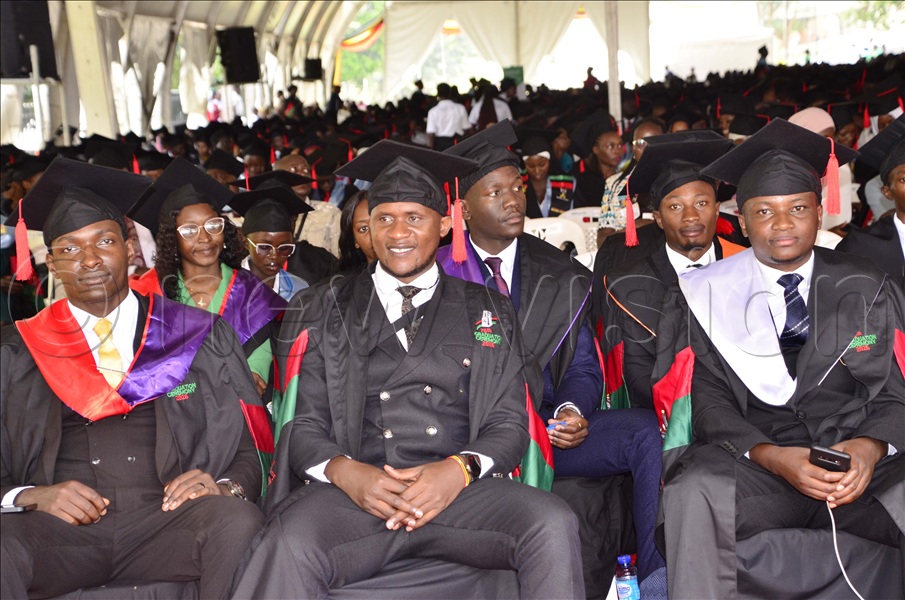
Some of the emerging leaders during the fourth day of the 76-graduation ceremony at Makerere University on February 27 2026. (Credit: Juliet Kasirye)
Dr Betty Tuhaise Tumuhirwe was also awarded a PhD following the approval of her research titled “Bond Market Development, Government Effectiveness, Private Sector Participation, and Infrastructure Development in Africa.”
Tuhaise examined the relationship between bond market development and infrastructure development, mediated by private sector participation, with government effectiveness as a conditioning factor in Africa.
Anchored on the Preferred Habitat, Systems and Good Governance theories, her study applied the System Generalised Method of Moments using Stata 18.0 on secondary data covering 2013 to 2022 from the World Bank and the African Development Bank.
Her findings revealed that bond market development had a positive and significant direct effect on energy access and an indirect effect on infrastructure development through private sector participation.
She further highlighted that public and publicly guaranteed bonds significantly support composite infrastructure and energy, while long-term private non-development guaranteed bonds are more effective in financing information and communication technology.
Tuhaise recommended strengthening government effectiveness through benchmarking against countries such as Botswana, Mozambique and Rwanda, and deepening bond markets through improved regulatory frameworks that foster sector-specific bond financing and co-financing.
Two brothers, Derrick Kajjoba and Jeff Briton Ssemudu, were both awarded PhDs in Mechanical Engineering. Kajjoba conducted research on factors affecting natural ventilation in residential buildings.
“This study was motivated by, first of all, where I used to stay in a house I used to stay in, and I realised that during hot days, we used to cover ourselves beyond midnight. So, this prompted me to research about which factors contribute to these conditions, in addition to the air quality that sometimes we do not focus on in our houses,” Kajjoba said.
He added, “I found the materials we use in the construction of our houses, the building orientation where a house or a building faces the occupancy density, that is the number of people that stay in these houses, in addition to the equipment and other things that we have in our houses, contribute substantially to the indoor conditions and the air quality.”
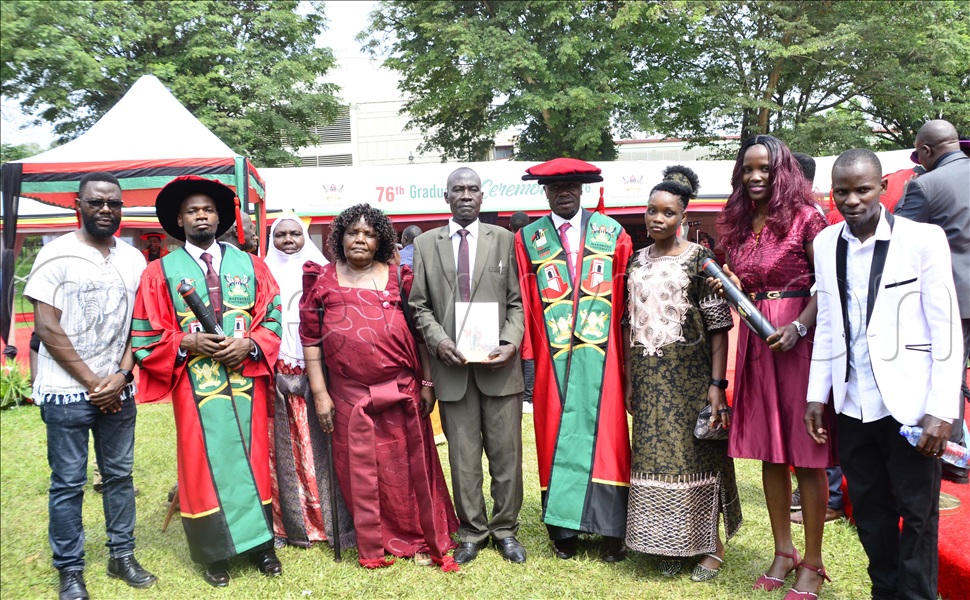
Derrick Kajjoba, Jeffy Semuddu with their family after receiving PHDs during the fourth day of the 76-graduation ceremony at Makerere University on February 27 2026. (Credit: Juliet Kasirye)
“In this research, I have developed a policy brief. Of course, during the conduct of this research, I involved key stakeholders in the building sector, like the National Building Review Board, the Ministry of Energy, and other consultants in the building space. So, I have developed a policy brief that I am yet to present to these stakeholders, and of course, as a requirement for a PhD, is a publication. I have done that, I have disseminated this knowledge out there in journals that are internationally recognised,” Kajjoba said.
“In my research, first of all, I recommend that we should consult experienced building stakeholders while designing our buildings. When you look at the urban space where I conducted this research, most of our buildings face in the direction of the nearest access road, and we leave out factors like the direction of the sun, where the sun sets and rises, the surroundings, like trees and other factors.”
Ssemudu, during his PhD, certified more than 2,000 people in occupational safety and health. “And most of them, over 43% of those are employed in safety roles in different industrial sectors across,” Ssemudu said.
The First Lady and Minister of Education and Sports, Mrs Janet Museveni, said, “We need our universities to produce not just graduates with certificates, but sovereign leaders with a character, men and women worthy of trust, capable of ethical decision-making, and committed to the common good. This is how we build the Uganda we want, a nation made by people of integrity, driven by a sense of purpose, and united in service to our country.”