
Makerere fellows urged on climate-smart agriculture policy reforms
Wamala noted that climate variability and environmental degradation continue to threaten agricultural production, food security and rural livelihoods in Uganda and across Africa, calling for innovative, evidence-based and scalable solutions.
(L-R) Kemigisha, Prof. Wamala, Dr Babyenda and Prof. Bbaale (First Left second row) with other graduates after getting their certificates. This was during the graduation ceremony for the 2025 Environment for Development Initiative (EfD) Inclusive Green Economy (IGE) Fellowship at the Makerere University Agricultural Research Institute at Kabanyolo. (Credit: John Odyek)
KAMPALA - Makerere University has urged graduates of the 2025 Environment for Development Initiative (EfD) Inclusive Green Economy (IGE) Fellowship to spearhead policy reforms that promote climate-smart agriculture and sustainable development across the region.
Five senior civil servants fulfilled the requirements for the award of the Certificate of Achievement in Inclusive Green Economy.
They are;
▪️Eng. Epeet Thomas from the agriculture ministry
▪️Getrude Basiima from the finance ministry
▪️Nicholas Magara from the water and environment ministry
▪️Boaz Tumusiime Mboijana from the tourism ministry
▪️Irene Kemigisha from the lands ministry
The graduation ceremony was held at the Makerere University Agricultural Research Institute at Kabanyolo on Thursday (June 25).
Prof. Robert Wamala, the director of research, innovation and partnerships at Makerere University, said government attaches strategic importance to climate-resilient agriculture, sustainable food systems and inclusive green growth.
Representing Vice-Chancellor Prof. Barnabas Nawangwe, he congratulated the five fellows for completing the year-long programme.
"Today's graduation is more than a celebration of academic achievement. It is a testament to our collective commitment to building the knowledge, skills and partnerships required to address one of the defining challenges of our time, namely climate change and its effects on agriculture, livelihoods and sustainable development," he said.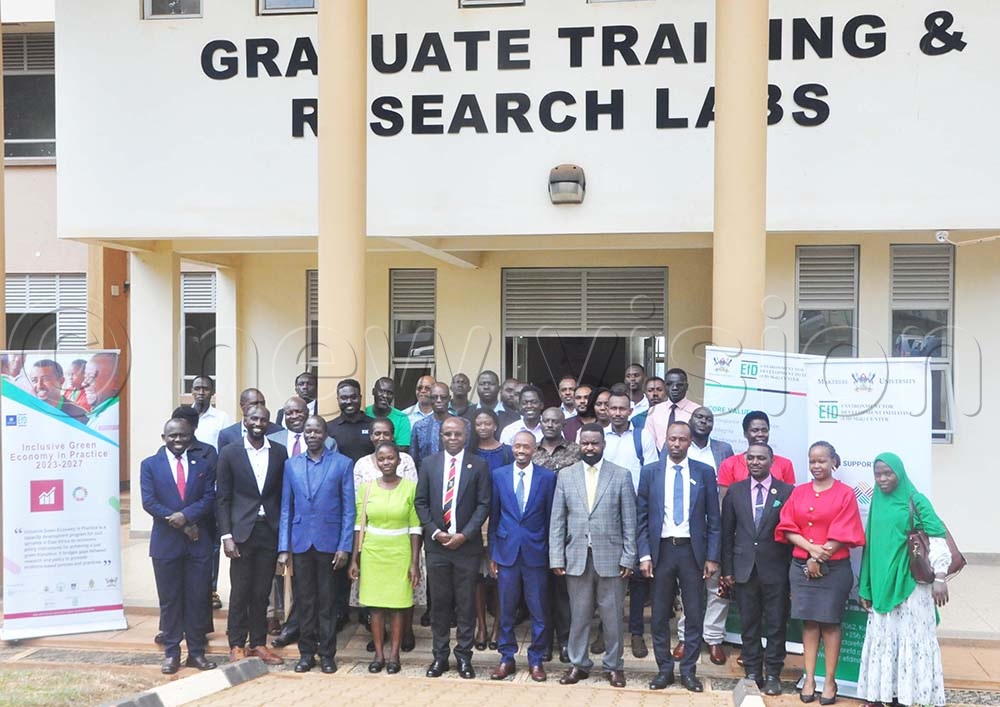
Officials from Makerere University, guests together with civil servants who got certificates. This was during the graduation ceremony for the 2025 Environment for Development Initiative (EfD) Inclusive Green Economy (IGE) Fellowship at the Makerere University Agricultural Research Institute at Kabanyolo. (Credit: John Odyek)
The 2025 fellowship was conducted under the theme, "Accelerating the Adoption of Climate-Smart Agriculture."
Wamala noted that climate variability and environmental degradation continue to threaten agricultural production, food security and rural livelihoods in Uganda and across Africa, calling for innovative, evidence-based and scalable solutions.
"As a research institution, Makerere recognises that sustainable agricultural transformation remains central to Uganda's strategic development and the achievement of national and continental development aspirations," he said.
The fellowship equipped participants with practical knowledge and skills in climate-smart irrigation technologies, soil and water conservation approaches and other innovations aimed at improving resilience and agricultural productivity.
"The fellows have not only gained technical competencies but have acquired the capacity to translate knowledge into practical solutions for communities and institutions," said Wamala.
One of the programme's unique features is its regional approach, which enables fellows from different East African countries to exchange experiences and learn from successful policy interventions.
Participants from Uganda, Kenya, Tanzania, Rwanda and Ethiopia benefited from cross-border learning and knowledge exchange on shared environmental and development challenges.
Such regional partnerships are seen to strengthen professional networks and advance the transition towards inclusive green economies and sustainable agricultural systems.
Wamala urged the graduates to become ambassadors of climate-smart agriculture and champions of sustainable development within their institutions and communities.
"The knowledge and skills acquired should inspire innovation, inform policy and drive transformative actions that improve livelihoods and strengthen resilience."
He reaffirmed Makerere's commitment to strengthening research, innovation and capacity development that responds directly to societal challenges, including climate action, food security, environmental sustainability and livelihood improvement.
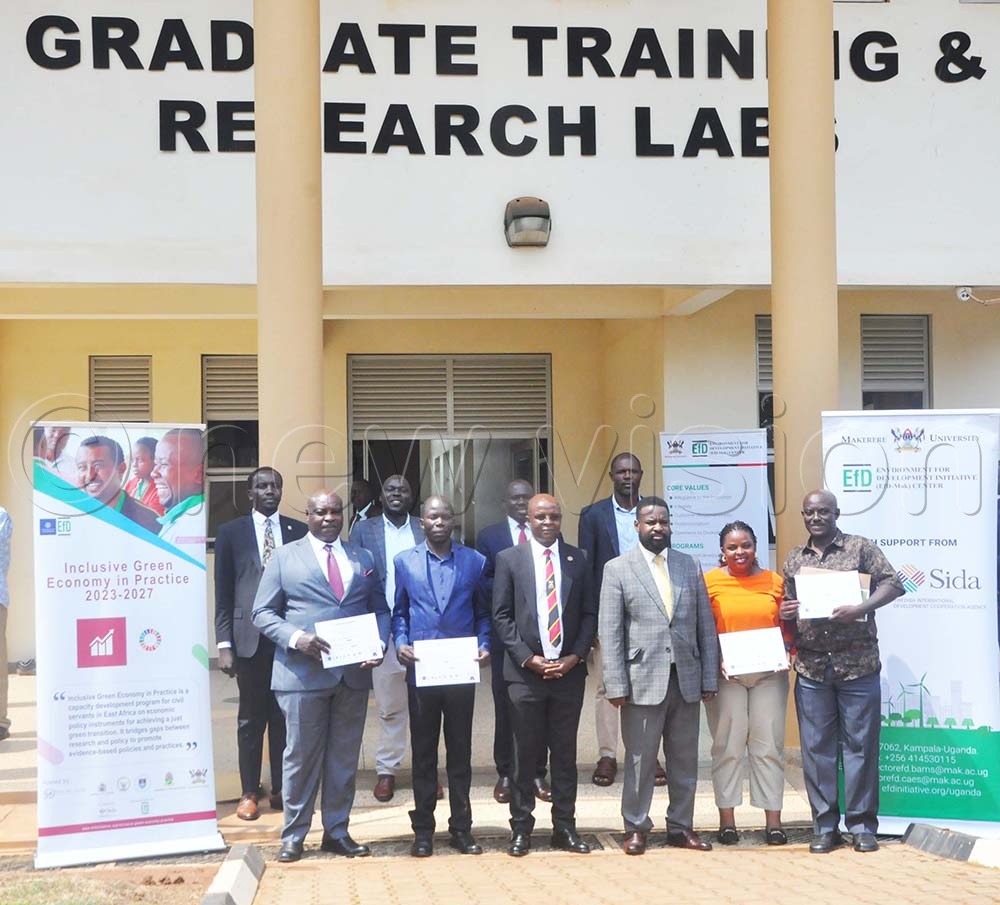
(R-L) Mboijana (First Right), Kemigisha (Second Right), Prof. Wamala (Third Right), Prof. Bbaale (Fourth Right) with officials from Makerere University, guests together with civil servants who got certificates. This was during the graduation ceremony for the 2025 Environment for Development Initiative (EfD) Inclusive Green Economy (IGE) Fellowship at the Makerere University Agricultural Research Institute at Kabanyolo. (Credit: John Odyek)
Prof. Edward Bbaale, the director of the Environment for Development-Makerere University Centre (EfD-Mak) and Principal of the College of Business and Management Sciences (CoBAMS), said the IGE Programme is equipping senior civil servants and policymakers in East Africa with the skills needed to drive a just green transition through evidence-based policymaking.
"The programme bridges gaps between research and policy and between researchers and policymakers in order to strengthen evidence-based decision-making," he said.
The programme delivers impact at individual, organisational and systems levels through high-level policy dialogues, professional in-service training, training of trainers, cross-country peer learning and the co-creation of practical solutions.
"This year, our focus has been on climate-smart agriculture, where fellows have undertaken policy reviews and developed transformation initiatives aimed at addressing emerging environmental and agricultural challenges," said Bbaale.
"We are able to learn from what other governments are doing in Eastern African countries, compare those experiences with our policy environment and adapt lessons that can improve policymaking at home."
Uganda hosted the programme's regional workshop in 2026.
The programme will run until 2027, with another cohort of five fellows expected to be recruited this year. The next intake will focus on forestry and water management.
Dr. Peter Babyenda, EfD-Mak Centre Inclusive Green Economy policy specialist at Makerere University and lecturer at the School of Economics, said the civil servants underwent training on how to influence policies that support the adoption of climate-smart practices.
"We concentrated a lot on climate change in agriculture to help reduce emissions from the agriculture sector. For example, the use of fuel pumps in agriculture leads to emissions, but these can be replaced with solar-powered pumps to eliminate emissions," he said.
Dr. Peter Ebanyat, the director of the Makerere University Agricultural Research Institute, Kabanyolo, said the institute is a multidisciplinary centre that provides practical training and research opportunities for students.
"We undertake research that addresses national challenges and generates products, solutions and innovations that can respond to those problems.
"Our mission is to generate and disseminate knowledge, innovations and technology through research, training and community engagement to improve agricultural productivity, environmental sustainability and rural livelihoods," he said.
Graduate Mboijana from the tourism ministry said different sectors of the economy are interlinked and that policies in one sector can affect another.
He cited coffee tourism as an example of the relationship between agriculture and tourism, noting that coffee production has become a tourism product, adding that high taxes on solar equipment affect its uptake.
Fellow Kemigisha said the agriculture sector faces challenges such as weak extension services, low adoption of climate-smart practices, high irrigation costs and limited land ownership among women, which affects their ability to use land as collateral to access credit.
She said farmers need access to markets and urged government to provide collateral-free loans, particularly for women.
Kemigisha said the course had expanded participants' knowledge and equipped them to contribute to policy reforms and climate action initiatives in their respective institutions.