
Education
Mak PhD graduates propose solutions to Uganda’s digital transformation journey challenges
According to Patrick Emmanuel Muinda, a commissioner of library and e-learning and information technology at the education ministry, about 70% of the digital projects in Uganda and Africa, including the education sector, collapse.
Mak PhD graduates propose solutions to Uganda’s digital transformation journey challenges
By: Nelson Kiva, Journalists @New Vision
_______________
Scholars have expressed concern over setbacks that dot Uganda’s digital transformation push across sectors, including education.
According to Patrick Emmanuel Muinda, a commissioner of library and e-learning and information technology at the education ministry, about 70% of the digital projects in Uganda and Africa, including the education sector, collapse.
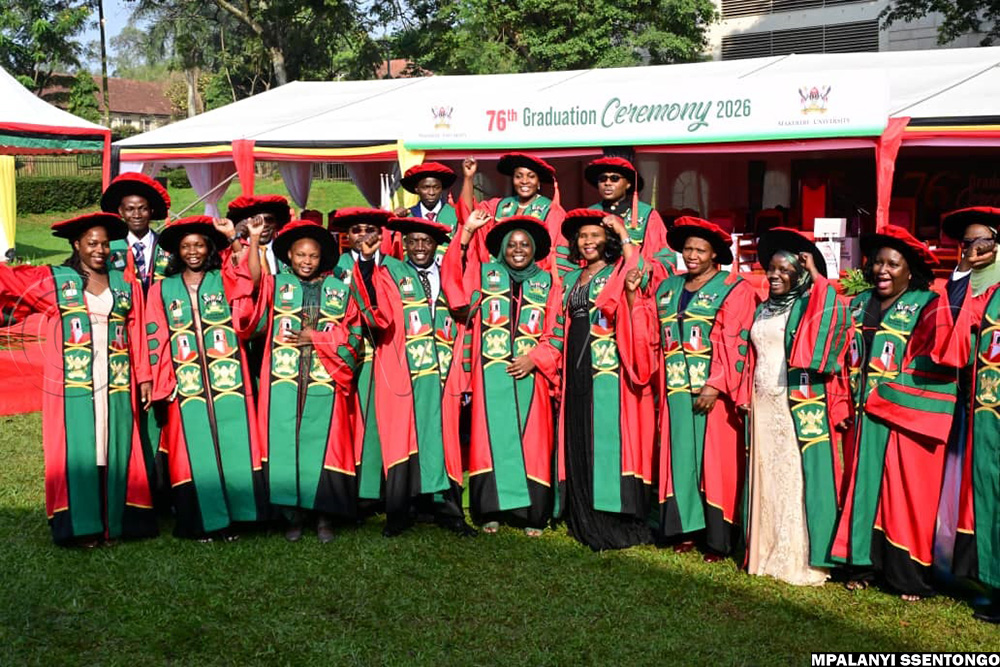
Muinda was among the graduates who were conferred with a Doctor of Philosophy (PhD) on the first day of Makerere University's 76th graduation at its Freedom Square on February 25, 2026.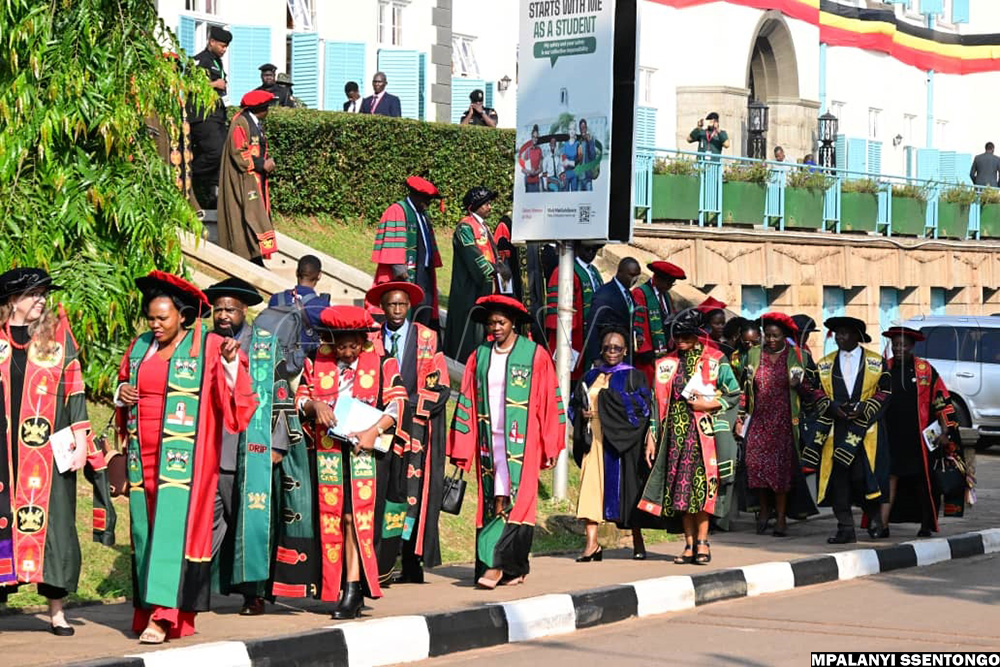
Muinda, whose doctoral research examined why digitalisation projects in Uganda’s technical and vocational education and training (TVET) systems continue to struggle despite TVET’s central role in the country’s transformation journey, sought process quality, accountability and minimising goal conflict in implementing successful information communication technology (ICT) projects.
Muinda said the key contribution of his investigative work is the discovery that process quality is critical for success, shaping how goal conflict and poorly assigned responsibilities influence project outcomes.
He added that his findings further highlight the need for stronger monitoring, clearer alignment of institutional objectives and sustained investment in ICT systems.
“These insights offer direct guidance for policy and practice, providing a pathway for more coherent governance and more effective digitalisation. Therefore, the key challenge this degree is meant to solve is to provide an integrated model for digitalisation in institutions. This model provides clear guidelines, steps, and procedures of what you should do and what you should not do,” Muinda said.
(TVET) Institutions are embracing information and communications technology (ICT) to enhance learning outcomes. The integration of ICT is transforming the way students learn and acquire skills, preparing them for the digital job market.

The Government has prioritised ICT adoption in its TVET institutions, which are among those opting for e-learning platforms, enabling students to access course materials, submit assignments, and interact with instructors online.
The digital skills, in other words, are being incorporated in their curricula, equipping students with skills in areas like computer applications, software development, and digital marketing. Some institutions are now using virtual labs to provide students with hands-on experience in areas like engineering and technology.
Uganda has since earmarked the ICT sector as a critical enabler for Uganda's Vision 2040, which is set to contribute significantly to the country's social and economic growth. The ICT sector has grown at an average rate of 14.8% and accounts for 9% of Uganda's gross domestic product (GDP).
"What this particular investigation found is that above even paying people to do a particular job, the processes implemented should be followed meticulously, with accountability, and correct communication,” he said.
He added, " Because projects have been failing at a rate of 70% in Uganda and internationally, this particular PhD is to help people reduce the amount of failure of very expensive ICT-related projects in TVET and other areas in Uganda".
Online transition and automation
On his part, Andrew Ojulong, the executive chairperson of Consortium of Uganda University Libraries and head Librarian at Lira University and who was conferred with a PhD in Information Science, said most of the universities have adopted the different aspects in terms of online transition and automation, where they have e learning platforms, and they have also developed e-resources.

He was, however, quick to note that despite some of them having the gadgets, they were not able to effectively compete in terms of access, uploads and downloads of the heavy files and also be able to run various sophisticated programmes in software.
His research focused on enhancing access to online content in Ugandan universities, and used Makerere University and Kampala International University (KIU) as the case study. He also examined the roles of the Research and Education Network for Uganda (RENU) and the National Information Technology Authority of Uganda (NITU-U) in aiding adoption and adaptation to technological access to online content.
“They have access to e-resources, and then the different study portals that the students use, which therefore support research innovation and help the students to have a competitive advantage in the global academic fraternity. However, barriers remain in place,” Ojulong said.
Ojulong, therefore, recommended a pioneering framework, which has four model pillars to support the university leaders, stakeholders, and also the academic fraternity and the researchers.
During the graduation, which will conclude on Friday (February 27, 2026), the university will present for conferment of 213 PhD graduates, 2,503 Master's graduates, 6,343 Bachelor's graduates, 206 Postgraduate Diplomas and 30 Diploma recipients, drawn from nine colleges and two schools for conferment.
Research-led university
University vice-chancellor Barnabas Nawangwe, citing the increasing number of PhDs, reiterated that the university was steadily advancing towards attaining its dream of a research-led university through generating knowledge that drives communities, strengthens industries, and advances national transformation.
“I wish to express my sincere appreciation to the Government of Uganda for entrusting Makerere with critical resources to support more than 1,400 high-impact research and innovation projects through the Makerere University Research and Innovations Fund (Mak-RIF). This Fund has empowered our researchers and innovators to deepen the University’s contribution to national development priorities by creating practical and innovative solutions to everyday challenges,” Nawangwe said.
Water and sanitation
Privah Atuhaire got a PhD in Environmental Communication, and her research focuses on behaviour change communication strategies for water and sanitation facilities in the schools of Kanungu and Wakiso districts.

“This study was basically comparing the behaviour change communication strategies in rural and urban settings, of which Kanungu was the rural setting, and Wakiso was basically a peri-urban setting. So, one of the key findings was that schools in the upcountry or the rural setting use a lot of rainwater harvesting compared to Wakiso, or the urban setting, where they use piped water,” Atuhaire said.
She added, “We discovered a lot of gaps in sanitation facilities in a rural setting compared to the settings in urban areas such as Kampala and Wakiso. So, I recommended that the ministries of health, water and environment and the ministry of education should work hand in hand to ensure rural schools can access water and sanitation facilities.”
According to the PhD abstract, Atuhaire pioneered a study of behaviour change communication (BCC) in environmental sciences because of its ability to increase awareness and change behaviour.
The study revealed that, although several BCC strategies and channels are applied to increase the use of water and sanitation facilities, few schools are actually utilising them.
A recent integrated assessment of water, sanitation and solid waste management in schools in Uganda revealed that 65% of schools lack basic hygiene and solid waste management. It added that the lack of proper sanitation and waste management practices poses a direct threat to the health and dignity of learners.
Bee behaviour
Ephrance Eunice Namugenyi, a lecturer at Kyambogo University, who was conferred with a PhD in software engineering, was able to come up with an in-IT innovation dubbed Internet of Things (IoT) platform to aid bee farmers in monitoring the behaviour of bees.
“My research was basically about developing an adaptive network architecture for the transfer of sensor data, specifically for beehive management. IT is a project for the community and basically benefits farmers and people who look after insects. And of course, we have fruit flies as well that are pests and predators. I My research was basically helping the agricultural sector, and I have done a couple of implementations around Makerere University farms so far. There is one in Bugirii and then Moyo district, and we have done a couple of IoT deployments,” Namugenyi said.
She added, “Of course, we first had just prototypes within the lab to make sure that the sensors are working, monitoring the temperature, the humidity, carbon dioxide, and, of course, taking images as well as the sound of the bees, to notice what is happening in the hive at the moment in real time. We hope to expand on the project by encapsulating things like drones to make sure that the process of capturing images for monitoring processes.” The innovation, she said, will help farmers to improve crop production by helping farmers at large in monitoring insects.
Plant breeding
Stella Bigirwa Ayesiga attained her PhD in plant breeding and biotechnology, and her research focused on addressing a fungal disease in maize called fusarium ear rot (FER) to help farmers improve maize productivity.
“Besides lowering yield, the fungus produces fumonisins, toxic compounds that threaten human and animal health. Breeding for resistance is the most effective long-term solution, especially since no FER-resistant varieties are documented in Uganda. This study aimed to identify sources of resistance, determine the type of gene action involved, and identify genomic regions associated with FER resistance,” Bigirwa said.
She said a total of 150 inbred lines were screened across two seasons, and ten consistently showed low disease levels, making them promising resistance sources.
“The 42 hybrids were then evaluated in five environments; additive gene effects were more influential than non-additive, and seven inbreds were identified as strong combiners,” she said.
Dr Samuel Kaheesi Kusiima, the Hoima City Production Officer, attained a PhD in Environment and Natural Resources and in his research determined the nexus of land use, land cover change, the supply of ecosystem services and human wellbeing in Budongo and Bugoma forests in Bunyoro, which are facing a threat of destruction.
“This was inspired by my desire to blend agriculture as well as ecology so that we can promote the new concept of agroecology. Precisely, my study found out that the natural ecosystems, forests, wetlands and grasslands, were declining, while the human-dominated land use, for commercial farming, subsistence farming and building environment were on an upward trend,” Kusiima said.
He, however, expressed concern that the regulating ecosystem services which are critical for ‘our’ well-being, for example, fresh air, good planting seasons, control, and regulation of pestilence diseases, were declining, and this was a threat not just to the environment but to human well-being.
“I have recommended the adoption of agroecology in farmlands, so that we produce food. As we produce material for processing, for industries, let us also be producing the other ecosystem services. Ecosystem services are synonymous with nature's contribution to people. The other thing I have recommended is the adoption of integrated landscape management, because this one looks at livelihoods but also conservation,” Kusiima said.
Harriet Cherotich from Kapuchorwa investigated the vulnerability of communities in post-disaster resettlement and analysed prospective interventions to reduce vulnerability by advancing knowledge on skills development to enhance the livelihoods of resettled communities in Uganda.
“Findings demonstrated that survivors are exposed to physical and socio-economic vulnerabilities, compounded by periodic dry spells and limited livelihood skills, hindering their ability to become resilient and adapt to the new environment,” Cherotich said.
As a coping and secure livelihood strategy, Cherotich said survivors engage in seasonal movements out of the resettlement. To enhance livelihood and ensure resilience of resettled communities, she recommended interventions by government and other stakeholders focused on livelihood diversification through target context-specific training programmes, entrepreneurial support, developing low-cost water systems for domestic /irrigation purposes, and addressing dry spells.