
Govt urged to prioritise quality early childhood education for better outcomes
The findings revealed that the majority of children aged 5-16 assessed in Uganda were able to do basic mathematics and unable to read and comprehend.
(Credit: Joseline Karungi)
___________
Learners are progressing through school without mastering foundational skills like reading, writing, and numeracy, New Vision Online has heard. As a result, the Government is being urged to prioritise quality early childhood education (ECE), stressing its critical role in shaping long-term learning outcomes.
This was revealed on December 12, 2025, as evidence was presented at the Open Data & Evidence in Education Day (ODEED), at which UWEZO shared outputs and insights from its learning assessments and collaborative research initiatives with strategic partners from 2020 to the present.
Data shows that many learners progress through school without mastering reading, writing and numeracy, raising serious questions about the effectiveness of current education policies.
Uwezo Uganda's Judith Nyakaisiki presented comparative data showing that fewer than four in 10 Ugandan children can read with comprehension and perform basic numeracy by age 10, placing Uganda among the lowest-performing countries globally.
Uwezo’s pilot study on writing skills among children aged eight to 12 shows that 57 per cent of learners are unable to write more than single words, while only 17 per cent can write connected text. The assessment pointed to weaknesses in grammar, vocabulary, sentence construction and limited exposure to reading materials, challenges that are closely linked to poor reading skills.
According to UWEZO, the discussion of findings from the 2022 assessment of life skills and values among adolescents shows that the majority of adolescents assessed in Uganda were able to recognise a problem but were unable to identify multiple solutions to solve it. It is a call to support our children in navigating daily problems to enable them to learn and thrive.
UWEZO senior programmes officer Faridah Nassereka presented the state of foundational learning in the global South, 2025 report. The findings revealed that the majority of children aged 5-16 assessed in Uganda were able to do basic mathematics and unable to read and comprehend. The gap in reading and comprehending at all levels is clear. Therefore, strategic interventions are needed to ensure that all children receive quality foundational learning.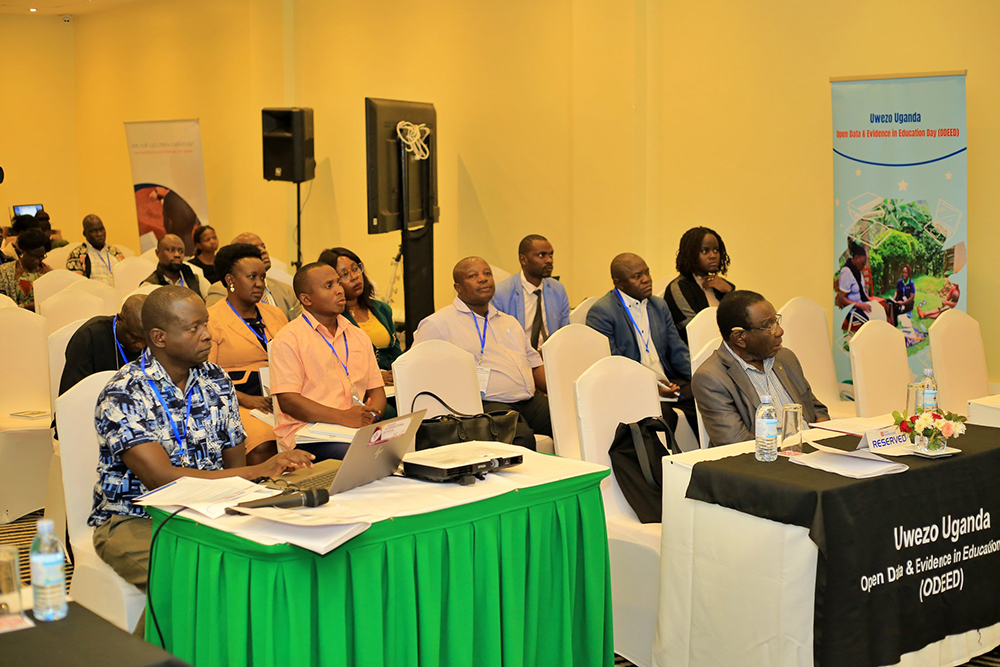
(Credit: Joseline Karungi)
The event at the Hilton Garden Inn in Kampala city attracted over 200 participants, including district education officers (DEOs), district inspectors of schools, and district-level education partners from across the country.
Local leadership is key
Findings from a national learning assessment presented by Joseph Kasasa showed that strong local leadership and parental involvement significantly influence children’s learning outcomes.
According to the assessment, communities where village leaders actively monitor school attendance record higher learner engagement.
Churches and other founding bodies were also found to support vulnerable learners through scholarships and school-based assistance.
Kasasa added that inequalities at the household level, especially children from single-mother-headed families, face greater challenges in sustaining school attendance due to economic pressures.
Education researcher James Urwick warned that Uganda’s ECE sector is under-supported and heavily relies on community initiative rather than government investment.
“Preschools exist because communities share costs, not because of strong state support,” he said, noting major gaps like weak links between preschools and health services and a lack of affordable infrastructure.
Urwick urged the education ministry to develop guidelines enabling communities to use local materials for constructing learning spaces, instead of unaffordable designs.
He also said supporting children with disabilities is complex, stressing the need for skilled teachers and specialised resources.
“No single model works for all learners,” he said, advocating for a mix of inclusive classrooms, special units, and specialised institutions.
Concerns were also raised about neglected learning skills.
On the sidelines, Dr Mary Goretti Nakabugo revealed that writing is rarely assessed despite being essential for communication, livelihoods and citizenship.
She also pondered on her study that over a third of assessed children were unable to write words, while only a small proportion could write full texts by upper primary.
"Ugandans are still grappling to cope up with AI skills, the skill of writing is deteriorating," she said.
The Government is committed
The government has reiterated its commitment to strengthening Uganda’s education system following the release of new data showing serious gaps in children’s foundational learning, particularly in reading and writing.
Addressing the gathering and speaking on behalf of the primary education state minister Joyce Moriku Kaducu, education commissioner Cleophus Mugenyi stressed the need for targeted, evidence-based interventions, particularly in the early grades.
According to Mugenyi, Uganda already has strong policies in place, including the early childhood care framework, Universal Primary Education and the competence-based curriculum, but implementation remains uneven.
Education ministry first policy officer in the department of education policy and research, John Mpande, said there are efforts to bridge gaps between research and policy. He announced the establishment of an education-embedded laboratory to foster partnerships with researchers and institutions, citing completed studies on learner attrition and failure rates.
Mpande also revealed plans for a national evidence symposium in 2026 focused on teacher effectiveness, underscoring the government’s commitment to evidence-driven reforms.
Call for Action
Uwezo Uganda board chairperson Prof. A.J. Lutalo Bosa said improving outcomes requires sustained use of research to inform policy.
Closing the forum, Mugenyi urged collaboration between researchers, policymakers and communities to address the learning crisis.