
How hunger, poverty push eastern Uganda’s children out of school
Dr Irene Munyango, Assistant Commissioner for Adolescent and School Health at the Ministry of Health, stressed that teenage pregnancy has remained a barrier to education for more than two decades.
Amina Naigaga, a primary seven pupil at Kamudooke Primary School in Namutumba district signing a commitment board, committing to stay in school until completion as other participants look on. This was during the Inception Breakfast Meeting for the sixth phase of the I AM GIRL project at Protea Hotel Kampala. (Credit: Lawrence Mulondo)
A baseline survey conducted in 40 schools across Namutumba, Butebo and Butaleja districts has painted a troubling picture of the silent struggles keeping children out of school.
The study found that only 18% of parents in the surveyed areas have committed, in any form, to providing food for their children at school, whether by packing meals, contributing produce, or supporting school-led feeding arrangements.
The survey, carried out in June 2025 by Fields of Life, covered 120 communities surrounding 40 primary and secondary schools.
Its findings reveal a chain reaction of hunger, poverty, teenage pregnancy and systemic gaps that are steadily pushing children, especially girls, out of classrooms.
Peter Elumu, the Monitoring and Evaluation Officer at Fields of Life, said the lack of school feeding is directly affecting retention and frustrating efforts to support teenage mothers back into education.
“You find there are schools without any feeding programme at all, yet food can help a child stay in school and concentrate,” he said. “It is something we want to solve together with everyone.”
Elumu was speaking during the inception breakfast meeting for the sixth phase of the I AM GIRL project held at Protea Hotel Kampala on Thursday. The three-year initiative is being implemented by Fields of Life East Africa in partnership with Hamiza Development Foundation, with support from Irish Aid.
The survey observed a steady dropout pattern as learners progressed through classes. While enrolment in Primary One often runs into the hundreds, the numbers sharply decline by Primary Four, with only a handful reaching Primary Seven.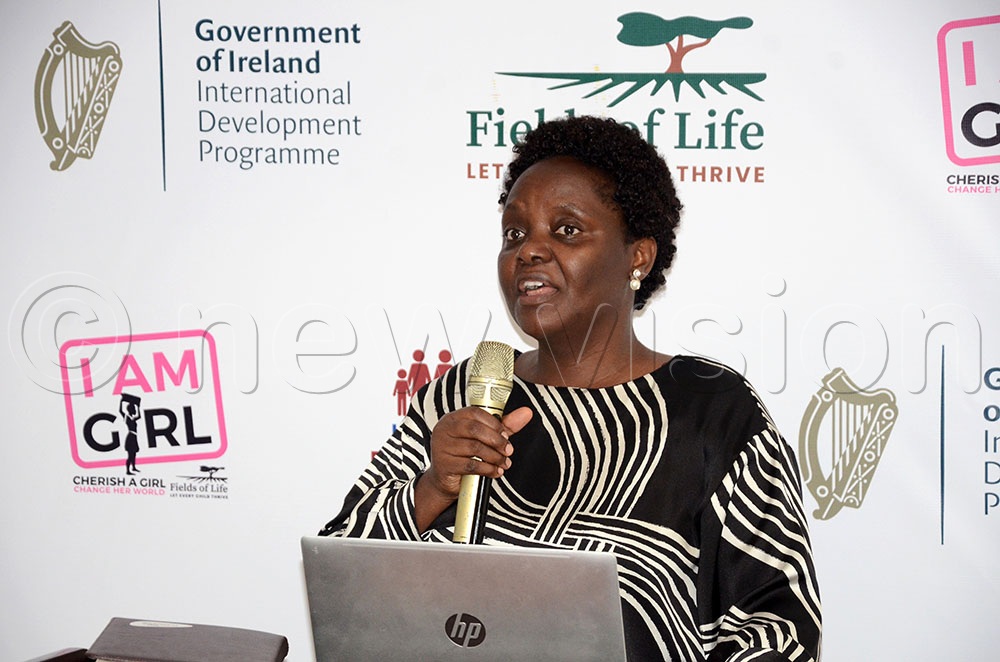
Esther Ssempebwa, the Executive Director Fields of Life East Africa addressing during the Inception Breakfast Meeting for the sixth phase of the I AM GIRL project at Protea Hotel Kampala on Thursday. (Credit: Lawrence Mulondo)
“In schools where enrolment is as high as 2,000 pupils, Primary Seven is always the smallest class,” Elumu explained. “So where do they go? When you ask neighbouring schools whether they transferred, the story is the same.”
Although attendance records show that up to 85% of learners attend at least 80% of designated school days, girls face more interruptions than boys. These disruptions, often linked to domestic responsibilities, menstruation challenges and vulnerability to abuse, affect their regular participation.
“This does not mean girls do not attend school,” Elumu clarified. “But they face more interruptions compared to boys.”
On a slightly positive note, he said that 97% of learners who reach candidate classes complete their level, regardless of their performance division.
However, learners with disabilities remain disproportionately affected. Of those registered in the 40 schools, only 74% managed to complete the level, largely due to accessibility and support challenges.
Documentation of teenage mothers also remains weak. Elumu noted that probation offices lack clear data, making planning difficult. In Butebo district alone, education authorities had a list of 144 teenage mothers in both primary and secondary schools.
Across the 40 surveyed schools, 188 teenage mothers were identified.
Many parents and even some teachers are unclear about re-entry procedures for teenage mothers.
“Parents ask where to begin for their child to return to school,” Elumu said. “The process is not clear, and this needs urgent attention.”
Water, sanitation and hygiene conditions also emerged as major concerns. Handwashing at critical moments remains weak at just 14%. Meanwhile, one latrine serves an average of 122 learners far beyond recommended standards, raising fears about dignity, privacy and safety, especially for adolescent girls.
At Kasiebai Primary School in Butebo district, head teacher Topista Kayendeke described school feeding as a daily struggle shaped by poverty and cultural pressures.
“You find a man with two wives competing in producing children,” she said.
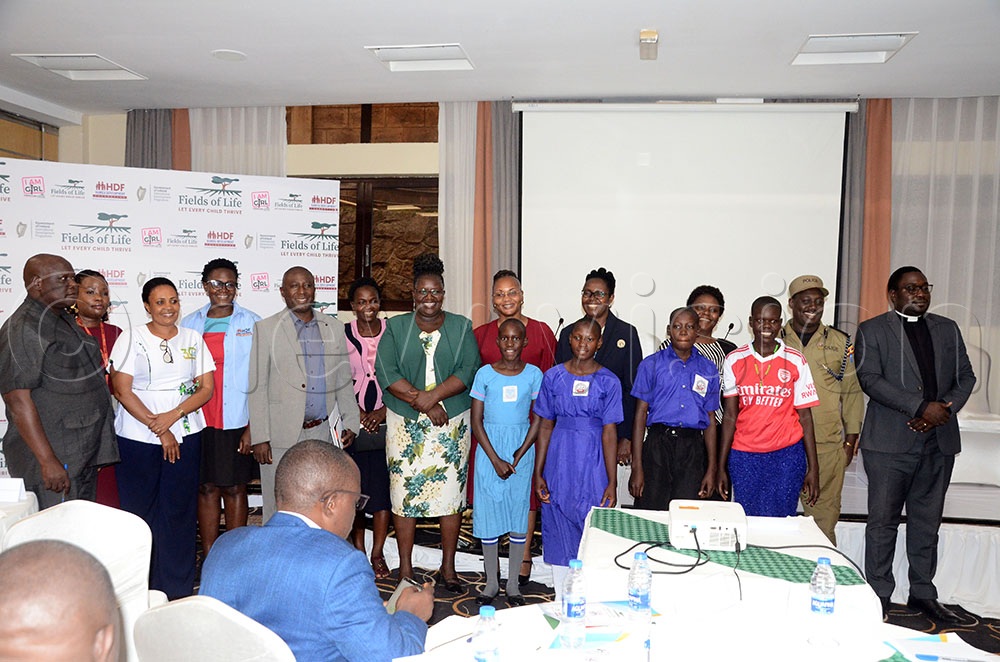
Participants pose for a group picture during the Inception Breakfast Meeting for the sixth phase of the I AM GIRL project at Protea Hotel Kampala on Thursday. (Credit: Lawrence Mulondo)
“Traditionally, people believe that the more children you have, the wealthier you are.”
When schools ask parents to contribute food, many say they simply cannot afford to feed their large families both at home and at school.
Her school’s Parents-Teachers Association resolved that each parent should contribute ten kilograms of maize, five kilograms of beans and sh5,000 to support meal preparation. Yet only about 40% of the 1,427 pupils have met this requirement, leaving the majority studying on empty stomachs.
“Even when we try to prioritise Primary Seven candidates, out of 60 pupils, only about 25 manage to eat,” Kayendeke said, her voice heavy with concern.
Josephine Kaanyi, the Butebo District Education Officer, said parental resistance has undermined performance.
“You cannot expect a child learning on an empty stomach to perform well,” she said.
She noted that the district recorded only 16 first-grade passes in the recent Primary Leaving Examinations, with 500 of the 3,100 registered candidates failing. The dropout rate stands at 35%.
Kaanyi warned that hunger is also exposing learners to danger. Pupils who walk home for lunch are often lured by men into sexual exploitation, leading to rape, teenage pregnancies and eventual dropout.
The I AM GIRL programme, coordinated by Moses Magala of Fields of Life, seeks to tackle these barriers holistically. The sh7b initiative will run from July 2025 to June 2028 in 40 schools, 34 primary and six secondary across Butebo, Butaleja and Namutumba districts, targeting 29,325 adolescents.
The project aims to strengthen education systems, improve retention and re-entry for teenage mothers, enhance water and sanitation facilities, safeguard children against gender-based violence, and economically empower vulnerable households through climate-resilient agriculture.
Esther Ssempebwa, Executive Director of Fields of Life East Africa, said the organisation’s mission is to nurture educated and skilled young people inspired by faith, hope and love to transform their communities.
“We do not believe in handouts,” she said. “We believe in a hand up.”
At the national level, Rosette Nanyanzi from the Ministry of Education noted that guidelines on preventing teenage pregnancy and HIV were first developed in 2015 and revised in 2020 following a spike in cases during COVID-19 school closures.
“Most pregnancies happened when children were at home,” she said. “There is a lot of work to fix families and parenting.”
Dr Irene Munyango, Assistant Commissioner for Adolescent and School Health at the Ministry of Health, stressed that teenage pregnancy has remained a barrier to education for more than two decades.
“We cannot remove these barriers by working in isolation,” she said. “The approach must be multisectoral and reach households.”
Dr Joyce Abaliwano Mulebeke, Gender Minister in Busoga Kingdom, affirmed the kingdom’s commitment to education, noting that the Kyabazinga is pursuing a PhD while the Queen is undertaking a master’s degree.
“This should encourage everyone in Busoga,” she said. “Education is the eye to one’s future.”