
Govt moves to help student innovators turn projects into businesses
The Minister for Science, Technology and Innovation, Eng. Jonard Asiimwe, announced the plan during a visit to the International University of East Africa (IUEA) on August 26, 2026, in Kansanga.
In the photo, Jonard Asiimwe, the Minister for Science, Technology, and Innovation, is inspecting the IUEA Electric Tractor. He is accompanied by Prof. Emeka Akaezuwa, the Vice Chancellor of the International University of East Africa (IUEA), and Mohammed Elshafey, the Estate Manager, who is demonstrating how the electric tractor works. (Photo by Mary Kansiime)
_________________
The government is planning to bring together university student innovators, industry players, manufacturers, financiers and government agencies in a national conference aimed at helping students turn their innovations into commercially viable products.
The Minister for Science, Technology and Innovation, Eng. Jonard Asiimwe, announced the plan during a visit to the International University of East Africa (IUEA) on August 26, 2026, in Kansanga, a suburb of Makindye division, where he toured several innovations developed by the university's students and researchers.
Asiimwe said the government wants to move away from a culture where students and researchers develop prototypes that remain in laboratories without reaching the market.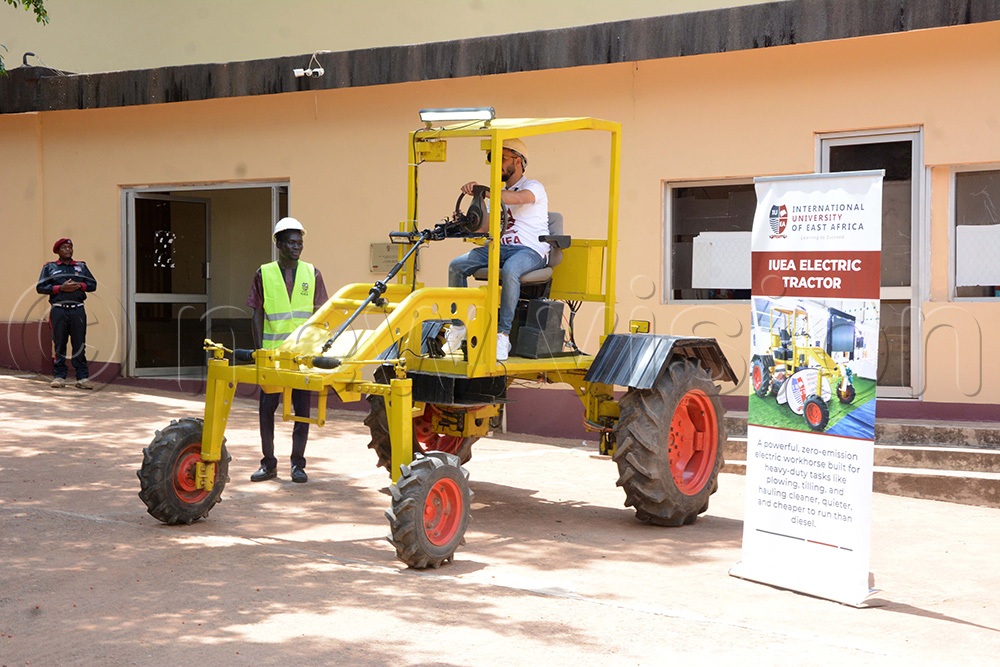
A student testing an electric tractor at the International University of East Africa (IUEA). The tractor is a powerful zero-emission electric workhorse built for heavy-duty tasks. (Photo by Mary Kansiime)
“We want to see our children start making money with their schools. We want to see them rich from their innovations. We want to see the universities having the money,” he said.
He said the planned conference will bring together innovators, government officials, industry players, manufacturers, standards bodies, financiers and potential markets to identify practical ways of commercialising promising technologies.
The minister said the conference will also help the government identify student innovations with potential for wider adoption and investment.
He directed his technical team to audit innovations in universities and identify projects that can be developed into marketable products.
Among the innovations he inspected at IUEA were an electric motorcycle, an electric tractor, farm equipment, a mineral exploration software system and other technology applications targeting agriculture, mining and security.
He said innovators would be required to develop clear roadmaps covering intellectual property, standards and certification, manufacturing, business models, target markets and financing requirements.
The government, he added, would seek to address the specific challenges facing each innovation, including product testing, standards compliance, market access, manufacturing partnerships and financing.
Asiimwe also said the government would support structured pilots involving real users to generate evidence on the safety, reliability, productivity and cost-effectiveness of the innovations.
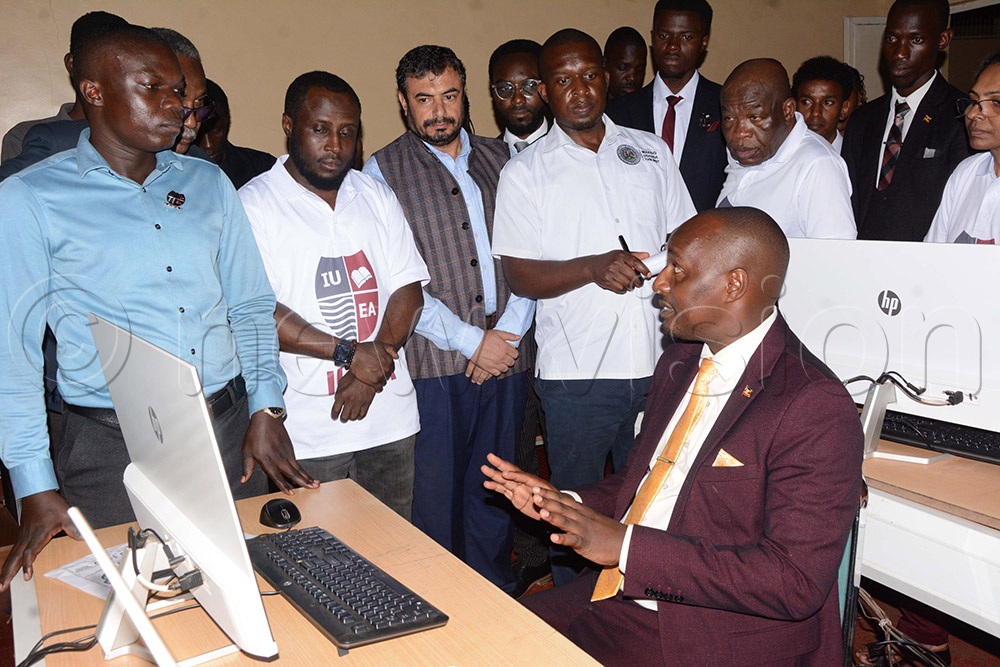
(L-R) Henry Sentalo, Lecturer Petroleum Engineering and Prof. Shema Abdulsalam Dean, Faculty of Engineering, explaining to Jonard Asiimwe, the Minister for Science, Technology and Innovation and Prof. Emeka Akaezuwa Vice Chancellor of International University of East Africa (IUEA)about engineering. (Photo by Mary Kansiime)
He cited the need to test agricultural technologies with farmers, electric motorcycles with boda boda riders, and mining technologies with miners and geologists before they are taken to larger markets.
The minister announced that the government would work with IUEA to organise what he described as a national student innovators conference, with a focus on practical solutions rather than exhibitions.
He said the initiative would particularly target younger students, arguing that universities should prepare learners not only to look for employment after graduation but also to create businesses and jobs from the problems they solve.
The minister's visit also brought attention to IUEA's efforts to fund innovation largely through its own resources.
IUEA Vice-Chancellor Prof. Emeka Akeazuwa said the university had invested billions of shillings in innovation, including electric mobility, smart agriculture, mining technologies and other applications.
“We have the evidence. We have proven it. But now, between where you have produced the prototype and you see it is working and taking it to market, that's the gap,” Akeazuwa said.
He said the university had largely relied on internal funding because support from the government and other external sources had not consistently materialised.
According to Akeazuwa, the university's students have access to laboratories where they can develop and test ideas, but additional investment is required to manufacture products at scale and take them into national and regional markets.
He said government support could help bridge the gap between innovation and commercialisation, creating employment and increasing Uganda's capacity to develop its own technologies.
Akeazuwa said the university deliberately focuses on solving local problems, including drought and food insecurity in Karamoja and challenges in the mining sector, although such projects require significant investment because of the difficult operating environments.
Asiimwe said the government was encouraged by the innovations despite the limited public funding available to the university.
He pledged to work with IUEA and other institutions to ensure promising innovations move from prototypes to products and enterprises.
The minister also said Uganda would explore investment in a factory for manufacturing lithium batteries, which he said would help address shortages affecting electric mobility technologies such as the electric tractor he saw at IUEA.
He urged universities and students to continue developing practical solutions, saying innovation would only achieve its purpose when it reaches users and improves people's lives.
Asiimwe said the planned national conference is expected to provide a platform for identifying promising student innovations and connecting their developers to the technical, financial and industrial support needed to take them to market.