
Campaign to procure 50 computers for vulnerable children launched
Together, the group raised funds to procure 25 computers. On her part, Munywevu tasked the school to use the computers responsibly to benefit the learners and teachers. She also implored Nakyejwe to take the campaign forward and achieve the target of 50 computers.
Shirley Nakyejwe targets 50 computers for vulnerable children. (Credit: Ritah Mukasa)
KAMPALA - Growing up, Shirley Nakyejwe lacked access to a computer neither at home nor at school.
Yet she dreamt of becoming a computer expert. Nakyejwe, a senior IT (Information Technology) specialist at the Ministry of ICT and national guidance, describes her journey to where she is as a treacherous one.
After her O levels, she joined Mbarara University of Science and Technology for a Bachelor of Computer Science, but her first semester was tough. She had never used a computer, yet the course revolved around it.
The excitement of joining university quickly faded, and anxiety took the best of her. While her classmates navigated the computer with ease, Nakyejwe spent the biggest part of the first semester learning basic computer skills. How to start the machine, use a keyboard, hold a mouse and open a file.
In hindsight, however, she developed a conviction to help children learn computer skills early in life.
“I don’t want any child to experience what I went through,” she says.
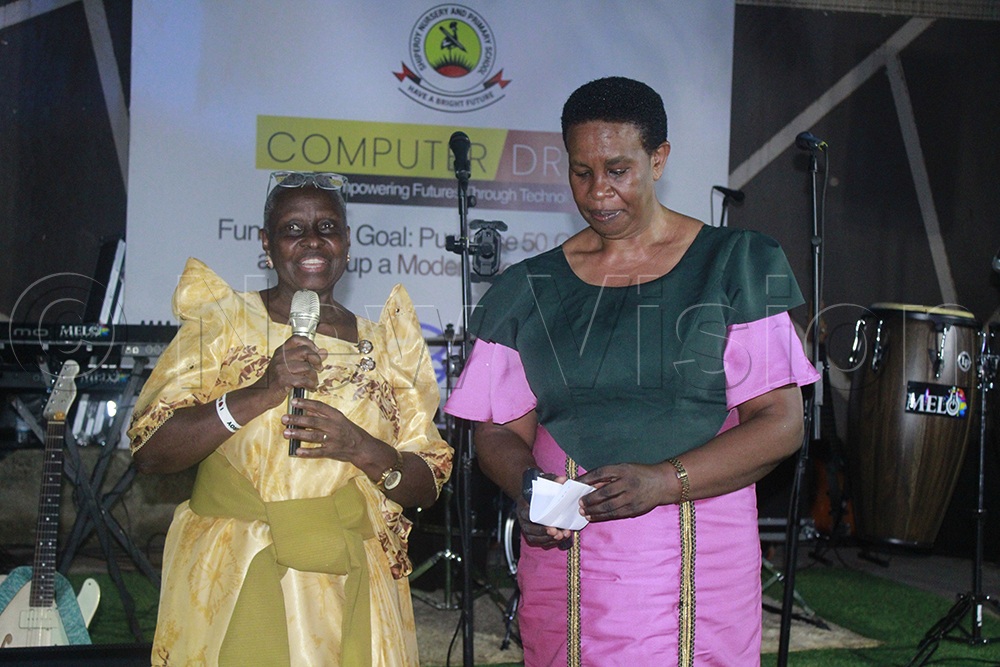
Anne Munywevu (R), who was the chief guest, delivered her speech, besides Mable Kalinzi Ssemuju, who started the school in 1997 to provide affordable education to vulnerable children. (Credit: Ritah Mukasa)
Located in Lusaka, Makindye, a suburb of Kampala, the school was established in 1997 by Mable Kalinzi Ssemujju, a retired teacher with an aim of providing affordable, quality education to the less privileged children.
The event, which happened at Kevina Gardens in Kisaasi, Kampala, was officiated by Anne Munywevu, president of Naomi Ministries, an association of widows in Namirembe Diocese.
Together, the group raised funds to procure 25 computers. On her part, Munywevu tasked the school to use the computers responsibly to benefit the learners and teachers. She also implored Nakyejwe to take the campaign forward and achieve the target of 50 computers.
Meanwhile, across Africa, only about three in every 100 school-going children have access to a computer. And for the vulnerable children, Nakyejwe says: “School is sometimes the only chance.”
She pointed out that digital literacy has quietly become the entry ticket to jobs and other opportunities. Therefore, every child who learns to use a computer is one more Ugandan ready for the digital economy the country is already building.
Beyond that, she says, “We actually intend to buy computers designed and manufactured by Ugandan engineers.”
They are the size of a smartphone. You simply plug each into any monitor and turn it into a full Windows machine.
The computers will also benefit over 50 teachers, and the laboratory will be open to the community during holidays.