
UN unveils 2026–2030 strategy to advance gender, economic, digital inclusion in Uganda
The new UN Women Strategic Note 2026–2030 is informed by lessons learned over the years and responds directly to the realities women and girls continue to face, including poverty, early marriage, limited access to finance, climate shocks and weak protection systems.
Some of the participants in a group photo with UNWomen's Paulina Chiwangu at Four Points By Sheraton on Wednesday (Courtesy Photo)
________________
UN Women has unveiled its 2026–2030 Strategic Note to advance gender equality, women’s economic empowerment and digital inclusion amid persistent violence and inequality affecting women and girls in Uganda.
Launched under the theme “Power, Progress and Partnerships Driving Equality in Uganda,” the strategy seeks to dismantle discriminatory social norms, strengthen governance and justice systems, expand women’s economic opportunities and close the digital gender gap through stronger partnerships with government, the private sector, development partners and civil society.
Speaking during the launch at Four Points by Sheraton Kampala last week, the Deputy Country Representative of UN Women Uganda, Adekemi Ndieli, described the strategic note as a bold but achievable framework designed to address persistent structural barriers facing women and girls across Uganda.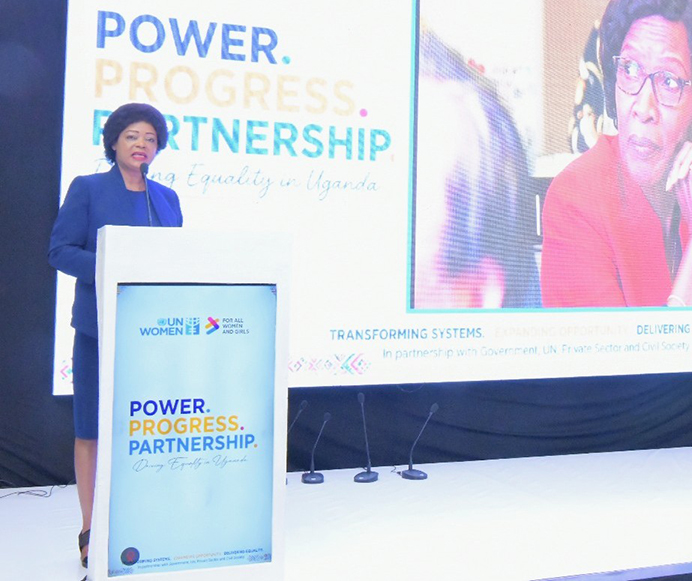
Paulina Chiwangu, the UN Resident Representative, said UNWomen is ensuring every woman & girl thrives, leads, lives free from violence & discrimination.
“This strategic note represents the collective vision of advancing gender equality and empowerment of women in Uganda over the next five years. It is ambitious and doable. I would say it is audacious also, and we depend on all partners for the successful implementation of this very important strategic note,” Ndieli said.
She noted that although Uganda has made visible progress in women’s leadership and participation in public life, deep inequalities continue to affect women socially, economically and politically.
According to Ndieli, Uganda continues to record some of the highest levels of violence against women in the East African region, with two out of every three women expected to experience violence during their lifetime.
“That is a huge challenge and calls for empowerment and protection together. Progress is visible, but not yet equitable, and we each have a role to play in advancing that agenda,” Ndieli said.
She explained that the new UN Women Strategic Note 2026–2030 is informed by lessons learned over the years and responds directly to the realities women and girls continue to face, including poverty, early marriage, limited access to finance, climate shocks and weak protection systems.
Ndieli identified early marriage as one of the major drivers of inequality, warning that it continues to undermine girls’ education, economic independence and long-term well-being.
“When you look at early marriage, it is a key driver of inequality because it limits access to education, economic opportunities and the long-term well-being of women and girls,” she explained.
She also emphasised the importance of strengthening gender data systems to support evidence-based planning and implementation, noting that only about half of gender-related Sustainable Development Goal indicators are currently available.
“UN Women has been working with the wider UN family and UBOS to strengthen gender data systems because evidence generation is critical in advancing gender equality,” Ndieli said.
She noted that Uganda continues to face multiple social and economic pressures, including hosting one of the largest refugee populations in the world, climate-related vulnerabilities and increasing economic challenges affecting women-led households and businesses.
“Uganda continues to host the largest number of refugees in Africa and the third largest in the world. At the same time, we are seeing constrained financial contexts and pushback against gender equality, which reinforces the need for integrated approaches,” she noted.
Ndieli said the strategy is designed around UN Women’s triple mandate of normative support, coordination across the UN system and operational work on the ground to drive long-term systems change.
Central to the strategy is tackling discriminatory social norms, strengthening institutions, and expanding women’s economic opportunities through decent employment, financial inclusion, and private sector partnerships.
She revealed that UN Women has already signed partnerships with Stanbic Bank Uganda and Equity Bank Uganda to improve women’s access to financial services and entrepreneurship opportunities.
Ndieli also highlighted unpaid care work as a major burden limiting women’s participation in economic activities and development opportunities.
Digital inclusion is another major pillar of the new strategy, with UN Women seeking to bridge the gender digital divide through technology, coding, robotics and innovation programmes targeting girls and young women.
“The gender digital inclusion gap is still very wide in this country. UN Women has supported young girls in coding, robotics and app development to help solve community challenges,” Ndieli said.
She emphasised that partnerships will remain at the heart of implementation, bringing together government institutions, development agencies, financial institutions, academia, civil society and the private sector.
“We are trying to work with all critical actors to advance gender equality in Uganda. The emphasis is on how these actors connect, reinforce one another and bring complementary strength across policy and action on the ground,” she noted.
Ndieli further said UN Women will strengthen internal accountability, innovation, and performance systems to ensure effective delivery of the strategy.
“Accountability is key for us at UN Women — accountability to beneficiaries, funders and stakeholders. We want to ensure that every resource contributes to sustainable and transformative change for women and girls,” she said.
The launch also attracted strong backing from government officials, who called for deeper coordination and integrated programming to address the complex challenges facing women and girls across Uganda.
Gov’t calls for integrated effort
Delivering the keynote address, the Deputy Head of Public Service for Coordination and Service Delivery in the Office of the Prime Minister of Uganda, Jane Kyarisima Mwesiga, said gender equality should be treated as a critical pillar of Uganda’s socio-economic transformation agenda.
“Gender equality is not only a social commitment, it is part of Uganda’s strategy for transformation,” Kyarisima said.
She commended UN Women for supporting Uganda’s progress in women’s leadership, access to justice for survivors of gender-based violence, women’s participation in peacebuilding and refugee governance, and gender-responsive planning and budgeting.
“These achievements matter because they show that progress is possible when policy commitment, financing, coordination and community action come together,” she said.
However, Kyarisima warned that despite the progress, many women and girls in rural and vulnerable communities continue to face serious challenges, including forced marriages, teenage pregnancies, and economic exclusion.
She recounted experiences from her recent nationwide visits, where she encountered girls fleeing early marriages and teenage mothers whose education had been disrupted.
“These experiences were deeply sobering. They showed that gender equality is not an abstract policy issue, but a lived struggle shaped by poverty, harmful social norms, weak protection systems, and limited opportunities,” she said.
Kyarisima revealed that health workers in some parts of the country had reported pregnancies among girls as young as 10 years old, underscoring the urgency of stronger interventions.
“We must do much more to break the barriers of patriarchy, protect girls at risk and build communities where women and girls are safe and free to realise their full potential,” she said.
She stressed that challenges such as gender-based violence, climate change, poverty, unpaid care work and exclusion from decision-making directly affect productivity, education outcomes, health, and national resilience.
“These are not isolated social issues. They affect productivity, household income, learning outcomes, health, social cohesion and national resilience,” she added.
Kyarisima also emphasised the need for interventions tailored to local realities, citing experiences in Karamoja and Northern Uganda, where boarding schools were found to be more effective than day schools in protecting girls from early marriages.
“In Karamoja and Northern Uganda, we realised that we need boarding schools because girls were running away from early marriages. We must design interventions that address the real challenges on the ground,” she explained.
She called for stronger collaboration between government institutions, local governments, development partners, civil society organizations and the private sector to ensure programmes are effectively coordinated and targeted.
“We cannot afford fragmented interventions that operate in silos while the realities facing women and girls are deeply interconnected,” Kyarisima said.
She further linked the UN Women Strategic Note to Uganda’s Fourth National Development Plan, describing gender equality as central to achieving human capital development, productive employment, resilient communities and effective governance.
“The UN Women Strategic Note should be understood as a delivery instrument for Uganda’s development priorities,” she noted.
Kyarisima also emphasized the importance of gender data and evidence-based planning, saying accurate data is critical in measuring progress and ensuring accountability.
“Without data, we cannot know who is being reached and who is being left behind. If we do not have data, how do we measure our success?” she asked.
She concluded by calling for stronger investment, coordination, and collective action to ensure that the strategy delivers measurable impact for women and girls across Uganda.
“The outcomes we seek cannot be delivered by one ministry, one agency or one partner. They require government, the United Nations system, development partners, civil society, cultural and religious leaders, the private sector and communities to work together in a coherent manner,” Kyarisima said.
Speaking at the launch, China, through the Chargé d’Affaires Fan Xuecheng, reiterated that China’s zero-tariff treatment for 100% of Ugandan products and training opportunities under China-Uganda cooperation help to create more space for women to access markets, gain skills and pursue better lives.