
BoU rolls out tool to track women's access to finance
The platform is intended to address gaps in sex-disaggregated financial data that have made it difficult for Uganda to establish how effectively financial institutions are serving women entrepreneurs and where additional interventions are needed.
Participating financial institutions receiving certificates. (Photo by Richard Ategeka)
_________________
The Bank of Uganda (BoU) has introduced a public data dashboard to track women's access to financial services, in a move expected to give policymakers and financial institutions a clearer picture of lending patterns, savings and gaps in financing women-owned businesses.
The Women's Financial Inclusion Data Dashboard, unveiled on November 23, 2026, at the WE Finance Code Uganda High-Visibility Signatory Event at Kampala Serena Hotel, provides information on deposits, loans, electronic money and the geographical distribution of financial services accessed by women and men.
The platform is intended to address gaps in sex-disaggregated financial data that have made it difficult for Uganda to establish how effectively financial institutions are serving women entrepreneurs and where additional interventions are needed.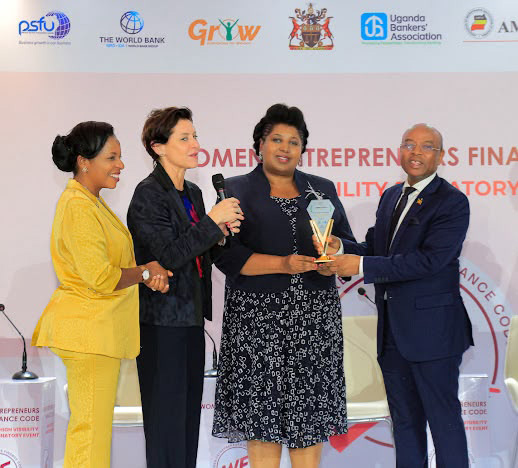
Bank of Uganda Deputy Governor, Prof. Augustus Nuwagaba, receiving an award for his contribution towards women's development. (Photo by Richard Ategeka)
Milly Nalukwago Isingoma, director of statistics at BoU, said the dashboard would help identify where women are accessing financial services, the channels they use and the extent to which they participate in the financial system.
“This dashboard is basically bringing together all the information that will help us as Uganda identify the women in finance,” she explained.
The information is expected to guide financial institutions in identifying underserved markets, developing appropriate products and assessing whether their interventions are improving women's access to financial services.
The event was organised by the Private Sector Foundation Uganda (PSFU) in collaboration with the Bank of Uganda, with support from the Ministry of Gender, Labour and Social Development and development partners, including the World Bank.
New definition to standardise reporting
Alongside the dashboard, Uganda has adopted a standard definition of women-owned enterprises, classifying businesses in which women hold at least 50 per cent of shares as women-owned.
The move is intended to address inconsistencies in how financial institutions and other stakeholders have previously classified women-owned businesses, with some relying on shareholding, management control or female employment levels.
Isingoma said the standard definition would make it easier to establish the number of women-owned enterprises and assess how much financing reaches them.
She said BoU's standard would guide reporting across commercial banks, microfinance institutions, savings and credit cooperatives, fintech companies and other financial service providers.
“Now we would have standard reporting. When you have standard reporting, you're able to see how far you have gone in ensuring that women are part of the financial space,” she explained.
The data is expected to support comparisons between Uganda and other economies while helping policymakers identify areas requiring additional financing interventions.
Meanwhile, PSFU chief executive Stephen Asiimwe said the initiative was gaining traction, with participating financial institutions and other players increasing from approximately 16 when the Code started to about 36 at Monday's event.
He said the growing participation would help expand monitoring of credit facilities extended to women and establish the impact of financing on their businesses.
“It will measure how much, how deep, how wide women are borrowing and the impact is,” he said.
However, he cautioned that the Code should not be mistaken for a direct intervention to reduce borrowing costs or eliminate lending requirements, saying its primary purpose was to measure progress and inform future financing interventions.
Financial institutions under pressure to deliver
The dashboard is being introduced under the broader WE Finance Code, which brings together regulators, government agencies, financial institutions and development partners to improve financing for women-led businesses.
According to the World Bank's country manager for Uganda, Dr Francisca Ayodeji Akala, the initiative's national coalition had grown to approximately 36 participating institutions, comprising 25 financial service providers and 11 ecosystem partners.
She said the growing participation was encouraging but warned that signing commitments would not be enough unless institutions translated them into measurable improvements in women's access to financing.
“The code was never intended to be just a commitment on paper. Its purpose is to change how Uganda's financial system serves women entrepreneurs,” Akala said.
The challenge is not limited to Uganda.
Anna Gincherman, a strategy expert and partner at ConsumerCentriX, cited World Bank data showing that the proportion of small and medium enterprises with functioning credit lines increased from 32 per cent in 2004 to only 36 per cent in 2026.
She said the limited improvement over more than two decades demonstrated the difficulty of expanding financing to businesses, particularly women-owned enterprises that face additional barriers.
“The needle has not really moved for SME overall, and you can't even imagine that it is a much worse situation for women-owned enterprises,” Gincherman said.
She called for the momentum generated by the WE Finance Code to translate into practical changes in how financial institutions serve women entrepreneurs.
Beyond opening bank accounts
The World Bank says the next phase must focus on developing financial products that respond to the different needs of women entrepreneurs rather than concentrating solely on opening accounts.
Akala said women running established businesses, rural women seeking to start enterprises, refugees and women with disabilities require different forms of financial support.
Meanwhile, GROW officials say the expansion of women-focused banking programmes shows that financial institutions are beginning to respond to the demand.
Kasolo said all banks now have programmes targeting women entrepreneurs, compared with some institutions that had none two years ago.
The WE Finance Code's partners are also working on developing financial products that go beyond account opening to provide financing for business growth.
For the Bank of Uganda, the dashboard is expected to provide the evidence needed to guide those interventions.
Its impact, however, will ultimately depend on whether the information collected translates into better-designed financial products, increased lending and improved opportunities for women-owned businesses.