
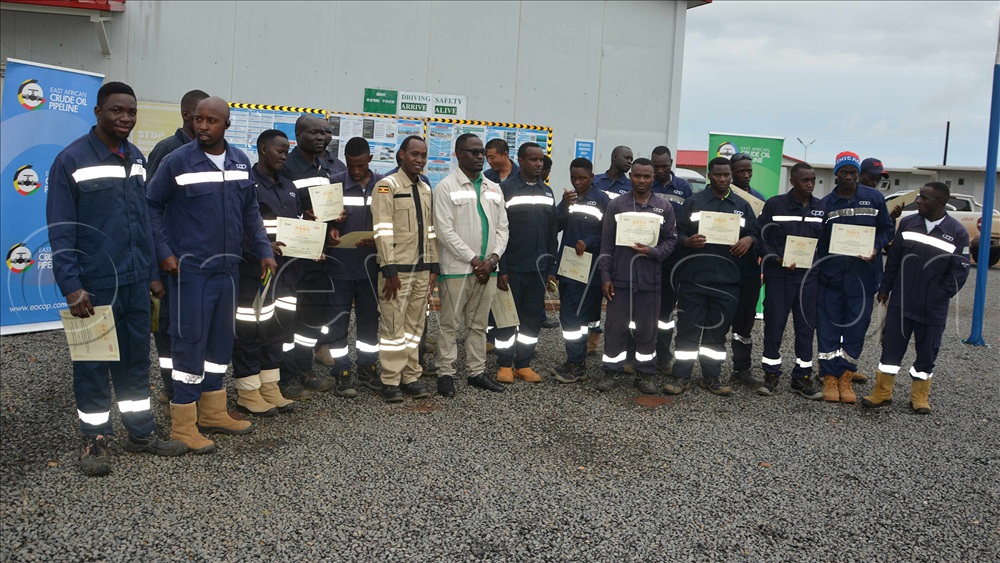
20 Ugandan youth equipped with specialised pipeline welding skills
According to Matia Bagatya, the national content deputy manager at CPP, 22 trainees participated in the training, but only 20 qualified.
Wilberforce Ainebyona, the National Content Officer at PAU, speaking at the passout of the beneficiaries of Automatic pipeline welding training. (Photos by Peter Abaanabasazi)
________________
As Uganda approaches its first oil production in 2026, twenty Ugandan youth have been equipped with specialised, internationally certified oil pipeline welding and technical skills.
The 20 oil pipeline welding experts have been undergoing a three-month training programme implemented under the Ugandan Welders Training Programme 2026, with support from the East African Crude Oil Pipeline (EACOP) in partnership with China Petroleum Pipeline Engineering (CPP), the contractors of EACOP.
According to Matia Bagatya, the national content deputy manager at CPP, 22 trainees participated in the training, but only 20 qualified. He noted that the beneficiaries were equipped with automatic pipeline welding skills.
Automatic pipeline welding uses mechanised, computer-controlled systems, often orbital welding bugs travelling on guide rings, to create consistent, high-quality and fast girth welds for pipelines.
He noted that the beneficiaries were selected from the Petroleum Authority of Uganda (PAU) list of youth who had previously undergone welding and electrical training, among others, from different institutions such as Kigumba Petroleum Institute.
He added that the company would select the best 10 out of the 20 trainees and train them in integrated non-destructive testing, which will equip them with five testing techniques to monitor and test the standards of welded pipelines.
He said the initiative is aimed at building the capacity of Ugandans to carry out critical technical work without relying on expatriates.
Wilberforce Ainebyona, the national content officer at PAU, commended EACOP and CPP for investing in skilling Ugandans, adding that the initiative would help Ugandans participate in the country’s oil and gas sector labour force.
He noted that the initiative supplements PAU’s efforts in promoting the national content policy, which emphasises the importance of building skills to empower local capacity so that Ugandans are able to benefit from the oil and gas sector.
Joshua Dola, the national content officer at EACOP, said the beneficiaries are now competent and able to provide labour during the welding of the pipeline.
He noted that the skills acquired by the beneficiaries are not only relevant to EACOP and the oil and gas sector but can also be transferred to other projects.
Vincent Zhou Zhongu, the CPP national content coordinator, said the training was initiated to equip Ugandans with skills that would enable them to provide labour and services in the oil and gas sector.
He noted that the training is one of the company’s commitments to enhancing national content development through skilling and capacity building for Ugandans.
Rosemary Naija, one of the beneficiaries, expressed excitement about the training, adding that the acquired skills would help her compete for job opportunities in the oil and gas sector.
The beneficiaries were awarded internationally certified certificates at a ceremony held in Butiaba town council, Buliisa district, on May 7, 2026.