
Northern Uganda oil millers seek VAT relief to boost agro-processing
According to the budget proposal, VAT on virgin oil has been increased to 18 percent, while excise duty has risen from sh200 to sh400 per litre of oil.
Allan Ssenyondwa, the Director Policy and Research at UMA and Singh Surjit, the chairperson of NUOMA (C), in a group photo with NUOMA members after the meeting at UMA offices. ( Photos by Joseph Ekol)
________________
The Uganda Manufacturers Association (UMA) and oil millers from northern Uganda have held a crisis meeting to discuss challenges affecting manufacturers in the northern region and financial opportunities to boost the agro-processing industry.
The oil milling companies under the Northern Uganda Oil Millers Association (NUOMA), an umbrella body that brings together oil producers in the region, held a four-hour meeting on May 5, 2026, with UMA to discuss challenges affecting the sector, especially heavy taxation, which they said is curtailing production capacity.
In a meeting chaired by Allan Ssenyondwa, director of policy and research at UMA, the oil producers highlighted that high taxation not only affects productivity but also farmers, who are the key suppliers of raw materials.
Singh Surjit, the chairperson of NUOMA, who led the delegation, said they are reaching over 250,000 farmers in rural areas across the region through the purchase of seeds and by employing more than 700 workers. However, he warned that excessive taxation could force farmers to abandon oilseed farming and shift to maize because its trade is VAT-exempt.
“By importing edible cooking oil, we are promoting farmers from countries where we import the oil. The scenario also heavily impacts our foreign currency,” Singh, who is also the proprietor of Guru Nanak Oil Mills, a manufacturer of shea butter, explained.
He appealed to the government to waive VAT and local excise duty on virgin edible cooking oil manufactured from locally produced oilseeds such as sunflower, soya beans, cottonseed, shea nuts and simsim to encourage farmers to produce more oilseeds.
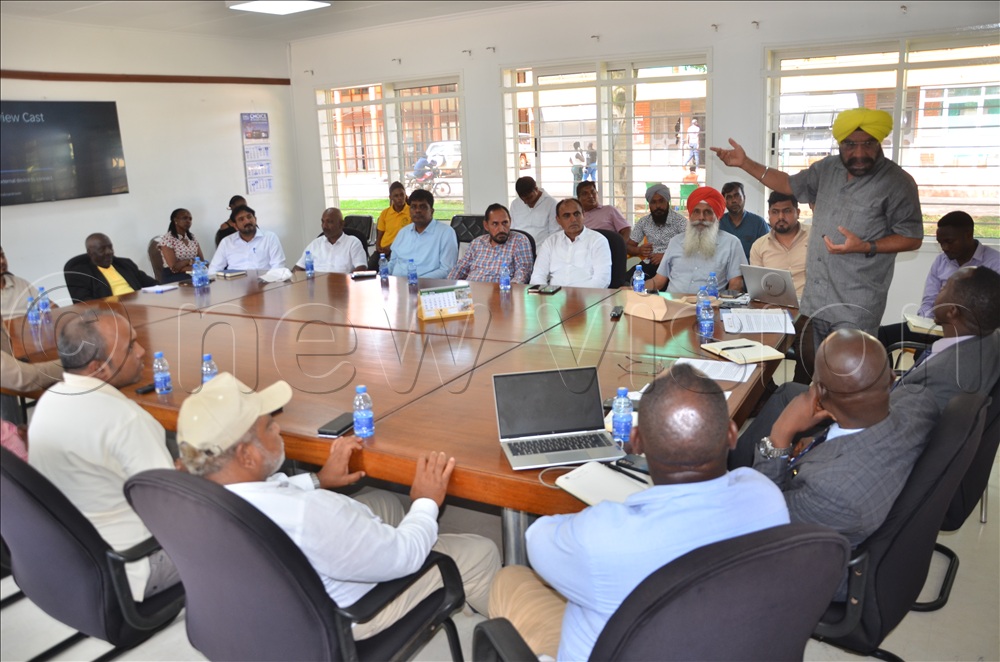
NUOMA members in a meeting with UMA in Kampala on Tuesday
In their proposal, the association further argued that, under the current tax policy in Tanzania, locally produced cooking oil is exempt from VAT, particularly when made from locally sourced oilseeds. They appealed for harmonisation of tax policies within the East African Community to support regional trade.
According to the budget proposal, VAT on virgin oil has been increased to 18 percent, while excise duty has risen from sh200 to sh400 per litre of oil.
Emmanuel Odongo, the operations manager at Jubico Industries, said waiving taxes on locally produced virgin oil would channel more money back into communities while also reducing pressure on foreign exchange.
Ssenyondwa pledged UMA’s commitment to protecting manufacturers against unfavourable trade policies, which he said remains part of its core mandate.
He agreed with NUOMA on the need to work towards harmonising tax policies within East African countries.
However, he said waiving excise duty taxes alone may not necessarily improve production growth and could instead weaken the agro-processing industry. As an alternative, he said UMA would work with NUOMA to develop another proposal to government seeking financial support through the Bank of Uganda to assist manufacturers.
The meeting also recommended that UMA send a research tool containing questionnaires to NUOMA to support a comprehensive analysis aimed at ensuring fair treatment of all grain processors.
According to Ssenyondwa, millers are concentrating heavily on virgin oil production while overlooking opportunities to generate income from animal and poultry feeds.
NUOMA currently has 35 oil mills, with a milling capacity of 35 million kilogrammes of oilseeds annually and an installed capacity of eight million litres of edible cooking oil.
Beyond profit-making, the association is also involved in community social responsibility initiatives, including supporting Lira Babies Home, donating wheelchairs to persons with disabilities, feeding patients at Lira Hospital, an activity it has carried out for more than 10 years, and donating boreholes to improve access to clean water.