
11 SMEs secure sh402m for renewable energy investments
The proposed investments include solar-powered cassava dryers, milling machinery, motor replacements and solar photovoltaic systems.
Senior bankers at Protea Hotel following a three-day training course in renewable energy finance held at Protea Hotel Kampala today. (Thursday, November 26). (Courtesy photo)
________________
Eleven Small and Medium Enterprises (SMEs) have been approved for approximately sh402m in financial support to invest in renewable energy and energy-efficient technologies under a programme aimed at reducing business operating costs and improving productivity.
The investment will be supported through a partial grant financing initiative implemented by the Uganda Institute of Banking and Financial Services (UIBFS) in collaboration with GIZ, Germany's development agency, and the Ministry of Energy and Mineral Development.
Under the arrangement, the grant component will contribute approximately sh206m, representing 51% of the total investment requirement, while banks and Savings and Credit Cooperative Organisations (SACCOs) are expected to provide the remaining sh196m, equivalent to 49%.
The 11 SMEs have been linked to five financial institutions—Pearl Bank, Centenary Bank, KCB Bank, Equity Bank and Moyo District SACCO—to facilitate financing of their proposed renewable energy investments.
The proposed investments include solar-powered cassava dryers, milling machinery, motor replacements and solar photovoltaic systems.
The technologies are expected to help businesses reduce energy expenditure, improve production efficiency and strengthen their competitiveness.
The initiative is part of the
Promotion of Renewable Energy and Energy Efficiency Programme (PREEEP), a Partial Grant Financing Initiative whose pilot phase targets at least 30 SMEs facing high upfront costs of adopting clean energy technologies and difficulties accessing affordable financing.
Since its launch in Gulu in March 2026, three rounds of field verification have been conducted across West Nile, Acholi, Lango and Soroti.
The verification exercise involved physical inspection of business premises, review of financial records, equipment assessment, and verification of supplier prices to establish the investment requirements of participating enterprises.
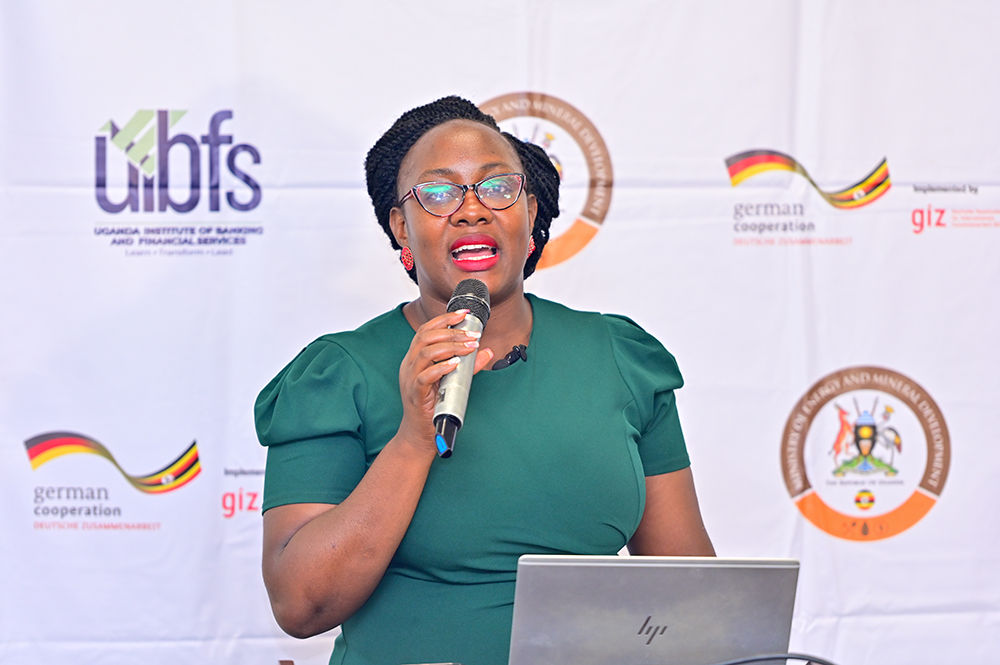
Speaking at the conclusion of a three-day specialised training for Heads of Compliance, Risk and Credit from financial institutions in Kampala on November 26 at Protea Hotel Kampala, the UIBFS Director for Business Development, Marketing and Membership, Christine Birungi, challenged participating banks to translate the knowledge acquired into actual financing decisions.
She said the grant had addressed part of the financing gap, but noted that the success of the proposed investments depended on financial institutions' ability to undertake sound credit appraisals, assess risks and make timely financing decisions.
"The grant has addressed part of the financing gap, but the success of these investments now depends on sound credit appraisal, appropriate risk assessment and timely financing decisions. We encourage financial institutions to develop the capacity and confidence to finance these opportunities," Birungi said.
The training was organised by UIBFS in partnership with GIZ PREEEP, acting on behalf of the German Government, and the Ministry of Energy and Mineral Development.
It sought to equip senior banking professionals with the knowledge and skills to assess renewable energy and energy efficiency projects, manage associated risks and structure appropriate financing solutions.
Birungi said financial institutions had a critical role to play in mobilising resources to support Uganda's transition to cleaner energy.
Birungi said the programme targeted Heads of Compliance, Risk and Credit because of their influence on institutional policies, risk appetite, credit appraisal and financing decisions.
GIZ Uganda Project Lead Lisa Eva Lotta Maria Hofheinz said strengthening Uganda-Germany cooperation in energy, private-sector development and access to finance was important in accelerating the development of sustainable energy solutions.
She emphasised the need to extend financing opportunities to businesses, particularly micro, small and medium enterprises in Northern Uganda and the West Nile region, where access to finance remains critical to economic development.
UIBFS chief executive officer Goretti Masadde urged financial institutions to use their relationships with clients to promote renewable energy and energy-efficient solutions.
She said such investments could lower business costs, improve productivity and create lasting economic and environmental value.
The partnership is also working on ensuring that renewable energy and energy efficiency financing courses are integrated into UIBFS's permanent training portfolio through the Skills and Market Development component of PREEEP.
This is intended to ensure that the knowledge and skills acquired remain accessible to professionals in Uganda's financial services industry.
Participants were encouraged to apply the training in assessing renewable energy proposals, reviewing institutional credit, risk and compliance frameworks, strengthening staff capacity and developing financial products suited to businesses and households investing in clean energy.
The second cohort of the capacity-building programme, which is targeting banking officers and operational representatives from financial institutions, is scheduled to take place from November 30 to December 2, 2026.
The initiative is expected to strengthen the financial sector's capacity to mobilise domestic capital for renewable energy and energy efficiency investments, as well as support Uganda's transition towards a cleaner and more energy-efficient economy.