
A peek into Uganda’s doctoral education
Doctoral research output remains wanting despite its role in driving innovation and evidence-based policy, writes Dr Clare Kaijabwango Muhumuza
Dr Clare Kaijabwango Muhumuza, PhD. (Courtesy)
__________
OPINION
By Dr Clare Kaijabwango Muhumuza, PhD
The majority of the richest countries in the world developed on account of the Knowledge Economy, where knowledge, information, and intellectual capital are the main drivers of growth, productivity, and innovation – rather than physical labour and raw materials.
Uganda’s capacity to transition into a knowledge-based economy and meet its high-level development aspirations – UN Sustainable Development Goals 2030, African Union Vision 2063, East African Community Vision 2050, Uganda Vision 2040, and the National Development Plan IV – is constrained by factors in its doctoral research ecosystem: the low output of PhD graduates/research outputs and low investment in R and D.
Research is not articulated as an independent goal in the high-level aspirations because it is an omnipresent driver integrated into the aspiration. SDG – Goal 9 encourages innovation and, substantially, increasing the number of research and development workers per 1 million people, and public and private research and development spending.
Goals 2, 3, 7, and 13 all call for investment in research to boost technology advancement and production. The Africa Agenda 2063 calls for investment in Research and Development and sets a target of a 1.0% of Gross Domestic Expenditure on R&D by each country by 2023. Research & Development and Science, Technology & Innovation are the enablers for the achievement of the EAC Vision 2050.
To satisfy the National Council for Higher Education (NCHE) recommended PhD/staff-to-student ratio of 1:15 (based on 2011-2020 student enrollment in 10 public universities ~1,903), Uganda requires a minimum of 18,700 PhD holders.
Projections estimate a staggering deficit of over 11,250 PhDs, and to bridge this gap, national institutions must graduate at least 1,000 PhDs annually. By June 2025, the entire country was producing only 200 PhD graduates annually.
The realities associated with these numbers are related to candidature and institutional issues. 15% of doctoral candidates complete their studies within five years, while 49% experience extended candidatures and 36% withdraw entirely.
Some key structural traits of Uganda's research environment: University Concentration: Most of Uganda's research output happens at universities, differing from high-income economies where research is typically driven by business and private industry. Government Support: Uganda’s 0.4% of GDP in 2025 compares poorly with the Sub-Saharan average of 1.1%. Workforce Deficits: Uganda has a low number of researchers relative to its population: ~29.8 researchers per million inhabitants, significantly trailing the broader African regional average.
Peeling back the layers off these numbers
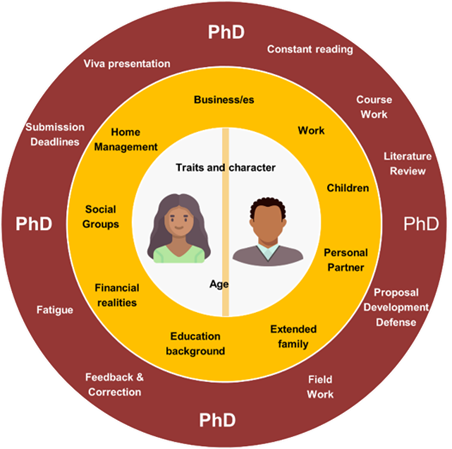
Take a moment to imagine the realities that come with these age groups. They are real. Doctoral study is therefore seldom a full-time, insulated academic engagement but a complex mosaic of demanding, competing, interrelated and highly pressurised realities. At any one point, each researcher is managing the pressures from their unique realities.
Unfortunately, our traditional doctoral education ecosystem lends little or no consideration to these non-academic veracities that determine candidate momentum. All this happens within challenging institutional systems and limited investment in Research and Development- issues that require separate papers to properly navigate.
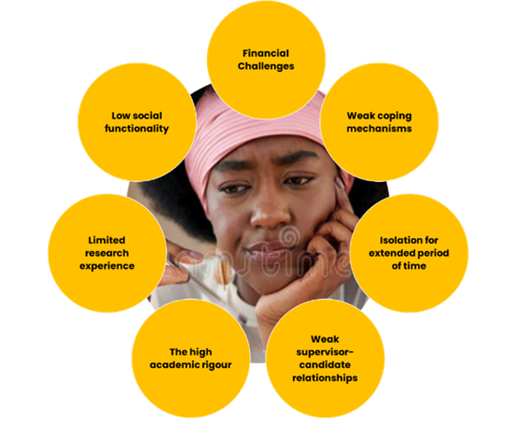
When institutions and researchers fail to acknowledge, plan for and support the non-academic veracities, candidates enter the Doctoral Incompletion Trap. Unanticipated family pressures, delayed feedback cycles, and financial strain etc interrupt research workflows.
As time slips, candidates lose academic momentum, face mounting fees, and experience rising psychological distress. The resulting inertia converts high-potential scholars into prolonged or non-completing candidatures.
This analysis speaks to the nature of the interventions required to create long-term improvement in PhD production, particularly at the researcher level. The need for intentional academic and non-academic support to researchers is inevitable and urgent, thus requiring Universities to be receptive to transformative ways to doctoral education.
The author, Dr Clare Kaijabwango Muhumuza, PhD is the CEO and Founder, Mirika Foundation. Email: clare.mirika@mirikafoundation.org