
Youth develop manifesto to promote climate governance
Wamani said that particularly within Sub-Saharan Africa, climate variability has exposed profound structural deficiencies in governance systems, environmental policy implementation, fiscal prioritisation, and institutional accountability mechanisms.
Elma Kapel Challa, youth member of parliament for Northern Uganda addressing participants as youth look on during the validation and dissemination meeting of international youth manifesto at Forest Cottages Naguru on May 28, 2026. (Credit: Juliet Kasirye)
KAMPALA - To ensure youth participation in climate decision-making internationally, a total of 450 youth from Uganda, Kenya, Tanzania, Austria and Italy have developed a manifesto that will work as an advocacy document for youth engagement with policymakers and duty bearers.
The manifesto is designed to promote climate justice, gender equality, and meaningful youth engagement in decision‑making processes at both local and transnational levels.
It was supported by the European Union, Environmental Alert, in partnership with WeWorld through the Our World Our Planet project.
According to Environmental Alert, the manifesto recognises that today’s global challenges, particularly the climate crisis, are deeply interconnected with social inequalities, gendered power relations, and unequal access to decision‑making spaces.
Junior Wamani, a youth activist, said the current climate crisis is no longer merely an ecological disturbance; it has evolved into a multidimensional systemic risk capable of destabilising economic productivity, weakening institutional legitimacy, accelerating social inequality, and undermining long-term developmental resilience.
Wamani said that particularly within Sub-Saharan Africa, climate variability has exposed profound structural deficiencies in governance systems, environmental policy implementation, fiscal prioritisation, and institutional accountability mechanisms.
“The increasing frequency of floods, prolonged droughts, biodiversity depletion, wetland encroachment, deforestation, energy insecurity, and ecosystem collapse reflect not simply environmental degradation, but a broader crisis of environmental and natural resources governance failure, ecological mismanagement, and unsustainable development trajectories.
“Uganda’s economy remains structurally dependent on climate-sensitive sectors, including rain-fed agriculture, forestry, fisheries, hydrological systems, and biomass energy, yet environmental governance financing, adaptive infrastructure investment, and climate-responsive institutional reforms remain critically inadequate relative to escalating ecological vulnerabilities.”
Wamani made the remarks during the validation and dissemination meeting of the international youth manifesto organized by Environmental Alert at Forest Cottages Naguru in Kampala on Thursday (May 28).
This initiative is designed to strengthen intercultural dialogue between the Global North and the Global South.
According to the youth, the manifesto creates a formalised policy platform through which youth priorities, ecological concerns, and climate justice demands can be systematically integrated into national planning frameworks.
This manifesto also strengthens accountability and policy responsiveness by establishing measurable governance obligations for state institutions, development actors, and private sector stakeholders regarding youth inclusion within climate adaptation, mitigation, and environmental governance systems.
Wamani said the manifesto offers a pathway toward democratising environmental governance, strengthening institutional accountability, and advancing ecologically sustainable economic transitions capable of safeguarding both present and future generations.
“If youth remain excluded from environmental governance today, future generations will inherit not only degraded ecosystems, but weakened institutions, intensified inequalities, and irreversible socio-ecological instability.
“However, if we institutionalise inclusive governance, evidence-based policymaking, ecological accountability, and intergenerational justice, then climate governance can become a catalyst for sustainable transformation rather than a narrative of collective failure," he said.
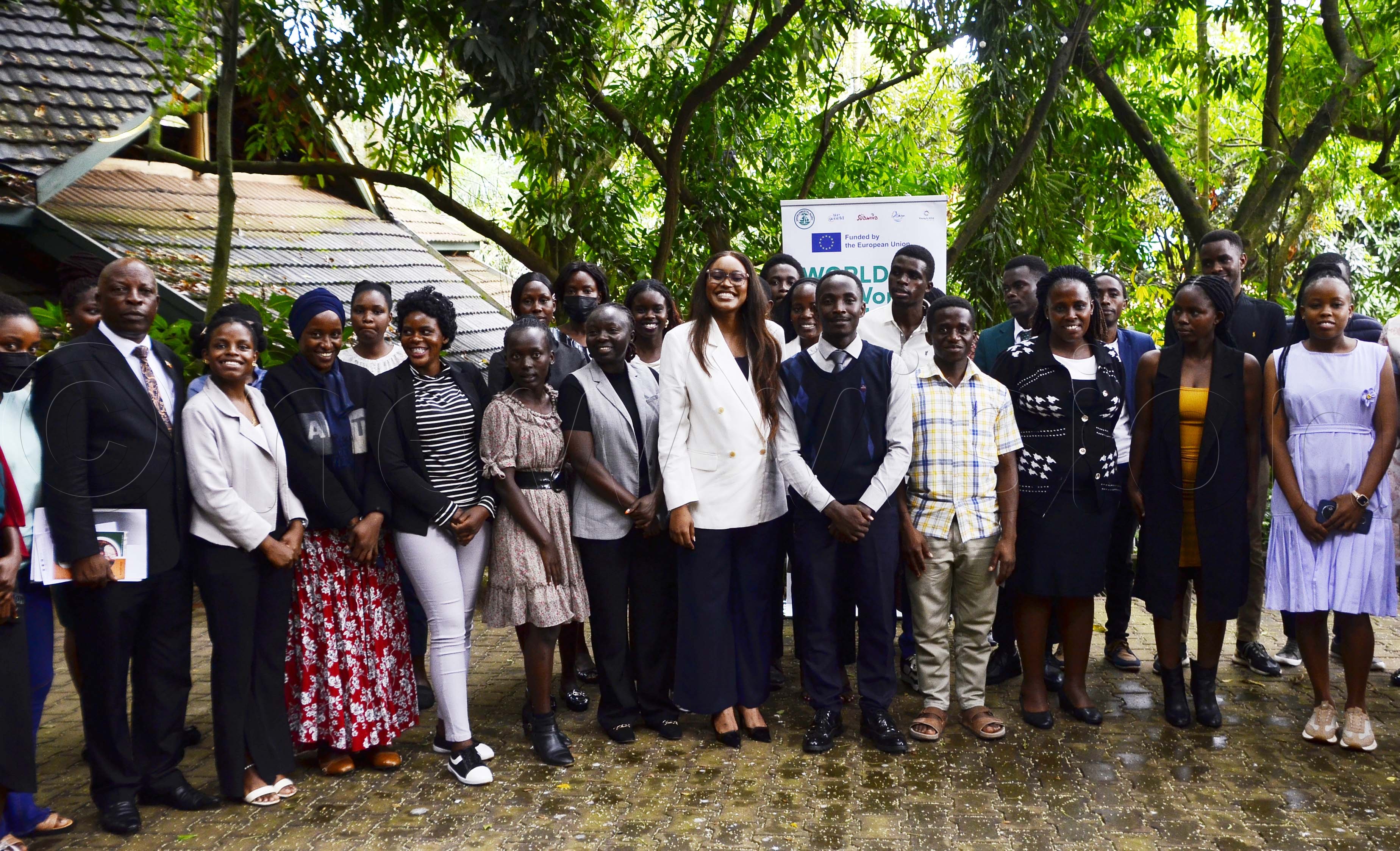
Sam Byibesho, Kisoro Municipality MP, Elma Kapel Challa, Northern Uganda youth MP poses for a photo with some of the youth during the validation and dissemination meeting of international youth manifesto at Forest Cottages Naguru on 28th May 2026. (Credit: Juliet Kasirye)
Gender equity
According to Racheal Letaru, a conservation biology student at Makerere University, across Kenya, Uganda and Tanzania, climate-related crises continue to disrupt girl’s education, increase unpaid care burdens, intensify gender-based violence and expose many to displacement, early marriage and long-term economic insecurity.
Despite women’s central role in community adaptation, food systems, and environmental stewardship, Letaru said they remain underrepresented in political leadership, climate governance, and technical decision-making spaces.
“We want establishment of gender transformative vocational training programmes that equip young women with technical skills for emerging climate sectors, supported by public-private partnerships and international climate finance."
Letaru added: “We also call for fair labour conditions, pay equity and care work recognition by enforcing equal pay legislation and eliminating gender pay gaps through binding transparency requirements, pay audits and sanctions for noncompliance.”
The executive director of Environmental Alert, Jacinta Nekesa, said the programme focuses on encouraging intercultural dialogue with developing countries and increasing tolerance through online people-to-people interactions, using digital and youth-friendly technologies.
“It involves active youth participation in advocating for more effective and coherent climate change solutions at the national, EU and international levels through intercultural dialogue and participation processes that consider gender perspectives," she said.
But before the manifesto is presented to policymakers, she urged youth in Uganda to contextualise it and see whether it speaks to the issues of climate change that concern the youth.
Regarding issues concerning the youth, especially unemployment, the Youth Member of Parliament for Northern Uganda, Elma Kapel Challa, told youth that they will be handling the university fund. The fund will support people who graduated from school and have stayed at home up to three years.
“You will receive this money to help you start up something," she said.
"The challenge we have money can be allocated to Kotido, but it ends up with someone from Jinja. As members of parliament, we shall ensure that the money reaches the rightful people in the district."