
Uncertainty as Bushenyi tea factory faces shutdown over biting sh25b debt
Shareholders and tea farmers report that the factory is grappling with leadership wrangles, financial mismanagement and unpaid suppliers, issues that have crippled operations and left farmers unpaid for months.
Workers at Igara Tea factory in Kyamuhunga, Bushenyi district carrying ready tea for processing. (Credit: Bruno Mugizi)
BUSHENYI - Thousands of tea farmers in greater Bushenyi are facing uncertainty as swirling reports indicate that the Igara Growers Tea Factory is struggling to remain operational under a debt burden estimated at over shillings 25 billion.
The debt is raising fears of an imminent shutdown
Located in Kyamuhunga town council in Bushenyi district, Igara is one of Uganda’s largest farmer-owned tea processing plants, supporting thousands of smallholder farmers across the districts of Bushenyi, Buhweju, Sheema, Mitooma, and Rubirizi.
The crisis was highlighted during a stakeholders’ meeting held at the factory premises in Butare, Kyamuhunga town council.
Shareholders and tea farmers report that the factory is grappling with leadership wrangles, financial mismanagement and unpaid suppliers, issues that have crippled operations and left farmers unpaid for months.
Stakeholders are now calling for urgent government intervention to save the struggling institution.
Leadership crisis
The factory’s troubles have been partly attributed to a leadership dispute that has left the company without what farmers describe as legitimate governance. Samuel Muhereza is the outgoing board chairperson, while Willis Bashasha was elected board chairperson in November 2025.
Bangumya Francis, a tea farmer and shareholder, said the current board of directors has remained in office despite its term expiring in August last year.
Farmers attempted to elect new leaders to address long-standing management problems, but the transition was halted by a court injunction obtained by a dissatisfied party.
“The factory currently has no legitimate leadership. The management is still in office illegally, and there is no accountability for the money coming in,” Bangumya said.
He warned that unless the leadership stalemate is resolved quickly, the factory could grind to a halt.
However, board chairperson Samuel Muhereza urged members to facilitate a smooth handover to the elected board. He said the delay was caused by the court case filed by some members.
“It is you, the members, who prolonged the process. My term expired last August, and I would not be here if the matter had not gone to court. We were supposed to hand over in November, but the court case delayed the process,” Muhereza said.
Mounting debts
The factory’s financial health has deteriorated rapidly, with liabilities now estimated at over shillings 25 billion. Among the debts is six billion owed to dfcu Bank, which recently attempted to seize the factory over unpaid loans.
“We begged the bank not to close us and agreed to pay Shs6 million per month, but that amount is insignificant compared to what we owe,” Bangumya said.
Workers and suppliers unpaid
The financial strain has spread across the supply chain. Workers have gone four months without salaries, firewood suppliers are owed eight months of arrears, and transporters who deliver green leaf have gone nine months unpaid.
Medical bills have also piled up, with Comboni Hospital demanding about Shs25 million for treatment provided to staff.
Julius Mutahunga, another shareholder, warned that the factory’s physical infrastructure is deteriorating. “Some of the machines are now being held together with ropes. At any time the factory may stop operating,” he said.
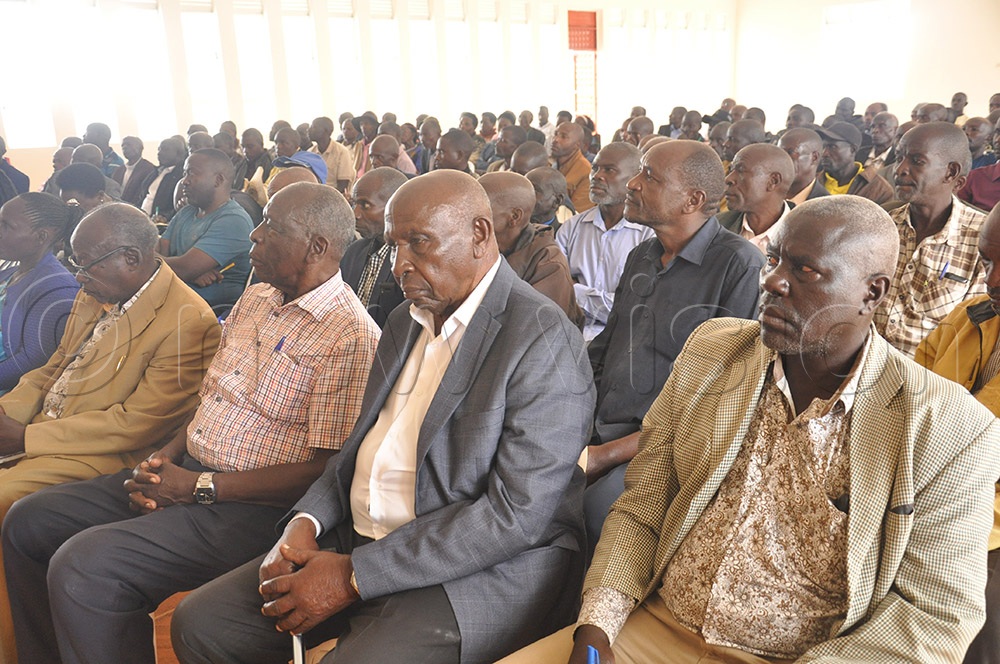
Tea farmers together with shareholders in Igara tea factory during a stakeholders meeting. (Credit: Bruno Mugizi)
Farmers losing trust
Willis Bashasha, the director of the Manifesto Implementation Unit in the Office of the President and interim board chairperson, said relations between farmers and factory management have deteriorated sharply.
Management recently encouraged farmers to increase their green leaf deliveries, claiming low volumes were affecting operations. Farmers responded, but many say they were never paid for their tea.
“These farmers have families to support and school fees to pay. When they supply tea and are not paid, it creates deep mistrust,” Bashasha said.
He blamed the crisis on leadership that has lost focus on the factory’s strategic direction.
Tea prices and quality
The Igara crisis comes amid broader challenges in Uganda’s tea sector, including fluctuating global prices and declining leaf quality.
Apollo Buzaare Turyamusiima, chairperson of the Uganda Tea Outgrowers Association, said the quality of green leaf significantly affects prices at the Mombasa Tea Auction, the region’s main market.
He noted that proper harvesting could earn farmers about Shs500 per kilogram, but poor practices often lower this.
“We lack strict regulations. Farmers harvest whatever they want, and factories accept it. Yet quality determines the price on the international market,” Buzaare said.
He urged the ministries of agriculture and trade to introduce national standards for green leaf harvesting.
Buzaare also revealed that the factory has not held an Annual General Meeting (AGM) since the COVID-19 pandemic, limiting oversight and allowing debts to accumulate.
Transporters have suspended services over unpaid bills, leaving the factory with about 20,000kg of tea that cannot be moved for sale.
“The vehicles that transport tea went on strike. Without transporting the tea, the factory cannot generate money to pay farmers,” he said.
Farmers pushed to the edge
Many farmers face severe financial stress due to delayed payments. Polly Natumanya, a tea farmer from Kigoma Cell, has not received payment for nine months.
“I am demanding Shs3 million from tea supplied in 2023 and another Shs800,000 from this year, but I have not received anything,” she said, adding that banks are demanding loan repayments, forcing her to consider selling land.
While other factories pay about Shs380 per kilogram of green leaf, Igara remains at around Shs330, widening farmers’ losses.
Farmers Abandoning Tea.
The crisis has pushed some farmers to uproot tea plantations and switch to coffee, which offers more reliable returns.
Elizabeth Ainembabazi, a farmer attached to the factory’s Buhweju branch, said many families are struggling to survive.
“Our children are at home because we cannot pay school fees. Some farmers have even been arrested over loans taken to grow tea,” she said, calling on the government to restructure the factory’s leadership.
Factory meant to empower farmers
Former minister Prof. Tarsis Kabwegyere said Igara was established to help smallholder farmers participate in the money economy.
“This factory belongs to the peasants who grow tea. It was created to ensure small farmers benefit from commercial agriculture,” he said, warning that its collapse would deal a severe blow to rural livelihoods in the Greater Bushenyi sub-region.
Call for intervention
Farmers have urged the government to act swiftly to stabilise Igara Tea Factory, warning that thousands of households risk losing their livelihoods.
Reverend Canon Geoffrey Kobwemi, a tea farmer, said farmers are preparing to petition government institutions for intervention.
“The factory is our main source of income. When it struggles, so do our families. If government steps in, it must be transparent and accountable to avoid fueling corruption,” he said, warning that without urgent action, the collapse could devastate tea-growing communities across Greater Bushenyi.