
Involve beneficiaries when discussing agrifinancing—experts
The FINAS Summit, which brought together policymakers, investors, development partners, researchers and private sector leaders from across Africa, discussed strategies to mobilise adequate, affordable and long-term financing to transform African agriculture into a competitive, resilient and inclusive economic sector.
Participants pose for a group photo during the FINAS Summit. (Credit: Prossy Nandudu)
_______________
Financial experts have appealed to the donor community to consider the beneficiaries of their loan products when designing them. This will lead to targeted financing that will help promote sustainable agri-food financing.
The call was made by Humphrey Mutaasa, the chief technical advisor at The Grain Council of Uganda (TGCU), during a panel discussion at the third Financing Agri-Food Systems Sustainably (FINAS) Summit at the Kenyatta International Conference Centre in Nairobi between June 30 and July 2, 2026.
“In detailing the demand side of access to agrifinancing, I am encouraging the financiers not only to know us but to understand us and involve us when designing financial products,” Mutaasa said.
The FINAS Summit, which brought together policymakers, investors, development partners, researchers and private sector leaders from across Africa, discussed strategies to mobilise adequate, affordable and long-term financing to transform African agriculture into a competitive, resilient and inclusive economic sector.
During the summit themed: Towards Sustainable Financial Architecture for Africa's Food Systems, speakers advised beneficiary countries of donor aid to focus on creating enabling policies, reducing investment risks and strengthening governance frameworks that encourage long-term private capital into agriculture.
To lead by example on how resources for agriculture financing are being mobilised by individual countries, Kenya launched a Ksh1.081 trillion (approximately sh30 trillion) National Agri-food Systems Investment Plan (NASIP).
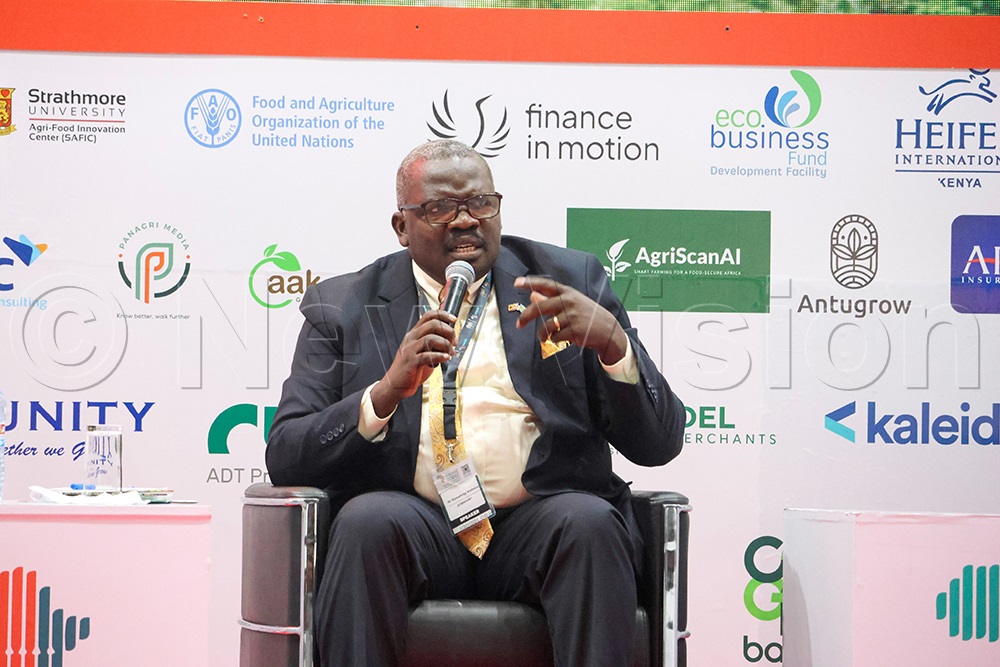
Humphrey Mutaasa, Chief Technical Advisor at The Grain Council of Uganda (TGCU), delivers a presentation during the summit. (Credit: Prossy Nandudu)
For Uganda and the wider East African Community (EAC), the initiative should reawaken their mobilisation efforts needed to transform agriculture, strengthen food security and build more resilient economies.
The summit comes at a time when African countries are beginning to implement the 2026–2035 CAADP Kampala Strategy and Action Plan, adopted in Uganda, which calls for stronger investment in sustainable food production, agro-industrialisation, climate resilience, trade and inclusive agricultural growth.
Kenya's NASIP, therefore, represents one of the first major national efforts to translate those continental aspirations into a fully costed investment framework.
Speaking during the official opening of the summit, Kenya principal secretary for agriculture, Jonathan Mueke, said NASIP, as a KES 1.081 trillion investment framework, will guide Kenya's agricultural transformation over the next five years.
“The financing model itself reflects an ambitious partnership approach, with national and county governments expected to contribute 35 per cent, the private sector 45 percent and development partners the remaining 20%,” Mueke said.
The financing structure is perhaps the most significant lesson for Uganda, which possesses fertile soils, abundant water resources and one of the youngest populations in Africa but remains constrained by inadequate financing, limited irrigation, post-harvest losses, weak market infrastructure and the growing impacts of climate change.
Dr Charity Mutegi, the director of the FINAS Summit, said this year's forum sought to move the conversation from commitments to delivery by bringing together governments, financiers and development partners to advance sustainable investment in African food systems.
Representatives from Ireland, Germany, AGRA and FSD Kenya emphasised that Africa's agricultural transformation will require stronger partnerships, greater private sector participation and innovative financial models that work for farmers, micro, small and medium enterprises (MSMEs) and agricultural value chains.
Climate-smart financing
On the issue of climate change, seen through prolonged droughts, floods and unpredictable weather across East Africa, participants called for targeted investments in adaptation, resilience and sustainable production systems. For the case of Uganda, the Government has prioritised agro-industrialisation and value addition as key pillars of economic transformation.
On financing irrigation, Uganda has already secured a loan worth €168.9 million from the United Kingdom Export Finance (UKEF) and Citi Bank to finance Phase II of the Solar Powered Irrigation Systems Project aimed at boosting coffee production and strengthening climate resilience.
The FINAS Summit also showcased practical tools developed by international institutions to help governments identify financing gaps, improve public expenditure and attract larger flows of investment into agriculture.
These approaches could strengthen evidence-based planning while helping countries build more credible pipelines of bankable agricultural projects capable of attracting investors.