
Govt to distribute free climate-resilient coffee seedlings
Scientists at NaFORRI said the seedlings are newly developed KR coffee varieties, including KR10, designed to withstand pests, diseases, and changing weather patterns while delivering higher yields.
The Ministry of Agriculture, Animal Industry and Fisheries (MAAIF) is set to distribute free drought- and pest-resistant coffee seedlings to farmers across the country in a major push to boost household.
The Ministry of Agriculture, Animal Industry and Fisheries (MAAIF) is set to distribute free drought- and pest-resistant coffee seedlings to farmers across the country in a major push to boost household incomes and strengthen climate resilience in the coffee sector.
The initiative, backed by state funding and implemented through the National Agricultural Research Organisation (NARO) and its forestry arm, the National Forestry Resources Research Institute (NaFORRI), will see at least one million improved coffee clones produced and supplied to farmers at no cost.
The coffee initiative, which is set to be launched and rolled out this month (April), is part of a wider effort showcased during the International Day of Forests commemorations organised by NaFORRI and World Vision on March 31, 2026, where scientists highlighted a range of tree-based solutions for climate adaptation and livelihoods.
Scientists at NaFORRI said the seedlings are newly developed KR coffee varieties, including KR10, designed to withstand pests, diseases, and changing weather patterns while delivering higher yields.
“We are maintaining the true-to-type coffee. These KR varieties yield highly, are adaptive to pests and diseases, and can grow better in different climatic conditions,” he explained.
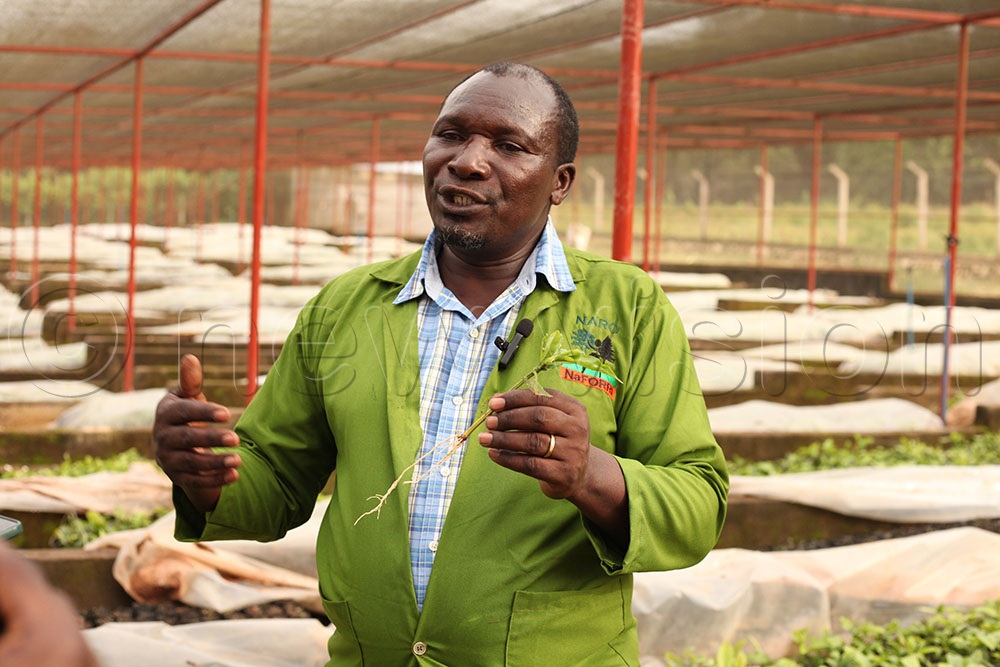
Dr. Boaz Juventine Odoi, a researcher at NaFORRI in Mukono said they are already multiplying the improved coffee using clonal propagation, a method that ensures farmers receive plants with consistent.
Unlike conventional coffee grown from seed, which can vary due to mixed parent traits, the cloned seedlings guarantee uniform quality and productivity.
He noted that the institute has already produced about 750,000 seedlings, which is about 75% of the target of one million assigned to them by the agriculture ministry, with more under propagation in Mukono and other branches, including Mbale.
He added that the improved coffee varieties can begin flowering within 12 to 18 months, offering farmers quicker returns compared to traditional types.
“All this coffee we are raising will be given to farmers free of charge,” Dr Odoi said, noting that distribution will be coordinated through the Ministry of Agriculture.
NaFORRI director of research, Dr John Adriko, said the institute is promoting agroforestry and climate-resilient tree species to address both environmental degradation and economic needs. Uganda is currently losing forest cover at a rate of about 1.3 percent annually, making tree-based interventions critical.
“We are promoting fast-growing species, fruit trees, and resilient varieties that can support incomes while protecting the environment,” Adriko said.
As of March 2026, Uganda continues to solidify its position as Africa’s top coffee exporter, generating approximately US$2.5 billion (sh9 trillion) in annual revenue.
According to data from the Uganda Investment Authority (UIA) and UCDA, Uganda exported a total of 8.8 million 60kg bags over the last 12 months.
The commemorations were also marked by the planting of a hectare (2.5 acres) of forest at Kifu, with the goal of increasing forest cover under the theme forests and economies.