
Govt moves to restore degraded R. Nile ecosystems under sh186b conservation project
The project aims to improve ecosystem functionality along the Nile from an estimated 10.5% to 95%, restoring degraded riverbanks, forest reserves and fish breeding grounds.
Maureen Anino, the Assistant Commissioner in the Department of Environment Sector Support Services at the Ministry of Water and Environment, addressing stakeholders during the inception meeting for the Kalagala-Itanda Falls Conservation and Protection Project (KIFCP), hosted by the Ministry of Water and Environment at Bilkon Hotel in Jinja City on July 30. (Photos by Donald Kiirya)
________________
The Government of Uganda, through the Ministry of Water and Environment, has officially launched the multi-sectoral Kalagala-Itanda Falls Conservation and Protection Project (KIFCP) to restore degraded ecosystems, boost tourism and protect the River Nile corridor across 19 districts.
The project, worth sh186b and fully funded by the Government of Uganda, will be implemented over the next four years. It aims to improve ecosystem functionality along the Nile from an estimated 10.5% to 95%, restoring degraded riverbanks, forest reserves and fish breeding grounds.
Speaking during the inception meeting held at Bilkon Hotel in Jinja city on July 30, 2026, key Ministry officials, district local government leaders and environmental experts outlined the scope of the project, which will initially focus on Jinja city, Buikwe, Kamuli, Kayunga and Jinja districts before rolling out northwards towards the South Sudan border.
According to Maureen Anino, the assistant commissioner in the Department of Environment Sector Support Services at the Ministry of Water and Environment, key project targets include gazetting and demarcating 2,400 kilometres of a 100-metre buffer zone on both banks of the River Nile as a Special Conservation Area; restoring 8,200 hectares of degraded riverbanks and 5,300 hectares of degraded fish breeding areas; and replanting and enforcing protection over adjacent Central Forest Reserves (CFRs), including Mabira, Kalagala Falls, Nile Bank, Namavundu and Namasagali.
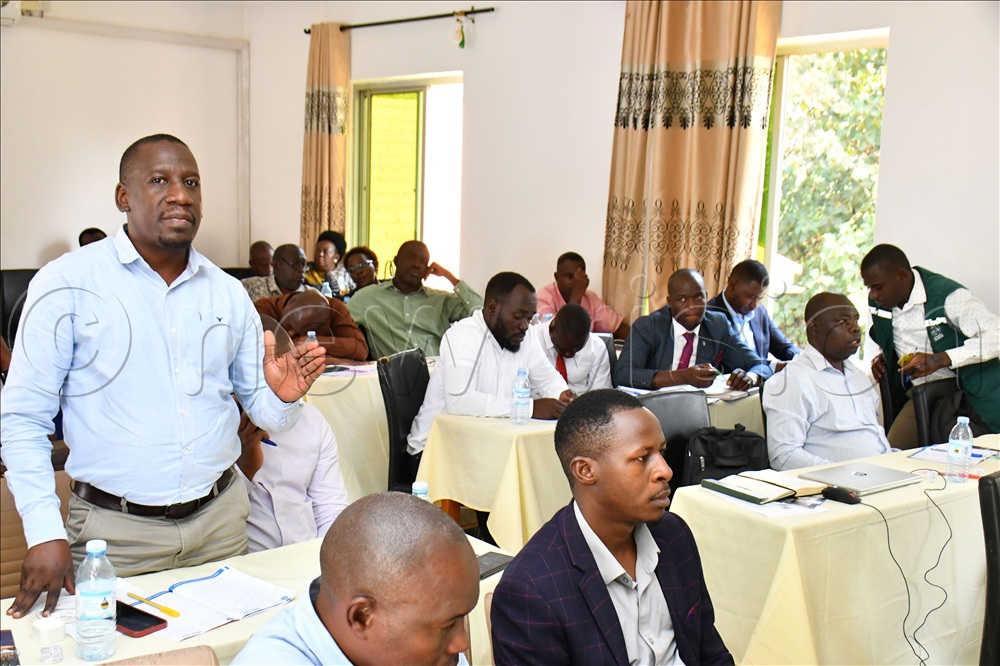
Jinja District Principal Environment Officer, Moses Maganda (L) outlining some of the challenges during the inception meeting for the Kalagala-Itanda Falls Conservation and Protection Project (KIFCP), hosted by the Ministry of Water and Environment at Bilkon Hotel in Jinja City on July 30.
She noted that other key project targets include supporting communities currently practising illegal agriculture within buffer zones with alternative income-generating projects, as well as establishing regional museums, training centres and eco-tourism initiatives to boost local revenue while preserving cultural sites held dear by institutions like the Busoga Kingdom.
"The River Nile is Uganda's most strategic natural asset—a lifeline for energy, agriculture, tourism, and water supply. Economic development and environmental conservation must go hand in hand. If we do not protect this stretch of the river, we face serious energy and water security threats, as well as geopolitical tensions within the Nile Basin," Anino noted.
"Our objective is to safeguard the ecological integrity of the river for future generations. Gazetting the 100-meter buffer zone as a Special Conservation Area gives us legal grounds to prevent further degradation. We are not chasing people away; rather, we are supporting affected farmers with alternative livelihoods so they can move out of protected zones in accordance with environmental regulations," Anino said.
John Magezi, the deputy RDC for Kayunga district, representing Jinja RCC Salim Komakech, commended the central government for funding the project and pledged full political leadership, community mobilisation and security enforcement.
“We must strictly adhere to executive directives prohibiting human activity within 200 meters of protected water bodies. Furthermore, we appeal to project managers to prioritise hiring skilled local youth and women from Jinja, Buikwe, Kamuli, and Kayunga," Magezi added.
Nicholas Magala, an acting assistant commissioner at the water and environment ministry, said the project aims to become a flagship conservation initiative for Uganda, adding that existing commercial developers and hotel operators along the Nile must comply with the law, regularise their operations and complete mandatory Environmental and Social Impact Assessments (ESIAs) to prevent further environmental damage.
Jinja district principal environment officer Moses Maganda outlined major challenges, including encroachment and deforestation of central and local forest reserves, illegal cultivation inside the 100-metre buffer zone and illegal sand mining.
He said the project comes at the right time as the Government intensifies restoration of wetlands, riverbanks and forest reserves.
By the end of the five-year period, he hopes all central and local forest reserves in the project area will be demarcated and reforested with indigenous species, aquatic life restored, and nature-based tourism involving local communities promoted. Regional museums and training centres are also planned.
Jinja District Local Government secretary for production Violet Nanangwe urged communities and leaders to work together.
“Things have not been moving on very well, but we, the local community members, are the ones who have been destroying these natural resources. So, let’s work together, and we protect the environment,” she said, noting that conservation would deliver financial and economic benefits, especially for women.
Moses Balimunsi, the Buikwe natural resources officer, pointed to practical enforcement constraints, including inadequate equipment, limited forestry staff, with sometimes only one officer per district, and complicated land ownership claims, including mailo and freehold titles inside the buffer zone.
He also noted that the cost and lengthy process of obtaining NEMA certificates discourage compliance, although awareness of their importance is growing.