
Farmers enlisted in low-cost push to reverse Uganda's forest Loss
FMNR involves farmers identifying and protecting naturally regenerating trees and shrubs, including those growing from existing stumps and root systems, rather than relying entirely on planting new seedlings. Uganda’s forestry standards recognise the practice as a technically simple and inexpensive approach to restoring forest landscapes.
Key FMNR stakeholders during the conference. (Courtesy Photo)
Uganda is turning to Farmer Managed Natural Regeneration (FMNR), a low-cost approach that allows naturally growing trees and shrubs to regenerate, in a bid to reverse forest loss and restore millions of hectares of degraded land.
The push comes as the Government says Uganda’s forest cover has improved from about 10% in 2015 to 12.7% in 2024. However, the country is still losing forests faster than it is restoring them.
Bob Kazungu, the assistant commissioner for forestry monitoring at the Ministry of Water and Environment, said the increase in forest cover should not create complacency because the country is not gaining forests at the rate at which it is losing them.
“We are not happy with the current situation. Restoration efforts in the sense that we are not gaining as much as we are losing,” Kazungu said.
He was speaking at Hotel Africana in Kampala on September 8, 2026, during the opening of the two-day Annual National FMNR Conference, organised under the theme, Scaling up Community-led Landscape Restoration using FMNR.
The conference brought together government officials, farmers, researchers, development partners, civil society organisations and FMNR practitioners to discuss how the approach can be expanded across Uganda.
FMNR involves farmers identifying and protecting naturally regenerating trees and shrubs, including those growing from existing stumps and root systems, rather than relying entirely on planting new seedlings. Uganda’s forestry standards recognise the practice as a technically simple and inexpensive approach to restoring forest landscapes.
Kazungu said the approach could help the Government reduce the cost of restoration at a time when there is high demand for seedlings and other planting materials.
Despite the recent improvement, Uganda’s forest cover remains significantly below the 24% recorded in 1990.
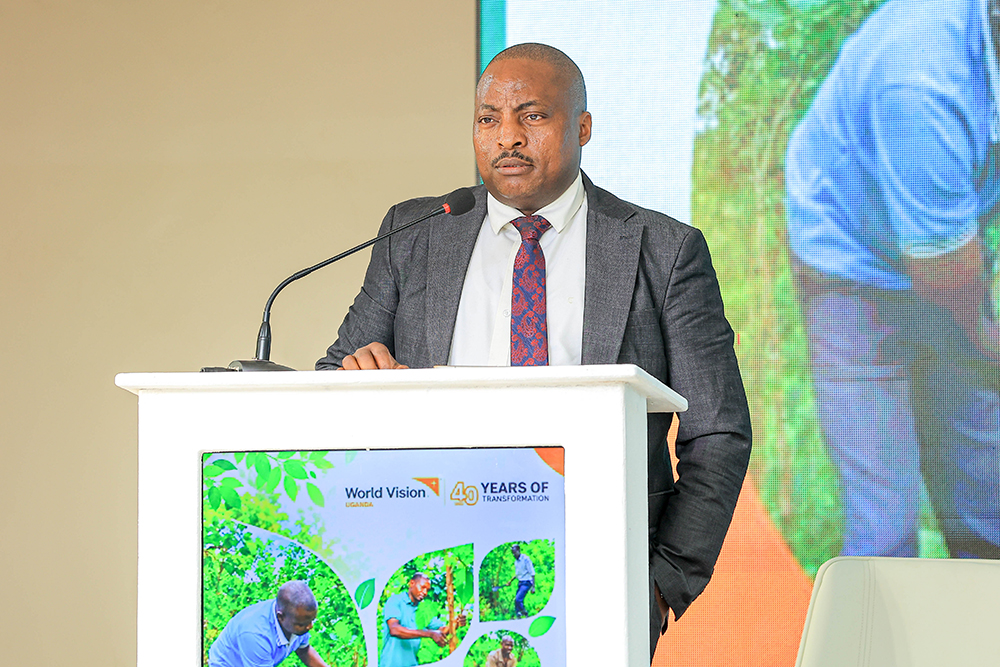
Kazungu said a Restoration Opportunities Assessment Methodology (ROAM) assessment conducted with partners identified about 8.4 million hectares of land with potential for restoration.
Kazungu attributed the continued loss to several factors, including agricultural expansion, demand for firewood and charcoal, illegal logging and timber extraction, population growth, settlement, and weaknesses in governance and policy.
He said the increase recorded in recent years has also been driven largely by the establishment of monoculture plantations, particularly eucalyptus and pine.
While these plantations have contributed to the increase in overall tree cover, Kazungu said the Government wants to achieve a better balance between exotic species and indigenous trees.
“We have to create a balance between our indigenous tree species and our exotics that we also promote,” he said.
The ministry is now looking at approaches that can restore landscapes while reducing the financial burden associated with conventional tree planting.
Kazungu said a Restoration Opportunities Assessment Methodology (ROAM) assessment conducted with partners identified about 8.4 million hectares of land with potential for restoration.
The Government is implementing several programmes to support restoration, including forest landscape restoration initiatives, catchment restoration projects and programmes targeting degraded landscapes.
The FMNR Network Uganda describes the approach as a low-cost method of regenerating trees and shrubs on degraded farmland and grazing areas, with potential benefits including improved soil fertility, biodiversity, food security and resilience to climate change.
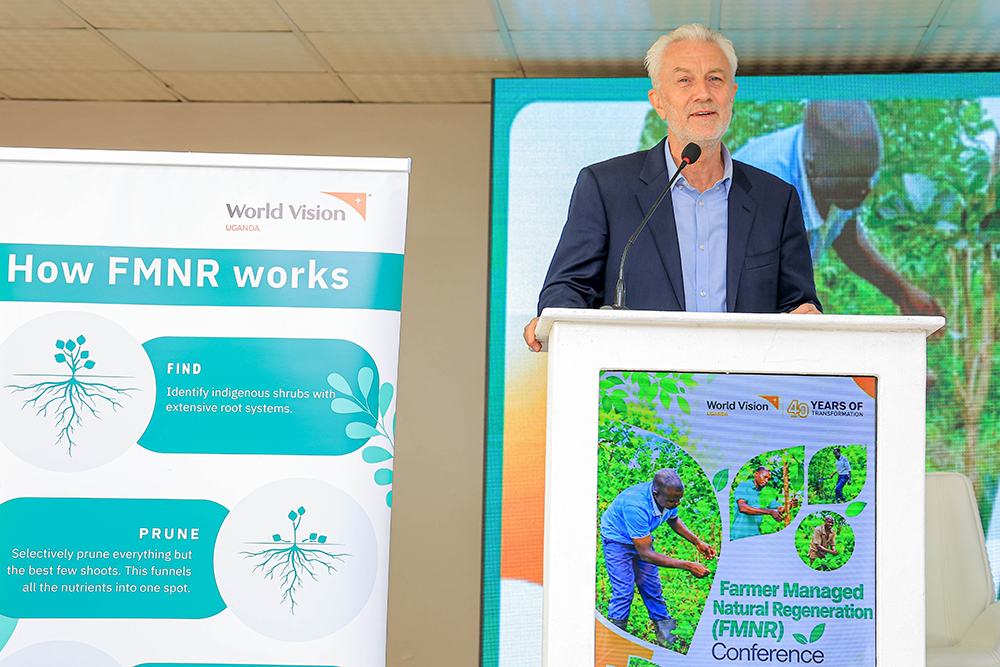
Richard Ramsey, World Vision Uganda’s programme development and impact director, said the organisation was working towards restoring 2.3 million hectares in Uganda through its broader restoration efforts, including a direct target of 570,000 hectares. (Courtesy Photo)
Kiyingi said the network now has 105 member organisations working across the country and has organised itself into six regional nodes to bring FMNR closer to communities.
The network’s members include civil society organisations, farmer groups, faith-based organisations, community organisations and development partners.
He said the expansion showed that FMNR had moved beyond a single project to become a broader restoration movement.
However, he acknowledged challenges, including limited resources, coordination difficulties, competing land uses, climate variability, and gaps in data and evidence.
Richard Ramsey, World Vision Uganda’s programme development and impact director, said the organisation was working towards restoring 2.3 million hectares in Uganda through its broader restoration efforts, including a direct target of 570,000 hectares.
He said FMNR had already demonstrated its potential in different parts of the world and should now be scaled up as Uganda works towards the 2030 global ecosystem restoration targets.
“This is not a new practice. This is the simplest practice on the earth in many ways. And yet these things happen out in communities quietly. But I think what we need to do now is accelerate that progress,” Ramsey said.
World Vision Uganda, which has promoted FMNR in Uganda, highlighted the importance of the approach in moving restoration from individual projects to the national scale, saying this would help ensure sustainability beyond individual projects.