
Communities applauded for protecting Kasyoha-Kitomi forest
“In the past, the forest was heavily encroached on. Through sensitisation meetings and training, communities are learning how to benefit from the forest without cutting trees for charcoal or firewood. The forest is now regenerating,” Muhoozi said.
Officials from NFA, Nature Uganda and Denmark tour part of the forest. (Credit: Bruno Mugizi)
Communities living near Kasyoha-Kitomi Forest Reserve have been praised for their role in restoring and protecting the once-degraded forest.
The forest, which stretches across the five districts of Buhweju, Rubirizi, Bushenyi, Ibanda and Kamwenge, covers about 433 square kilometres.
Local communities in these districts are leading a remarkable revival of the natural forest in western Uganda.
Although not the largest in the region, Kasyoha-Kitomi plays a key role in sustaining biodiversity, regulating rainfall and supporting local livelihoods.
Their efforts, supported by Nature Uganda and the National Forestry Authority (NFA), have helped restore degraded areas and improve the forest’s ecological health.
Severe encroachment
Didas Magezi Mucunguzi, the Rubirizi district forestry officer, said Kasyoha-Kitomi Forest faced severe encroachment in the past, with small-scale farming more than doubling between 1990 and 2005, while grasslands declined significantly.
“Illegal timber harvesting, charcoal burning and gold mining further degraded the forest, reducing canopy cover and threatening wildlife habitats,” he added.
Community-based conservation
During a tour of Kasyoha-Kitomi Forest on March 21, 2026, officials observed that the canopy in previously degraded areas is gradually regenerating.
Nature Uganda, in partnership with the National Forestry Authority and other development partners, has been implementing community-based conservation initiatives to curb encroachment and restore the forest.
Jimmy Muhebwa Muhoozi, a director at Nature Uganda, said the forest is beginning to recover.
“In the past, the forest was heavily encroached on. Through sensitisation meetings and training, communities are learning how to benefit from the forest without cutting trees for charcoal or firewood. The forest is now regenerating,” he said.
He added that promoting alternative livelihoods has been critical in reducing pressure on the forest.
“We are supporting communities with alternative livelihoods, including apiculture (bee-keeping), banana farming and improvement, goat rearing, winemaking, tree nursery establishment and climate-smart farming. These activities provide income while reducing dependence on forest resources such as charcoal burning and illegal logging,” Muhebwa said.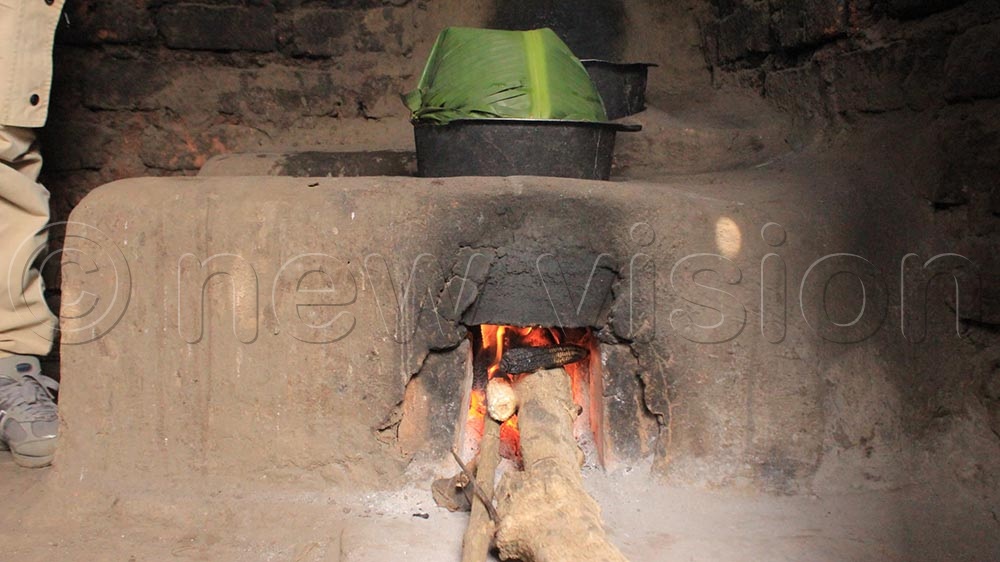
A resident near Kasyoha-Kitomi prepares food using firewood from the forest. (Credit: Bruno Mugizi)
Community groups lead
Residents have formed conservation groups, including Mwongyera Parish Environmental Conservation Association (MPECA), Butooha Tukwataniise Turinde Ebyobuhangwa Association (BTTEA), Buzenga Environmental Conservation Association (BUECA) and Ndangaro Environmental Conservation Association (NECA).
Members are now engaged in alternative income-generating activities supported by Nature Uganda and NFA, helping to reduce encroachment on the forest.
Banana yields have increased from about 15 kilogrammes to 50 kilogrammes per harvest due to improved farming practices.
“We have trained farmers in improved banana varieties and modern farming methods to increase production and reduce the need to expand into forest land,” Muhebwa said.
Mugabe Robert, chairperson of Butooha Tukwataniise Turinde Ebyobuhangwa Association, praised Nature Uganda for equipping farmers with skills to earn a living while protecting the environment.
Some farmers, including Claire Ahimbisibwe and Claire Kyobutungi, said climate-smart agriculture has enabled them to farm responsibly without degrading the forest.
More than 2,200 energy-saving stoves have also been distributed to households to reduce firewood consumption and limit tree cutting.
Government and partners
Rubirizi resident district commissioner Ahmed Kibazo Kinene said the government is committed to supporting conservation efforts.
Development partners from Denmark have signed a four-year agreement with Nature Uganda to strengthen forest management.
The partnership will focus on environmental policy, public awareness and biodiversity research, including bird species in the reserve.
Voices from the community
Community members say the initiatives have improved livelihoods and fostered a culture of conservation.
“Before, many depended on hunting and charcoal burning. Now we understand the importance of protecting the forest and are teaching our children the same,” said Annet Nabada, a member of MPECA.
Challenges remain
Despite the progress, challenges persist. NFA officials cite limited funding, inadequate staffing and difficulties in monitoring forest activities.
“There is a need for increased government support to strengthen patrols and sustain community engagement,” said Francis Muhanguzi, an NFA official.
Although a few individuals continue to engage in illegal activities, Jimmy Muhebwa said they are optimistic that community participation, strengthened monitoring and alternative livelihoods will sustain the forest’s recovery.