
Hoima tree planting campaign launched to mitigate climate change effects
The campaign was organised by Good Forest Foundation Uganda in partnership with the Lions Club of Hoima. The exercise, which saw over 300 tree seedlings planted on the degraded Kihombonza Hill, formed part of activities to commemorate the International Day of Forests marked on March 21, 2026.
Emmanuel Ssempara, the Hoima district CAO planting a tree as Mugabi Collins a tree planting project manager at Good Forest Foundation Uganda (second right) and Deputy RDC Ntuyo (left) looked on. (Photo by Peter Abaanabasazi)
______________
In an effort to restore depleted natural forest cover in Hoima district, a tree planting campaign has been launched, with a call to sensitise the public on the importance of conservation.
The campaign was organised by Good Forest Foundation Uganda in partnership with the Lions Club of Hoima. The exercise, which saw over 300 tree seedlings planted on the degraded Kihombonza Hill, formed part of activities to commemorate the International Day of Forests marked on March 21, 2026, under the theme “Forests and Economies”.
According to statistics from Global Forest Watch, between 2021 and 2024, Hoima district experienced a total natural forest loss of approximately 9.4 thousand hectares, representing a period of intense deforestation. In 2024 alone, the district lost 2.3 thousand hectares of natural forest, emitting roughly 540 kilotonnes of CO₂.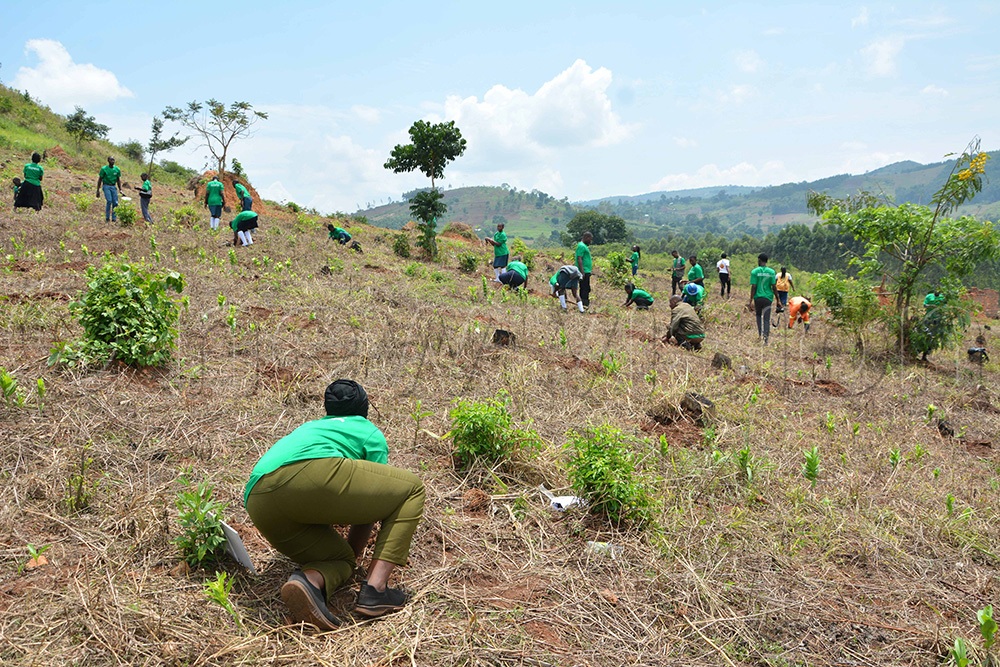
Residents and students planting trees at degraded Kihomboza Hill. (Photo by Peter Abaanabasazi)
The depletion of forests has disrupted the chimpanzee corridor between Kyabigambire and Kitoba subcounties, leading to increased encroachment of primates into nearby communities.
Mugabi Collins, a tree planting project manager at Good Forest Foundation Uganda, said the organisation is working with individuals who own land to implement the campaign across 22 districts, including Hoima, Kikuube, Masindi and Kagadi.
He added that the programme has so far seen over 100,000 trees planted in Hoima district and two million trees across the 22 districts, alongside the establishment of 19 community tree nursery beds.
He said they are currently working with 6,500 farmers under the initiative, which is aimed at promoting conservation and restoring degraded areas.
“We do restore degraded land for both institutions, individuals, and the government. The intention is for greening, restoration of degraded areas and mitigation of climate change,” he said.
However, he noted that Uganda is estimated to be losing 122,000 hectares of forest annually, while restoration efforts only cover about 7,000 hectares each year, creating a significant imbalance between loss and recovery.
He attributed the continued forest loss to increased demand for charcoal and timber, agricultural expansion, population growth, urbanisation and industrial development.
District officials speak out
Hoima district forest officer Stuart Tusabege commended the organisations for promoting reafforestation but emphasised the need to ensure the survival of planted trees.
He noted that although organisations plant at least 100,000 trees in the district annually, survival rates remain low.
“Planting is being done widely, but the survival rate is low. The major cause of the poor survival rate is that we are planting seedlings of poor quality, planting trees in shallow holes, people have embraced planting, opposed to growing,” he said.
Francis Abitegeka Kiva, senior assistant chief administrative officer of Kikuube district and president of the Lions Club of Hoima, noted that more people are involved in forest destruction than in conservation efforts.
He stressed the need for stakeholders, including religious, political and cultural leaders, local communities and civil society, to work together to promote conservation and restore degraded ecosystems.
“The damage we have done to nature demands more effort to recover," he said.
Hoima district senior natural resources officer Joseline Nyangoma emphasised the need to involve young people in environmental protection to ensure sustainability.
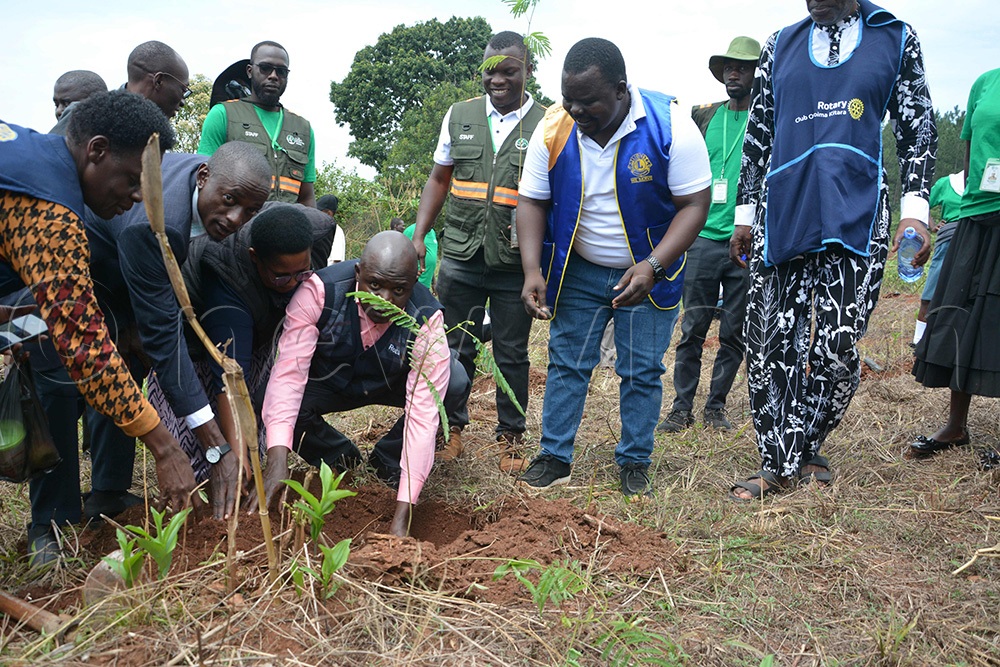
Hoima district officials led by Emmanuel Ssempara, Hoima district CAO, planting a tree as they launched tree planting campaign. (Photo by Peter Abaanabasazi)
She noted that instilling conservation values in the youth would reduce future involvement in forest destruction.
Nyangoma also appealed to organisations engaged in tree planting to promote fruit tree planting, noting that it supports both environmental conservation and food security.
Officiating at the exercise, Hoima district deputy RDC Ntuyo Safik urged partners and local leaders to prioritise community sensitisation on the importance of protecting forests.
He said rising deforestation trends indicate limited public awareness, which has led to continued encroachment on sensitive ecosystems such as wetlands and forests.