
Govt to recruit 87,000 COVID-19 workers
According to the Prime Minister, Dr. Ruhakana Rugunda, the strategy seeks to empower individuals and communities to fight the pandemic.
The Government is in the process of recruiting 87,000 community health workers to help in the fight against the coronavirus disease (COVID-19). The workers will be paid a monthly allowance.
This was revealed on October 21, 2020 by Prof. Francis Omaswa, the chairperson of the newly created Community Engagement Strategy (CES) sub-committee on COVID-19.
He said the idea is to ensure that at least every village has one community health worker being paid sh100,000 per month to provide communitybased surveillance and case detection, including deaths.
The community health workers will be chosen from the already existing village health teams (VHTs). VHTs were created in 2000 but were working on voluntary basis. Omaswa said each selected community health worker will be paid a monthly allowance and will be required to work full time.
He said the Government has set aside an annual budget of sh70b to cater for the allowances. The health workers will also be given backpacks, thermometers, sanitisers, soap, face masks, gumboots, uniforms, a smartphone, umbrella, rapid test kits and other relevant medical supplies.
He was speaking at the launch of the National Community Engagement Strategy (CES) for COVID-19 response at Hotel Africana in Kampala.
Maj. Gen. Geoffrey Muheesi, the chairperson for the Technical Inter-sectoral Committee on COVID-19, said the health workers will superintend over the activities of the village taskforces, which have also been created.
According to the Prime Minister, Dr. Ruhakana Rugunda, the strategy seeks to empower individuals and communities to fight the pandemic.
"The objective of this strategy is to ensure that all people in Uganda are aware, empowered and are participating actively in the prevention and control of the outbreak of COVID-19 both as a duty and right, using existing structures, systems and resources as much as possible," he said.
Uganda is currently in phase four of COVID-19's spread where there is a wide community spread of the virus and almost every district in the country has registered a case.
As of yesterday, Uganda had 10,788 cases with 97 deaths. The institution of the CES sub-committee was based on President Yoweri Museveni's directive following an August 28 meeting with the national taskforce.
The sub-committee falls under the technical intersectoral committee. CES brings together ministries of gender, local government and internal affairs, civil society represented by the Uganda Red Cross Society and the African Centre for Global Health and Social Transformation (ACHEST).
The 14-member subcommittee is headed by Omaswa, who is also the executive director of ACHEST.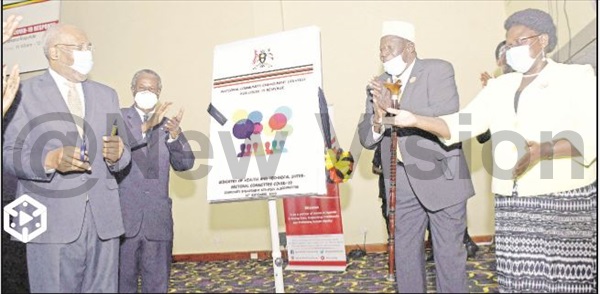
LC1 TASKFORCES
To implement the strategy, the sub-committee has set up a COVID-19 taskforce in every village. This will be headed by the LC1 chairperson, who will work with VHTs, a full-time community health worker, parish chief, religious and cultural leaders, school representatives, health facility representatives, community development officers (CDOs), volunteers, private sector and local civil society organisations.
This taskforce will carry out community-based surveillance, case detection, case management, including isolation; community-based drug distribution and referrals, contact tracing and reporting, protection of the vulnerable, awareness creation and maintaining village health register on households.
The implementation of the strategy will start with the hotspot districts such as Kampala and the border ones before it is rolled out to other areas across the country.
"Today, we are formally handing over ownership and responsibility for the control of this disease to individual Ugandans, individual households and individual communities. In a nutshell, this is power to the people to defeat COVID-19," Rugunda said while launching the strategy.
The prime minister stated that individuals have the primary responsibility of maintaining their own health and that of their communities, and to ensure that COVID-19 does not spread among them.
Omaswa said they are also decentralising further COVID-19 response by bringing on board the LC2 and LC3s. The LC2 committee will work with the parish council and planning committee and parish intelligence officers to carry out oversight and support in addition to maintaining law and order.
On the other hand, the LC3 committee will work with the health assistants, gombolola intelligence officers, CDOs, schools, CSOs, agricultural extension workers, religious and cultural leaders, and health centres.
This committee will carry out treatment of illnesses, planning and resource mobilisation. These will leave the responsibility of providing overall leadership, information and communication, supervision, enforcement, and monitoring and evaluation to the district taskforces.
Muheesi said the strategy is timely and comes at a time when the fight against COVID-19 is still raging on.
"The fight against COVID is about education and enforcement and that is what we are doing," he said.
This is not the first time Uganda is using such a strategy in the fight against infectious diseases. It has been used successfully in the fight against HIV/ AIDS and Ebola.
STRATEGY
Omaswa said each chosen community health worker will be paid a monthly allowance and will be required to work full time.
He said the Government has set aside an annual budget of sh70b to cater for the allowances. The health workers will also be given backpacks, thermometers, sanitisers, soap, face masks, gumboots, uniforms, a smartphone, umbrella, rapid test kits and other relevant medical supplies