
Xi Jinping's new Long March
Growing up in such a revolutionary family, Xi developed a deep connection to the Long March and the region. He was not yet 16 when he left Beijing for a village in Yan'an, where he spent seven years living and working alongside farmers.
A drone photo taken on April 16, 2026 shows students taking part in a memorial event at a monument commemorating the departure of the Central Red Army during the Long March, in Yudu County, east China's Jiangxi Province. (Xinhua Photo)
BEIJING - On the banks of the Yudu River in east China, a choir sang of soldiers leaving home more than nine decades ago. Beside the singers, eight large red Chinese characters proclaimed: "May the spirit of the Long March shine forever."
In October 1934, some 86,000 Red Army soldiers crossed the river, little knowing that they were embarking on a grueling 12,500-kilometer journey, which American journalist Edgar Snow hailed as "an odyssey unequaled in modern times." In October 1936, three main Red Army forces converged in northwestern China, marking the end of the Long March.
As China commemorates the 90th anniversary of the Long March's victorious conclusion this year, visitors have traveled to the mountainous county of Yudu in Jiangxi Province to see where it all began.
Yudu's visitors number in the millions each year. Among those who have made the trip is Chinese President Xi Jinping.
During his visit in May 2019, Xi laid a floral basket at a Long March departure monument, went to the river crossing used by Red Army soldiers and met their descendants.
"I have come here to let people across the country know that the Party has not forgotten its original aspiration," said Xi, who is also general secretary of the Communist Party of China (CPC) Central Committee and chairman of the Central Military Commission.
"We must build on the past, pack our bags and set out again," he said.
Carry the baton forward
The Long March was a strategic shift. In 1934, the fledgling CPC was forced to abandon its main base in the provinces of Jiangxi and Fujian after failing to repel the Kuomintang regime's fifth encirclement and suppression campaign.
The maneuver took the Red Army across nearly 100 rivers and more than 40 towering mountains, and through marshland known as a "death zone." The troops fought more than 600 battles. Many lost their lives along the way.
Far in the northwest, Xi's father, Xi Zhongxun, and his comrades Liu Zhidan and Xie Zichang established the Shaanxi-Gansu revolutionary base. The existence of the base was an important factor in Mao Zedong's decision to make it the Long March's final destination.
After the Long March, the Party established a firm foothold in northern Shaanxi, with Yan'an as its headquarters for more than a decade. From there, it grew in strength, led the Chinese people in fighting against Japanese invasion and eventually overthrew the Kuomintang regime.
Growing up in such a revolutionary family, Xi developed a deep connection to the Long March and the region. He was not yet 16 when he left Beijing for a village in Yan'an, where he spent seven years living and working alongside farmers.
There, he joined the Party, became the village Party chief, forged close ties with local people, and made a commitment to serving the people through public office.
Yan'an, the Chinese revolution's foothold after the Long March and its springboard for national victory, was thus the starting point of Xi's political journey.
"Whenever I went to Yan'an in those years, I felt a deep sense of reverence and excitement," Xi recalled.
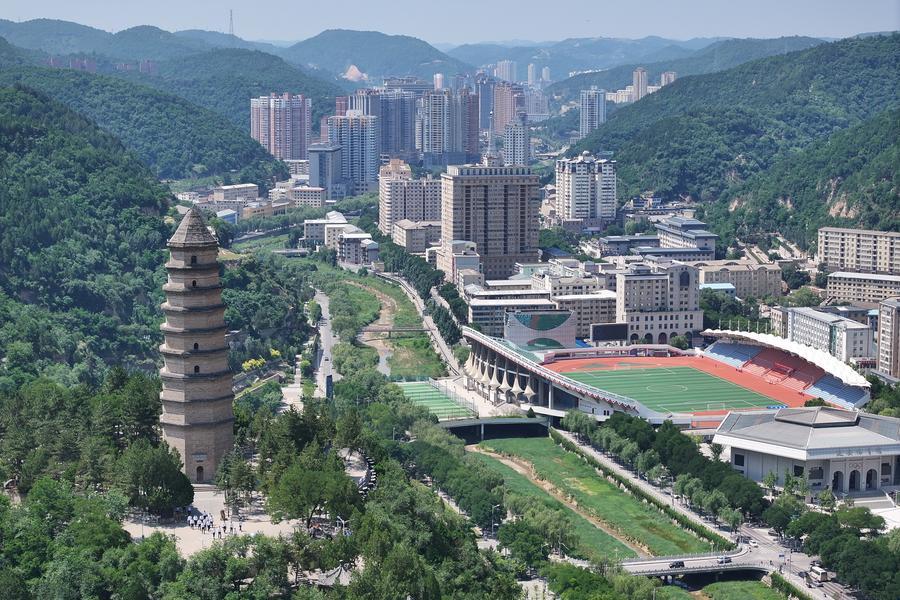
A drone photo taken on June 16, 2026 shows a view of Yan'an in northwest China's Shaanxi Province. (Xinhua photo)
As a young man, Xi was deeply fascinated by the history of the Long March. In the 1980s, he was acquainted with writer Wang Yuanjian, who devoted himself to chronicling the Red Army's heroism. Wang had interviewed many Long March veterans. As he recounted their stories, Xi would pull a notebook from his pocket and carefully take notes, Wang's wife recalled in an article.
In 1996, while serving as Fujian's deputy Party secretary, Xi joined a 1,000-person torch relay marking the Long March's 60th anniversary. He set off at the front alongside an 82-year-old Red Army veteran.
In 2006, as Party secretary of Zhejiang, Xi visited a photo exhibition marking the 70th anniversary of the Long March. He described the Long March as both an extraordinary test of the human spirit and will, and a journey in pursuit of the rejuvenation of the Chinese nation.
Since taking the top office in late 2012, Xi has retraced the Long March routes on visits across the country: from Yudu, where the Central Red Army assembled and set out, to Quanzhou, where soldiers fought the bloody Battle of the Xiangjiang River; Zunyi, the site of a decisive turning point; and Jiangtaibu, where Red Army forces joined up at the end of the Long March.
At museums, Xi studied artifacts and asked questions. At monuments, he paid tribute to revolutionary martyrs by presenting flower baskets and bowing. He also instructed authorities to recover and properly bury soldiers' remains and build memorial facilities.
On one visit, he paused before a painting of Chen Shuxiang, whose division served as the Red Army's rear guard. Captured after covering the main force's river crossing, Chen refused to surrender and died after tearing open his abdominal wound.
Xi asked how the Red Army had broken through encirclement and held together despite devastating losses, then offered his answer: the power of conviction.
For generations of Chinese leaders, the Long March is not just a military campaign, but a metaphor for the ongoing task of transforming China.
In 1949, more than a decade after the Long March ended, the People's Republic was founded. Earlier that year, with victory in sight, Mao said that winning the revolution "would be only the first step of the Long March." The journey of building a new China had just begun.
It significantly gained pace with the launch of the reform and opening up in 1978. Deng Xiaoping, a Long March veteran, proposed a three-step strategy for China's modernization, which was later elaborated as follows: meet the people's basic needs of food and clothing by 1990, achieve moderate prosperity by the end of the 20th century, and basically attain modernization by the middle of the 21st century. This modernization drive came to be known as the new Long March.
"The Long March of our generation is to attain the 'two centenary goals' and realize the Chinese Dream -- the rejuvenation of the Chinese nation," Xi said.
The two goals refer to achieving moderate prosperity in all respects by the Party's centenary in 2021 and building a great modern socialist country in all respects by the centenary of the People's Republic around the middle of the century.
In 2017, Xi brought forward the timetable for basically achieving modernization under Deng's three-step strategy by 15 years to 2035.
"Every generation must undertake its own Long March," Xi said.
Brave through all odds
In the winter of 1934, the struggle reached a critical point at the Xiangjiang River. Under heavy bombardment, Red Army troops fought their way toward the crossing points. By the time the army broke through, its ranks had dwindled from some 86,000 at the start of the march to just over 30,000.
The new Long March Xi is leading would test the Party's resolve against a different set of challenges. When he was elected the Party's top leader in 2012, China had become the world's second-largest economy and largest manufacturer after more than three decades of rapid economic growth.
That transformation also brought new challenges. China needed to sustain its economic momentum while narrowing regional disparities, tackling corruption, eradicating absolute poverty, and easing mounting environmental pressures. Meanwhile, the international community's expectations for China were rising.
Talking about "today's Long March," Xi said that although the conditions and tasks differ greatly, it remains "a pioneering, arduous and complex undertaking."
The modernization drive Xi now leads is unprecedented in human history. A population exceeding 1.4 billion is collectively advancing toward modernity on a scale surpassing the combined populations of existing developed nations. His goal is common prosperity for all, encompassing both material wealth and cultural-ethical advancement. Harmony between humanity and nature is emphasized. China also pursues rejuvenation through peaceful development.
None of these is easy.
Xi believes that overcoming the risks and challenges on the new journey requires the same revolutionary will forged during the Long March. "No matter how great the difficulties, think of the Red Army's Long March, and think of the bloody battle at the Xiangjiang River," he said.
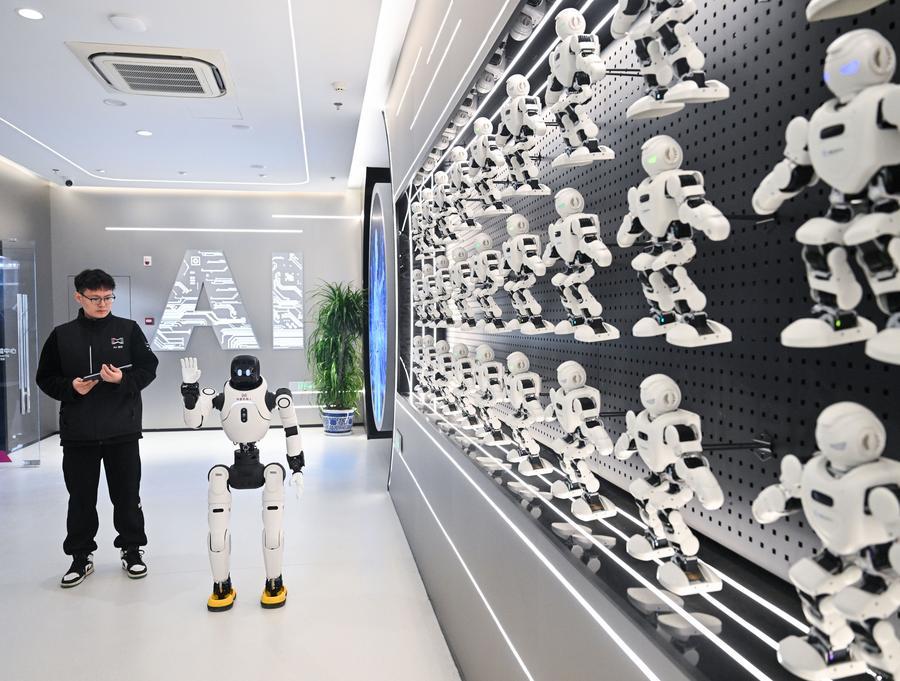
A humanoid robot greets people at an artificial intelligence distribution center in Nanjing, east China's Jiangsu Province, on Dec. 4, 2025. (Xinhua Photo)
He put forward a series of visionary strategies to ensure the march proceeds in the right direction. These include an extensive reform package -- the most comprehensive in history -- that gives the market a "decisive" role in allocating resources while making sure the government better fulfills its role. He promises broader market access for foreign investors. Since 2013, the number of pilot free trade zones in China has expanded from one to the current total of 23.
He put forward a new development philosophy that places greater emphasis on innovation, coordination, green development, openness and shared benefits. All these echo the important experience drawn from the Long March -- acting on one's own initiative, seeking truth from facts, and proceeding from reality.|
More recently, Xi introduced "new quality productive forces" -- his term for growth driven by technological advances and industrial upgrading. Like his predecessors during the Long March, Xi leads from the front, demonstrating his strategic vision and decisiveness.
Upon visiting an automobile factory years ago, he called for a shift from conventional fuel-powered vehicles to new-energy vehicles, identifying the transition as the future of China's auto industry. Over a decade ago, Xi urged China's top scientists to pay attention to a "robot revolution" that could reshape global manufacturing, emphasizing the need for China to strengthen its robotics capabilities and compete for a larger share of the market.
During the Long March, the Red Army fought the enemy with outdated weapons. Today, the challenge is different: keeping pace with the scientific revolution and the explosion of technological innovation.
As the pressure of overseas technology restrictions and trade barriers rises, Xi directs the country to strengthen independent innovation and the resilience of industrial and supply chains, and ensure both development and security.
He spearheaded a campaign to build China into a sci-tech powerhouse, elevating the country to the world's forefront in fields such as artificial intelligence, quantum technology and new energy.
From carrier rockets to nuclear submarines, China has named some of its major technological achievements after the Long March, honoring a history of self-reliance and perseverance while inspiring new technological advances
In 2014, Xi led high-ranking generals to Gutian in Fujian, where a 1929 Red Army meeting established the principle of the Party's absolute leadership over the army, to reinforce that principle. He initiated a sweeping military reform, laying the groundwork for achieving the goals for the centenary of the People's Liberation Army in 2027 and building world-class armed forces
The new Long March is progressing steadily with significant results. From 2012 to 2025, China's GDP grew from about 54 trillion yuan to more than 140 trillion yuan, while per capita GDP rose from just over 6,000 to nearly 14,000 U.S. dollars. The country has built a complete industrial system covering all industrial categories in the United Nations classification.
China's economy remains the largest engine of global growth, accounting for roughly one-third of the increase in global output in recent years, according to data from the Chinese government and international institutes. China's technology and cultural influence are also increasingly viewed positively around the world.
A global survey released by the Pew Research Center in July found that views of China had improved in many countries in recent years. For the first time, China was viewed more favorably than the United States in a majority of the countries surveyed.
Yet, as the 2035 modernization target draws closer, Xi has warned against complacency. "There are still many 'snowy mountains' and 'grasslands' for us to cross," Xi said
Meeting those challenges hinges above all on strengthening the Party's leadership. The historical parallel is explicit. The Long March helped form a new central leadership with Mao at its core and opened a period in which the Party increasingly found its own answers to the problems the Chinese revolution faced.
"After the Long March, the Party and the Red Army were stronger, not weaker," Xi said. "This is because they had found the right path and the theory to guide them.
In the new era, the Party established Xi's core position on the Party Central Committee and in the Party as a whole and established the guiding role of Xi Jinping Thought on Socialism with Chinese Characteristics for a New Era.
Lu Yi, a professor at the Party School of the CPC Central Committee, said navigating the challenges of the new Long March requires sound strategic direction from the Party's leadership, unity within the CPC and across the country, as well as discipline, commitment and dedication among all Party members.
"This is how the steel was tempered," said Yuri Tavrovsky, a Russian expert on China. "The dramatic events of 1934-1936 brought to the fore and strengthened the CPC's finest qualities, enabling it to unite a divided country and build a great one.
All for the people
In his masterpiece "Red Star Over China," first published in 1937, Snow recorded a Red Army soldier's simple explanation of what he and his comrades were fighting for: "Here everybody fights to help the poor, and to save China."
Lu, the Party school professor, said that the history of the Red Army's epic march is also a history of the deep bonds between the army and the people, and of how the Party relied on the very people it sought to serve.
In Yudu, residents took down doors and dismantled beds to build makeshift bridges that carried the Red Army across the river. Along the Long March, local people supplied them with food, served as guides and sheltered the wounded.
"Back then, we relied on the people at every turn. We relied on them for food, and to fight our battles we had to mobilize them and rely on their support. Without them, we could not have accomplished anything," said Xi's father, Xi Zhongxun, when recalling his early revolutionary years.
That reliance on the people remains central to Xi's approach to governance. He has stressed that the Party must work for the people and draw on their wisdom and initiative, grounding its policies in their needs and experience
Xi called on officials to draw inspiration from the Long March spirit and better understand the Party's original mission, which is "to seek happiness for the Chinese people and rejuvenation for the Chinese nation."
When Xi took the top office, the Party had been in power for more than six decades, and some of its members had increasingly strayed from the traditions forged during the revolutionary years.
Xi condemned some officials for being so brazen in their misconduct, including cronyism, factionalism, dangling official posts and feigned compliance -- practices that alienated the Party from the people.
Xi warned that unchecked corruption could spell the end of both the Party and the state. He soon introduced a code of conduct known as the eight-point rules to curb official extravagance. He launched the largest anti-corruption drive in the Party's history, which has seen millions of people investigated for disciplinary violations. He also led improvements to the internal Party regulatory framework and established supervision commissions, all to "confine power to an institutional cage.
Earlier this year, Xi initiated a Party-wide study campaign, prodding Party members to fix their mindset regarding governance performance. A key target is to stamp out the tendency among some officials to sacrifice public well-being in seeking to polish their performance records.
"Ultimately, the Long March succeeded because the Party and the Red Army stood together with the people, maintained a close bond with the people, and shared weal and woe with the people. This is also a fundamental guarantee that enables us to overcome all difficulties and dangers," Xi said
Sustaining that bond means understanding what people hope for and acting on their most urgent concerns.
Xi spearheaded an unprecedented poverty alleviation campaign that lifted nearly 100 million rural residents out of absolute poverty over eight years. Since the start of reform and opening up in 1978, over 70 percent of the world's poverty reduction has been attributed to China.
Xi used Long March metaphors for the tough battle against poverty. "Just as Liupan Mountain was the last high peak the Red Army had to cross during the Long March, lifting all people out of poverty is the final summit we must overcome to build a moderately prosperous society in all respects," he said.
Xi's anti-poverty war was vast in scale but granular in its approach, reaching into individual households to identify what kept them poor. Aid was tailored accordingly -- fostering industries suited to local conditions and relocating villagers out of inhospitable places. Over eight years, more than 3 million cadres were sent to villages to work on the frontline of fighting extreme poverty.
As in the Long March, some never lived to see the victory: more than 1,800 Party members and officials died in the line of duty. Xi has described the willingness to make sacrifices for the country and its people, whatever the hardship, as central to the spirit of the Long March.
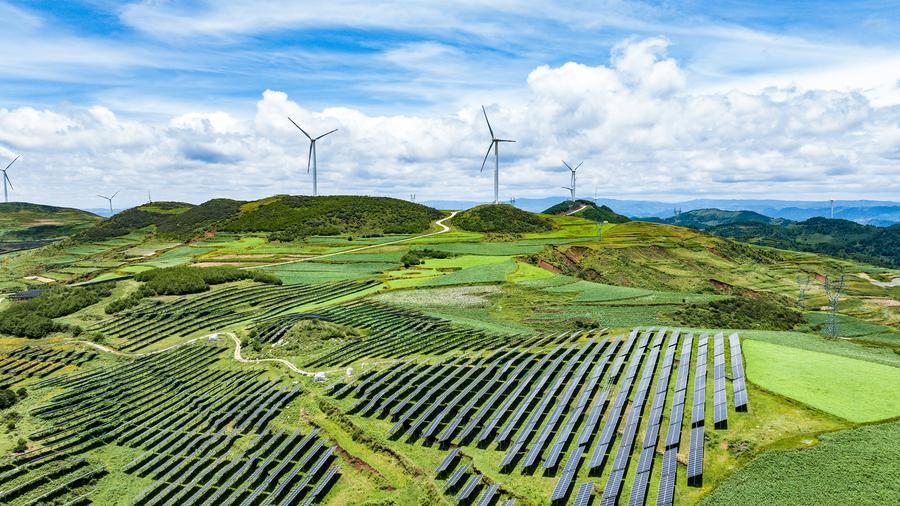
An aerial drone photo taken on July 3, 2025 shows a solar power station for agricultural use in Weining County, southwest China's Guizhou Province. (Xinhua Photo)
The snow-capped mountains and grasslands that the Red Army had to surmount on foot are now linked by highways and railways. China has built the world's largest expressway and high-speed railway networks, which have brought agricultural products out of remote villages to boost income for local residents.
Ecological restoration is another feat. China has become the country with the largest and fastest increase in forest area worldwide. At the foot of the mountains along the Long March routes, ordinary visitors today may encounter giant pandas and other wild animals. Photovoltaic and wind power installations rise from the grasslands. Kerosene lamps that herders once provided to the Red Army are now mostly seen in museums.
The country has also built the world's largest education, social security and health-care systems. Life expectancy reached 79.25 years in 2025. China now ranks among the best in upper-middle-income countries on major health indicators.
The Long March China pursues today requires no less effort than the historic Long March, British scholar Martin Jacques said.
"It's a complicated challenge, but there's so much possibility and so much potential in that. And the rewards will be enormous," he said.
Echo across the world
The international community, according to Xi, increasingly believes that the Long March was one of the key events that shaped world history in the 20th century, regarding it as an epic of ideals, devotion, willpower, and bravery whose inspirational power has transcended time and borders.
In the 1930s, Snow anticipated that someone would one day write the full epic of the Long March. In the decades since, many people have retraced its path, sought out survivors and written their own accounts.
Among the best-known was American journalist Harrison Salisbury, who in his 1985 book "The Long March: The Untold Story" described the Long March as "sui generis," with its heroism firing the dreams of a huge nation and setting it moving toward a destiny no man can yet divine.
Kenyan military officer Felix Gitaari Njage, among more than 100 officers from over 80 countries and regions who were studying in China, visited sites along the Long March routes this summer. He said the Long March spirit is a precious asset for the world, offering lessons for military personnel across nations.
"Its underlying spirit offers countries of the Global South strategic wisdom and intellectual strength for achieving unity and self-reliance and overcoming adversity," he said.
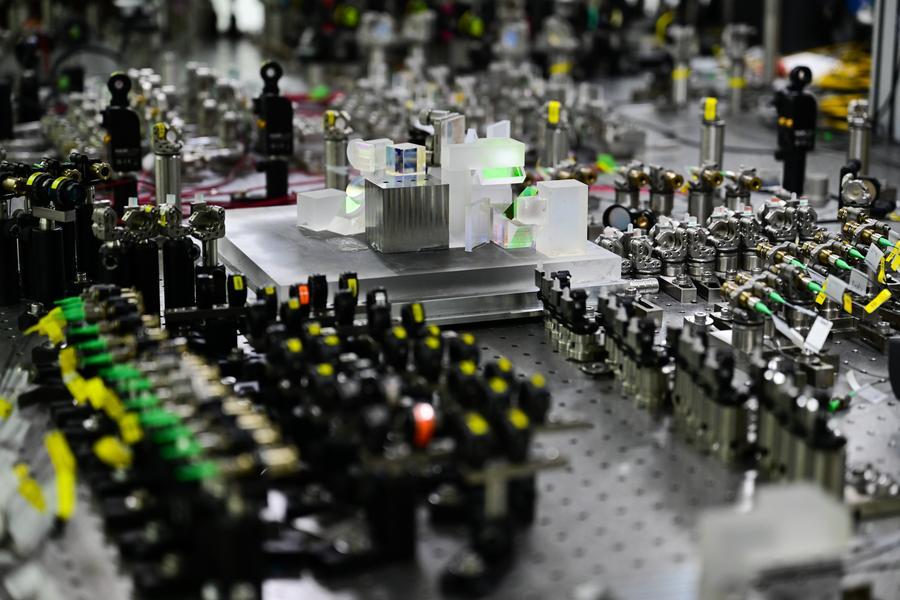
This photo taken on April 10, 2026 shows part of a programmable quantum computing prototype called "Jiuzhang 4.0." (Xinhua Photo)
The Long March continues to draw interest from scholars in both developed and developing countries. They believe China's success in the new Long March would benefit people beyond its borders as well as its own population.
In 2013, Xi put forward the vision of a "community with a shared future for humanity." The vision, together with the initiatives he later proposed on global development, security, civilization and governance, set out China's proposals and solutions to tackle shared challenges in a world marked by wealth gaps, conflicts, mistrust, unilateralism and bullying.
In September, at the BRICS summit in India, Xi urged the grouping to take the lead in promoting innovation, peace and stability, exchanges between civilizations, and reform of global governance.
Kirill Babaev, director of the Institute of China and Modern Asia at the Russian Academy of Sciences, interpreted China's message as a call for other major countries to join a "new Long March" toward an international order based on equality and mutual respect. Its outcome, in his assessment, would matter to all humanity, not only to China.
Keith Bennett, vice chairman of Britain's 48 Group, has drawn a similar connection between revolutionary memory and international cooperation. Writing in "China Today" in July, he said that the spirit of the Long March now finds expression in projects such as the Belt and Road Initiative, which connects countries through infrastructure, trade and development.
The Long March, he wrote, remains a guiding force in tackling difficult and complex tasks, overcoming development bottlenecks, and pressing ahead with long-term national goals.
For countries that look to China's experience, its efforts to combine development with security, shift toward cleaner energy, and advocate common prosperity may offer insights into addressing challenges such as climate change, public health emergencies, food and energy insecurity, and inequality.
The Long March stands as a powerful testament to the boundless strength of the human spirit once awakened, said Professor Lu. "It offers confidence to developing countries and hope to all humanity, affirming that even in a world rife with uncertainties, there are still forces steadfastly defending justice and striving toward a brighter future," he said.
The horizon stretches far ahead. The first of China's "two centenary goals" has been achieved. The second, tied to the People's Republic's centenary in 2049, still lies ahead.
"Today, we are closer, more confident, and more capable than ever of reaching the goal of rejuvenating the Chinese nation," Xi said.
"We will strive to safeguard world peace and development as we pursue our own development," he added.