
U.S. national debt tops 40 trillion dollars, underscoring challenges ahead
The U.S. national debt had surpassed 39 trillion dollars in March, after crossing the 30-trillion-dollar threshold in January 2022.
This photo taken on Aug. 19, 2026 shows the U.S. national debt surpassing 40 trillion U.S. dollars, in New York, the United States. (Xinhua)
________________
The U.S. federal government on Tuesday saw its total public debt topping 40 trillion U.S. dollars, according to a Treasury Department report issued on Wednesday.
The U.S. national debt had surpassed 39 trillion dollars in March, after crossing the 30-trillion-dollar threshold in January 2022.
The new milestone in rising national debt underscores challenges to rein in widening borrowing, stoking fresh concerns.
No slowdown in debt growth
Growth of U.S. national debt accelerated during the global financial crisis and COVID-19 pandemic but didn't return to its previous state after the crisis response period.
"It's shocking that we've doubled the federal debt in less than 10 years, and we must change course," said Michael Peterson, CEO of the Peter G. Peterson Foundation, in a statement on Wednesday.
U.S. federal debt has quadrupled over the past 18 years, said Jeff Crouere, a New Orleans-based political analyst and commentator, arguing that the massive increase in borrowing has not translated into broad-based benefits for Americans.
Crouere noted that at the end of 2024 there were 35.9 million Americans struggling in poverty, 770,000 individuals without a home, and 12.3 percent of the U.S. population relying on food stamps.
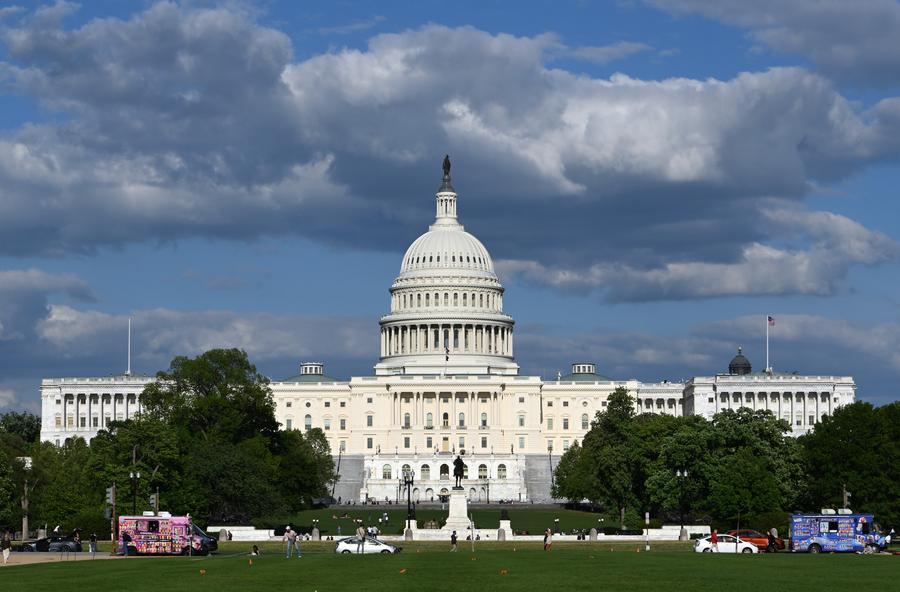
This photo taken on April 30, 2026 shows the U.S. Capitol building in Washington, D.C., the United States. (Xinhua)
He attributed much of the debt buildup to spending on wars, financial-sector bailouts, healthcare programs and the government's response to the COVID-19 pandemic.
U.S. federal debt held by the public as a share of the economy will exceed the record set during World War II, according to the Congressional Budget Office (CBO).
In its February 2026 report, the CBO projected that debt held by the public would rise from nearly 31 trillion dollars in early 2026 to 56 trillion dollars by 2036.
Debt held by the public would increase from about 100 percent of GDP to a record 108 percent by 2030 and reach 120 percent by 2036, the report said.
Notably, the Social Security program has run yearly deficits since 2010 and is expected to turn insolvent by the end of 2032, threatening a cut of more than 20 percent in benefits payments.
Both parties "total failures"
Both the Democrats and Republicans have been criticized for the continued expansion of governmental spending and the lack of political will to address the increasingly pressing issue.
"In the next two weeks, our country will hit 40 trillion U.S. dollars in debt. It's one of the biggest problems facing young Americans right now, yet politicians in Washington and around the country aren't even discussing it," Nikki Haley, former South Carolina governor and former U.S. ambassador to the United Nations, said in a social media post on August, 5.
"We are leaving an entire generation broke," she warned.
"The two parties give us the same result no matter who is in charge. More debt. More foreign wars. More unaffordable living no matter how hard you work. The two parties are total failures," former Republican Congresswoman Marjorie Taylor Greene said in a post on social media on the same day.
U.S. President Donald Trump promised during his presidential campaign not to add to the national debt and said he would seek to reduce it, according to American entrepreneur, investor and podcaster Jason Calacanis.
Trump has "failed badly on both counts" and is on track to add more than 9 trillion dollars of debt in his second term, beating the previous high-water mark of 7.8 trillion dollars set in his first term, said Calacanis in a recent social media post.
"Congress has failed our country. Our out-of-control spending has jeopardized our economy, our security, our leadership in the world," Jodey Arrington, House representative from Texas and chairman of the House Budget Committee, said in remarks to Congress in March.
The U.S. national debt is likely to continue rising, but there is not enough political will to address the problem and nor any easy solution on the table.
Much of the increase in federal spending is now being driven by demographic trends, with a growing share of the budget devoted to programs serving an aging population, according to an opinion piece by the editorial board of The Washington Post.
"In the past, huge surges in the national debt were largely caused by wars or recessions," said the opinion.
Though the federal budget has been able to withstand more than many expected, the 2030s could bring a more difficult reckoning, it warned.
A balanced budget amendment is seen as one of the possible solutions, but it faces high political and constitutional hurdles.
Such an amendment would require approval by two-thirds of both houses of Congress and ratification by three-fourths of state legislatures, Crouere noted.
"Unfortunately, politicians are hesitant because, for every government program, there is a constituency that does not favor cuts," he said.
Crouere called for efforts to examine the defense budget, as well as spending in every government department for waste, fraud and abuse.
"To address this debt crisis, there needs to be structural changes in our spending across the entirety of the federal government. The answer to the debt problem is not additional taxes," he said.
Peterson, meanwhile, urged U.S. lawmakers to put the country on a more affordable and sustainable path to improve living standards for both current and future generations.
The United States cannot grow its way out of a debt load that size, according to Mike Novogratz, founder and CEO of Galaxy Digital.
Novogratz said the country could theoretically reduce the real value of its debt through a prolonged period of higher inflation, but such an approach could undermine confidence in policymakers' commitment to controlling inflation.
Persistently high inflation, he added, could ultimately erode ordinary Americans' savings and wealth.