
Survivors of S.Africa's 1960 massacre launch legal claim
Lawyers for Human Rights announced it would seek to overturn legislation passed a year after the massacre that prohibited legal action by the survivors and the dependents of those killed.
A member of the protocol lays flowers to the graves of the dozens killed on March 21, 1960, during what is remembered as the Sharpeville Massacre, at the Phelindaba Cemetery in Sharpeville, on March 21, 2026. (Photos by AFP)
________________
JOHANNESBURG — Lawyers for survivors and relatives of dozens of people killed when apartheid police opened fire on a 1960 protest announced Thursday the launch of legal action against the South African government.
The Sharpeville Massacre was a defining point in the fight against the white-minority regime and brought the brutality and injustices of the apartheid regime to world attention.
Lawyers for Human Rights announced it would seek to overturn legislation passed a year after the massacre that prohibited legal action by the survivors and the dependents of those killed.
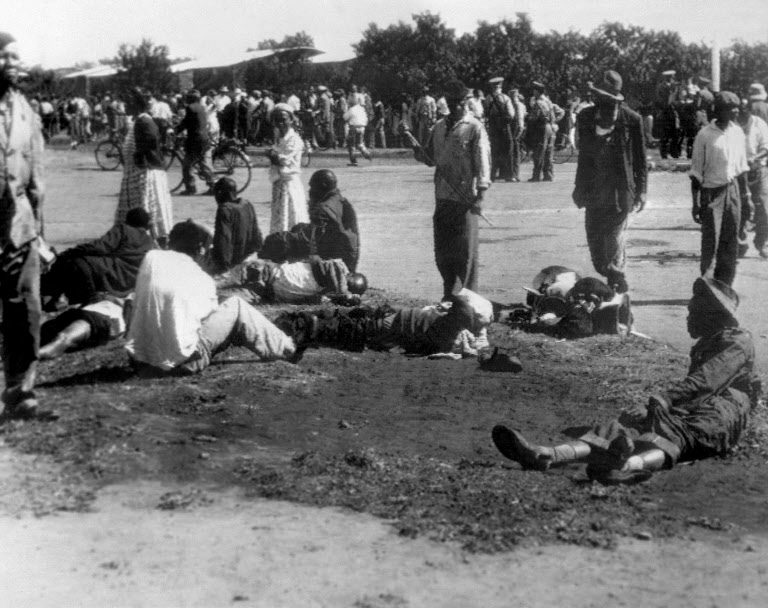
Wounded people lie in the street, 21 March 1960 in Sharpeville, near Vereeniging, where at least 180 black Africans, most of them women and children, were injured and 69 killed, when South African police opened fire on black protestors. The protest was organized by the Pan Africanist Congress (PAC) against pass laws, which required all blacks to carry pass books (identity cards) at all times. On 30 March 1960, the government declared a state of emergency, detaining more than 18,000 people. The Sharpeville massacre led to the banning of the ANC and PAC and signalled the start of armed resistance in South Africa with the foundation of Umkhonto we Sizwe, the military wing of the ANC, and Poqo, the military wing of the PAC.
The law had effectively extinguished all legal claims arising from the massacre and infringed the plaintiffs' constitutional right to access courts, it said in a statement.
While apartheid-era police records indicate 69 people were killed and at least 180 wounded in the massacre, the statement said subsequent research found at least 91 people were killed and more than 238 wounded.
Many were shot in the back as they tried to flee.
Apartheid officially ended with the first all-race election in 1994.