
Nepal toll surges as rescuers struggle through 'unimaginable' disaster
Rescue teams are in a race against time in treacherous conditions to free around 100 hydropower workers believed trapped in multiple tunnels -- digging, drilling and blasting through debris.
This handout photograph taken and released by the Nepal Army on August 31, 2026, shows Army personnel conducting a search and rescue operation at a tunnel site of the Rasuwagadhi Hydropower project in Rasuwa. (Photos by Handout / NEPAL ARMY / AFP)
________________
NUWAKOT — Rescuers struggled on Monday through mud and debris for a sixth day, as the number of missing people soared to nearly 4,500 since tsunami-like glacial floods roared down from the China-Nepal border, creating an "unimaginable" disaster.
The latest confirmed death toll surged above 900, with unidentified bodies buried in mass graves after DNA sampling.
The huge wave of freezing water, rocks and debris that smashed into villages and towns on Wednesday killed at least 939 people in Nepal and in Tibet, in China, with at least 17 bodies also pulled from rivers downstream in India.
Nepali Prime Minister Balendra Shah, in a statement on Sunday, called the disaster "unimaginable and heartbreaking".
Rescue teams are in a race against time in treacherous conditions to free around 100 hydropower workers believed trapped in multiple tunnels -- digging, drilling and blasting through debris.
So far, three dead bodies have been pulled out of two tunnels, and the teams have found routes blocked with mud.
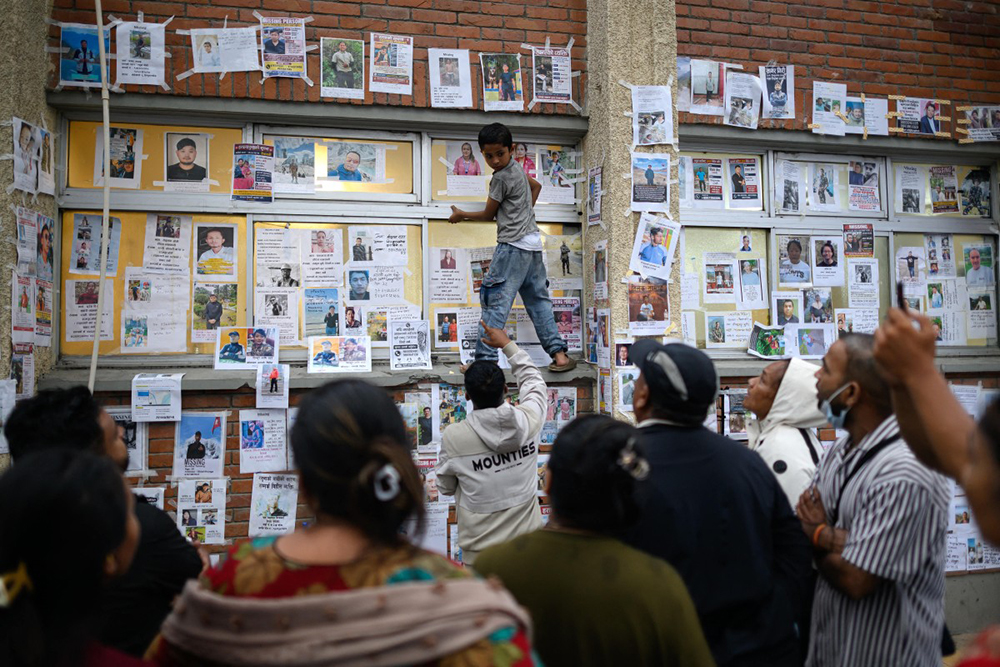
A young boy (C) climbs on a ledge to paste photographs of missing persons in the aftermath of flash floods, at the Tribhuvan University Teaching hospital in Kathmandu on August 31, 2026.
An Indian army officer deployed as part of a specialised tunnel rescue team said rescuers were digging through "sludge". He told AFP he was "still hopeful" there were survivors inside.
Amid the horror, there has been some hope; a six-year-old pulled out of the mud on Friday was reunited with her parents after police found her crying for her mother.
"Her body was trapped in mud, but her head was outside," Nepali Armed Police spokesman Netra Bahadur Karki told AFP.
"She is out of danger and recovering at a hospital and has reunited with her family."
'Changing climate'
The disaster was sparked by a glacial collapse, the US Geological Survey said.
While the exact cause of that collapse is unclear, climate change is causing glaciers to melt worldwide, raising the risk of such disasters.
Nepali Foreign Minister Shisir Khanal said: "The people of Nepal are one of the major victims of the changing climate and its impact."
Scientists say the Himalayas, the world's highest mountain range, are melting faster as global temperatures rise.
Aid needs are enormous. Entire communities have been swept away, leaving families homeless in heavy rain or sheltering in temporary facilities.
"This is an unfolding disaster," UN children's fund official Abiodun Banire told AFP, saying the needs of the tens of thousands impacted were vast.
Roads have been washed away, power plants destroyed and dozens of bridges smashed.
"There are too many challenges," said E. Hawadi, a police officer coordinating rescue efforts in the badly affected Nuwakot district.
"There are no roads; they have all been washed away, and many areas are just not accessible," he told AFP on Monday.
Overflowing mortuaries
With mortuaries overflowing with the dead, Nepal has begun burying some of the hundreds of bodies recovered after taking DNA samples so families can later retrieve them.
Distraught families, desperate for news of missing relatives, are watching images of bodies on screens at community centres in a bid to identify the dead.
Shobha Adhikary, in the southern Nepali city of Bharatpur, told a local coordinator she believed one image showed her childhood best friend."It looks like him, for sure," she said, showing a photograph of a smiling, middle-aged man.
Among Nepal's list of the missing are 592 foreigners, including tourists who had come for trekking in its mountains, as well as Hindu pilgrims seeking spiritual peace at Tibet's sacred Mount Kailash.
'Billions of dollars'
In China, Tibet is largely inaccessible to foreign journalists, and Chinese authorities are the only source of information.
More than 2,000 personnel are part of rescue operations there, but they have faced intense challenges and are slowly advancing towards the epicentre of the disaster.
China has said 16 people died in Tibet, with 546 people missing.
Tibetan advocacy groups in exile have questioned China's account of the disaster.
Tencho Gyatso, president of the International Campaign for Tibet, called for China to disclose "complete and verifiable information about the damage and casualties".
Beijing's foreign ministry said on Monday that the "release of information has been open, transparent and timely", and rejected international reports that it is underreporting deaths.
In Nepal, the disaster agency recorded the total number of people missing on its side of the border at 3,925 — revising an earlier number — with 939 bodies recovered.
Nepal's economy is already under pressure, and foreign governments have pledged millions of dollars in humanitarian aid.
Kathmandu warns that the reconstruction bill could run into "billions of dollars".