
Hitler's Austrian birthplace transformed into police station
"I believe that the opening of the police station today brings clarity to the discussion, perhaps also a bit of calm for the people of Braunau," the mayor said, in a ceremony also attended by Interior Minister Gerhard Karner.
Picture taken on July 16, 2026 shows a prison cell inside the listed building of the birth house of former German dictator Adolf Hitler that is turned into a police station, in Braunau am Inn, Austria. (Photos by AFP)
________________
Austria opened a new police station in Adolf Hitler's former house on Wednesday, in the hope of deterring today's ascendant far-right extremists from making the pilgrimage to the Nazi dictator's birthplace.
In a ceremony to mark the opening, Johannes Waidbacher, mayor of the small town of Braunau-am-Inn, said he hoped the transformation would show that the local community is "confronting its history, that it is assuming responsibility".
The decision to turn the house into a police station follows a long and delicate debate over what to do with the site, in a country often criticised for not taking full responsibility for its role in the Holocaust.
"I believe that the opening of the police station today brings clarity to the discussion, perhaps also a bit of calm for the people of Braunau," the mayor said, in a ceremony also attended by Interior Minister Gerhard Karner.
Around 100 people watched an orchestra play in the house's courtyard, including around 30 officers in uniform -- though few local residents made the trip.
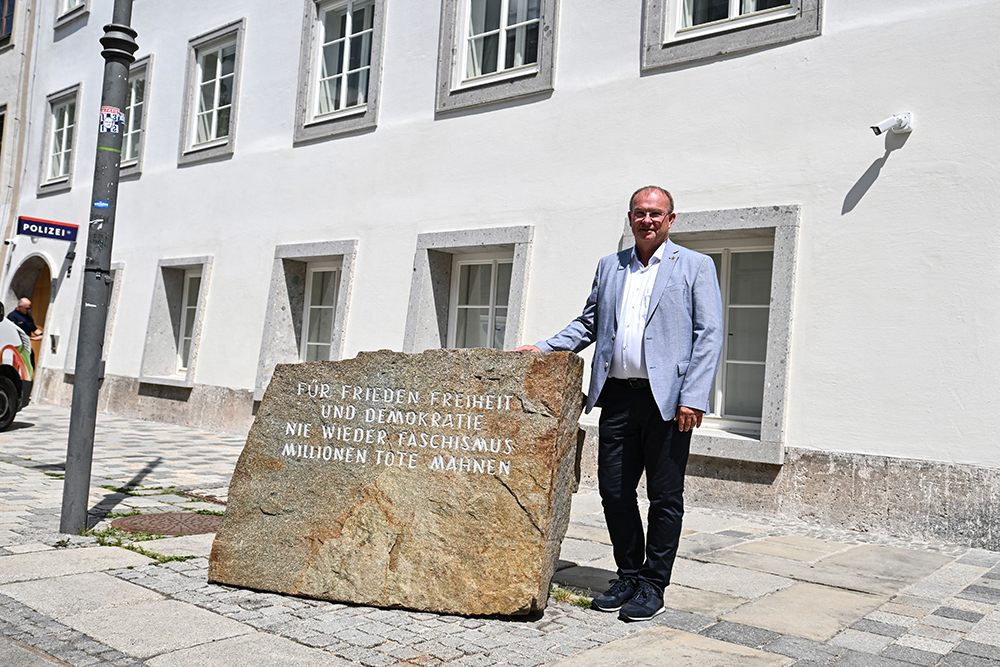
Braunau’s mayor Johannes Waidbacher poses on July 16, 2026 next to a commemoration stone with the inscription "For peace in freedom and democracy.
After a 20-million-euro ($23-million) refurbishment finished three years behind schedule, the unassuming building where one of history's most notorious figures was born is all but unrecognisable.
'Place of democracy'
The roughcast yellow walls of the 17th-century home near the German border, where the future Fuehrer was born on April 20, 1889, have been whitewashed over by the Austrian architecture firm Marte.
A police sign hangs above the entrance, while the pavement still bears a memorial stone with the inscription: "For Peace, Freedom and Democracy. Never Again Fascism. Millions of Dead Warn."
Interior Minister Karner said that from now on the house would be "a place of democracy, of the rule of law, of security, of freedom, and of human dignity".
"And at the same time... the memory does not disappear, nothing is covered up. The memorial stone in front of this house, hewn from the granite of the former Mauthausen concentration camp, remains in place," he said.
After Hitler's Germany annexed its Alpine neighbour in 1938, 65,000 Austrian Jews were killed and another 130,000 forced into exile.
But the country's most popular political party is now the far-right FPOe, which was founded by former Nazis. Around 37 percent of Austrians back the party, according to polling aggregator Europe Elects.
The house, which had been in the hands of the same family from 1912, was from 1972 leased to the Austrian state and used as a centre for disabled people, who were also among the Third Reich's victims.
Three years after Austria passed a law in 2016 to take control of the dilapidated building, the Supreme Court finally approved the 810,000-euro purchase of the 800 square-metre (8,600 square-foot) property.
'Humanity will not forget'
Demolishing the site was out of the question for historians. They urged Austria to face up to its role in the Nazis' murder of more than six million Jews, along with Roma, LGBTQ people and communists.
An expert commission decided to make it a police station, with the Austrian government insisting that would "clearly show" that no commemoration of Nazism would be acceptable and would "neutralise" the site.
"But that's absurd: humanity will not forget where the worst mass murderer in history was born," Robert Eiter, spokesman for the Mauthausen Committee Austria, an association of escapees from the concentration camp, told AFP.
"And this renovation will not prevent a single neo-Nazi from making the pilgrimage to Braunau."
Former Interior Minister Wolfgang Peschorn, in office at the time of the decision, said Wednesday that putting a police station "tasked with... safeguarding the rule of law" in the house was "the clearest sign of a democracy".
But Florian Kotanko of Braunau's Association for Contemporary History said he doubted the conversion would end the controversy.
"Braunau will always be associated around the world with the town where Adolf Hitler was born... This is not the end of the story," he told AFP.