
European concern grows over maritime security in the Strait of Hormuz
Earlier Monday, British Prime Minister Keir Starmer said Britain does not support U.S. President Donald Trump's proposed blockade of the Strait. The developments underscore a broader European stance that backs reopening the waterway while stopping short of fully aligning with Washington's approach.
Closed pumps are seen at a petrol station in London, Britain, March 26, 2026. (Xinhua Photo)
LONDON - Britain and France said Monday that they will co-host a meeting this week on maritime security in the Strait of Hormuz, as European concern grows over the waterway's closure and its economic fallout.
Earlier Monday, British Prime Minister Keir Starmer said Britain does not support U.S. President Donald Trump's proposed blockade of the Strait. The developments underscore a broader European stance that backs reopening the waterway while stopping short of fully aligning with Washington's approach.
Despite "some considerable pressure," Britain would not be "dragged into the war" that is not in its national interest, Starmer told the BBC. French President Emmanuel Macron said France and Britain will convene countries willing to contribute to a peaceful, multinational mission to restore free navigation, stressing such a mission would be strictly defensive and separate from parties to the conflict.
The two moves are consistent with Europe's earlier messaging. Since the start of the war, European governments have broadly called for freedom and safety of navigation in the Strait of Hormuz while resisting pressure to endorse the U.S. proposal to seal it off.
Common concern, different lines
Britain has sought to draw a line between defensive support and offensive involvement. Starmer regards it as his duty to assess Britain's national interest and has ruled out backing offensive strikes or a blockade.
France has taken an even sharper legal and diplomatic stance. Since the outset of the conflict, Paris has said it was not consulted and is not part of the U.S.-Israeli military offensive. Macron said that using force to "free" the Strait was unrealistic and would not provide a lasting solution to the Iranian nuclear issue.
Italy has also aligned with the broader European position. Rome has backed freedom of navigation and safe commercial passage but insisted on de-escalation, diplomatic dialogue and a multilateral framework. Italy's Foreign Ministry has said any participation in a wider initiative would require a clear UN mandate.
Portugal has voiced support for freedom of navigation, a ceasefire and diplomatic efforts while stopping short of military involvement. Lisbon has allowed the United States to use Lajes Air Base for logistical support, but Portuguese officials say the country will not take part in military action in the Middle East or join any combat deployment.
The Netherlands has kept its options open but has not committed to Washington's approach. Dutch Defense Minister Dilan Yesilgoz-Zegerius said that her country is working with allies to examine possible military options to help restore shipping, and that no concrete decisions have been made, and any move will depend on clearer needs.
From northern Europe, Finnish President Alexander Stubb said Monday that he could not predict the outcome of the war or how the Hormuz issue would evolve, voicing hope that a ceasefire will hold.
What has emerged is not a single European line in every detail, but a shared reluctance to turn maritime security into support for a U.S.-led blockade.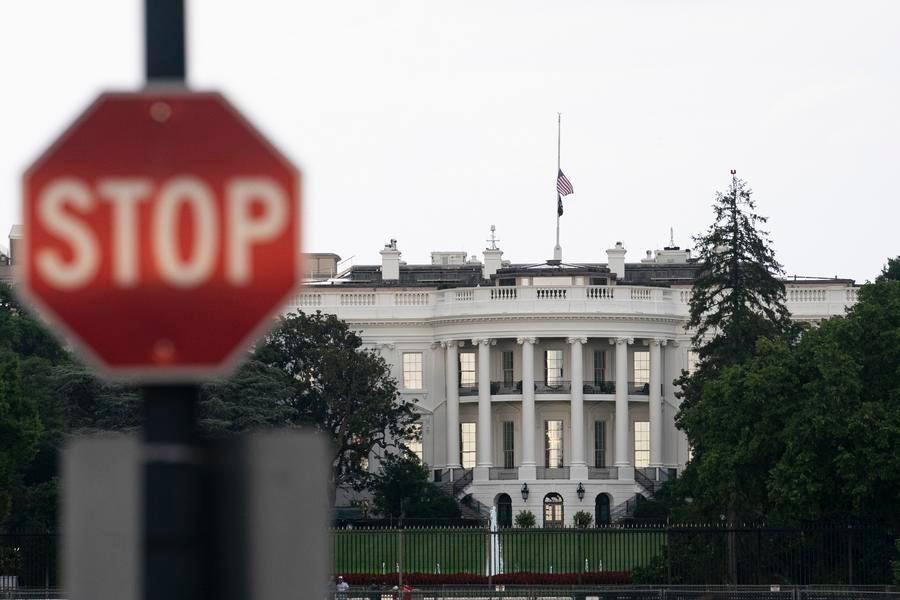
This photo taken on August. 4, 2022 shows the White House and a stop sign in Washington, DC, the United States. (Xinhua photo))
Europe's preferred response has centered on diplomacy, multilateral coordination and narrowly defined security arrangements.
Iain Begg, a professor at the London School of Economics and Political Science, told Xinhua that Britain has sought to lead diplomatic efforts bringing together European countries and Gulf states. In his words, there is "clear exasperation" with the United States.
Ian Scott, an expert in U.S. politics at the University of Manchester, said Britain appears to be at the forefront of keeping European partners on a simple line: the strait must be reopened because its closure harms all.
He said that was "no small feat" at a time when European governments had responded differently to the conflict.
France has paired that effort with broader diplomatic outreach. Last week, Macron called for a "strong, lasting" solution in a phone call with Turkish President Recep Tayyip Erdogan, urging intensified diplomacy and saying no effort should be spared to reach a durable settlement.
The French debate has also reflected a broader political shift. Sylvie Kauffmann, a columnist at Le Monde, wrote that Europe's refusal to join Washington in the current Middle East war shows the transatlantic rift now runs deeper than during the 2003 Iraq crisis.
In her view, Europe's reaction is not only technical or military, but deeply political.
The Dutch government said it is working with allies, including Britain, France and Germany, on ways to help restore shipping in the strait. The language underscores caution: restoring movement, not endorsing escalation.
Portugal has backed ceasefire efforts and welcomed mediation. After the temporary ceasefire between the United States and Iran, Lisbon applauded the development and thanked the mediating parties, including Pakistan.
Portuguese historian Rui Lourido said Europe's partial divergence from Washington is consistent with a long-standing diplomatic tradition based on multilateralism, balance and the aim of "maintaining order."
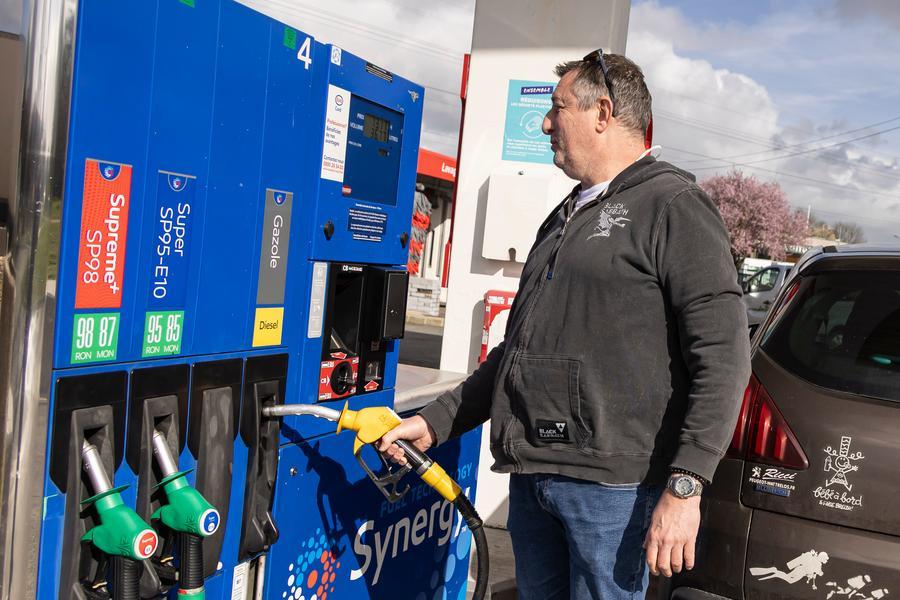
A man refuels his car in a petrol station in Villeneuve d'Ascq, north France, on March 11, 2026. (Xinhua Photo)
Not following Washington
If Europe's rhetoric has centered on freedom of navigation, its restraint reflects a broader set of concerns, notably an economic one.
Begg said Britain, like other European countries, is dismayed by restrictions on navigation through the strait but sees the issue primarily as economic, given the risk of renewed inflation driven by higher energy prices.
That concern runs across the continent.
In Italy, Prime Minister Giorgia Meloni warned that if Iran were to gain the ability to impose additional transit duties through the strait, the result could be "unpredictable economic consequences."
The Rome-based Istituto Affari Internazionali said a prolonged Iran-Israel confrontation could push oil and gas prices to unprecedented levels, making renewed diplomacy an urgent strategic and economic priority for Europe.
In Bosnia and Herzegovina, economic analyst Admir Cavalic depicted the shock as "primarily an energy issue and consequently an economic one." Higher oil prices would fuel inflation, lower living standards and reduce economic competitiveness, he told Xinhua.
Another factor is legal and strategic caution.
John Bryson, a professor at the University of Birmingham, said Starmer does not want to see Britain involved in actions that could be seen as offensive military operations.
Access to international waters, he said, should remain protected and open to all.
Bryson also linked the crisis to a broader British reassessment. In his view, the conflict has exposed Britain's vulnerability to oil and gas disruptions and years of underinvestment in defense, including the Royal Navy.
There is also a political dimension to Europe's caution: many capitals do not want to be drawn into a conflict they did not shape and that may not serve their interests.
Begg said the United States and Israel launched the war without consulting NATO partners, yet Washington later expected Britain to help address the Hormuz issue. He said it is difficult to see how a U.S. blockade would resolve the problem, though Britain has signaled limited willingness to assist with de-mining.
Nenad Stekic, senior research fellow at Serbia's Institute of International Politics and Economics, said Europe's posture reflects a tension between declared values and material interests, and that its divergence from Washington is partial rather than complete.
In his view, Europe has not fully aligned with the United States due to pressure from energy security, geopolitical risk and economic interdependence.
Europe, he argued, cannot absorb the shock of disrupted Iranian oil at low cost, fears wider instability on its southern flank, and has commercial interests in Iran affected by U.S. sanctions.