
China urges Global South journalists to tell new stories of a changing world
Against these global changes, Hong said Chinese President Xi Jinping has put forward the Global Development, Global Security, Global Civilization, and Global Governance initiatives.
Hong Lei, the Assistant Foreign Minister of the People’s Republic of China. Courtesy photos
The world is undergoing “once-in-a-century transformations” as global challenges multiply, multilateralism comes under severe strain, and economic tensions deepen, China’s Assistant Foreign Minister Hong Lei has said.
Hong noted that a governance deficit has become more prominent, pointing to tariff barriers and efforts by “a certain country” to push economic decoupling among the challenges confronting the world.
He made the remarks on Tuesday at Renmin University of China in Beijing while officially opening the second half of the 2026 China International Press Communication Centre (CIPCC) programme, which has brought together 109 journalists from 101 countries for a four-month media exchange.
Against these global changes, Hong said Chinese President Xi Jinping has put forward the Global Development, Global Security, Global Civilization, and Global Governance initiatives.
He explained that the initiatives place economic development as the goal, security and harmony as safeguards, mutual learning between civilisations as a bond, and orderly governance as a pillar in building a community with a shared future for humanity.
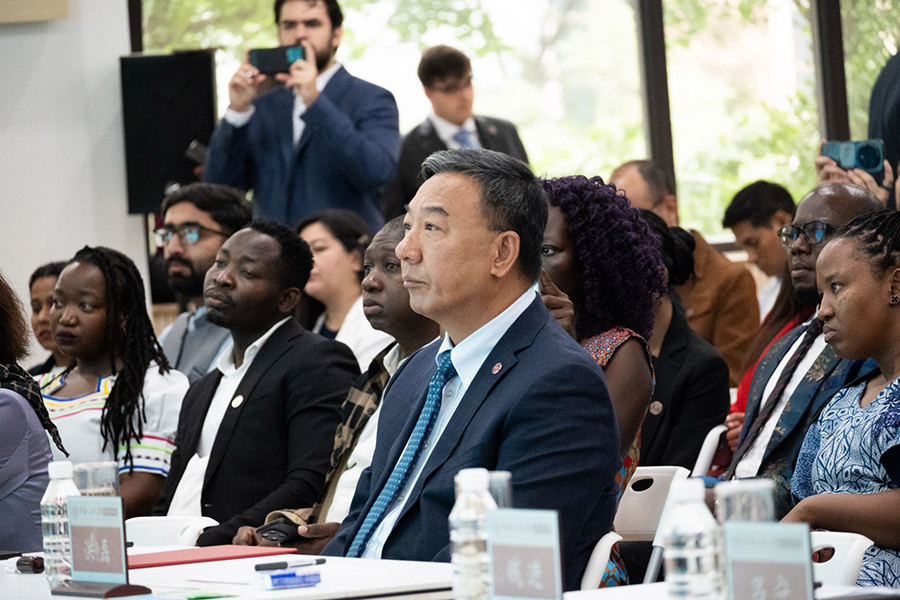
Dignitaries and participants
Together, Hong said, the initiatives are important public goods China provides to the world. They have injected positive energy into a turbulent and changing international environment and received wide endorsement and support from the international community.
As a member of the Global South, he added, China stands firmly with other developing countries and shoulders the responsibility of upholding shared interests and promoting common development.
“China proves through concrete actions that our development is not a closed-door endeavor,” Hong said, describing it instead as a process of sharing opportunities with the rest of the world, particularly fellow developing countries, while practicing multilateralism and working to reform global governance.
He also pointed to the upcoming APEC Economic Leaders’ Meeting in Shenzhen, which will be held in just over two months.
By hosting this major Asia-Pacific economic cooperation event, Hong said, China will bring fresh impetus to regional economic integration, expand the depth and substance of the Asia-Pacific community with a shared future, and contribute to the development of the region and the wider world.
Beyond China’s diplomatic and economic message, Hong challenged the journalists to look more deeply at the experiences of countries across the Global South and bring those stories to wider audiences.
He urged them to highlight the “vivid practices” of Global South countries advancing modernization together and to allow the world to hear the voice of South-South cooperation.
He also called for greater mutual respect and learning across cultures and civilizations, saying dialogue between civilizations should continue.
The call comes as the journalists participating in the CIPCC programme prepare to spend the next four months observing China more closely.
Tong Xiaoling, Vice President of the China Public Diplomacy Association, said that in a world experiencing profound shifts and intertwined global challenges, differences in perceptions and narratives among countries remain.
She emphasized that news media play an important role as bridges across national borders and as bonds connecting peoples.
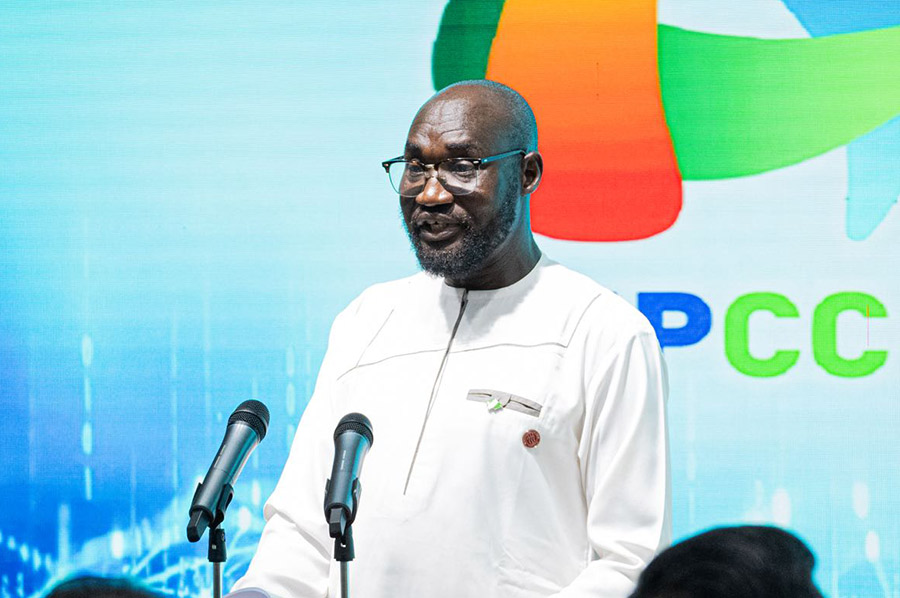
Mark Longyen of the News Agency of Nigeria (NAN)
She argued that stereotypes should be replaced by on-the-ground observations and global narratives enriched by diverse perspectives.
The CIPCC has been providing such opportunities for more than a decade.
Over the past 12 years, the centre has invited journalists to China for training and field visits, giving overseas media professionals opportunities to observe and document the country firsthand.
Successive generations of journalists have traveled across China and reported on its development, people-centered vitality, and cultural heritage.
Launched in 2014 with nine journalists from Africa, the CIPCC has expanded over the years to include participants from the Asia-Pacific, Latin America and the Caribbean, Eurasia, the Arab world, and Central and Eastern Europe.
Professor Zhang Donggang, Secretary of the CPC Renmin University of China Committee, said journalists are the observers and chroniclers of their times.
Through cameras, he said, they capture reality, while through words they foster understanding. They turn fragmented information into verifiable facts and voices from around the world into subjects for shared discussion.
At a time of geopolitical clashes, perception gaps, and information overload, Zhang said journalism is needed more than ever to promote communication grounded in truth, reason, equality, and mutual respect.
For Mark Longyen of the News Agency of Nigeria, who spoke on behalf of the participating journalists, the opportunity is about going beyond conventional narratives.
The journalists, he said, are in Beijing not just for training but to listen, learn, ask questions, and build bridges between people.
“We want to travel beyond the headlines,” Longyen said.
He explained that participants want to meet ordinary Chinese people, visit institutions and communities, and engage experts and officials in order to understand China’s development story, economy, culture, technology, diplomacy, and media landscape from the inside.
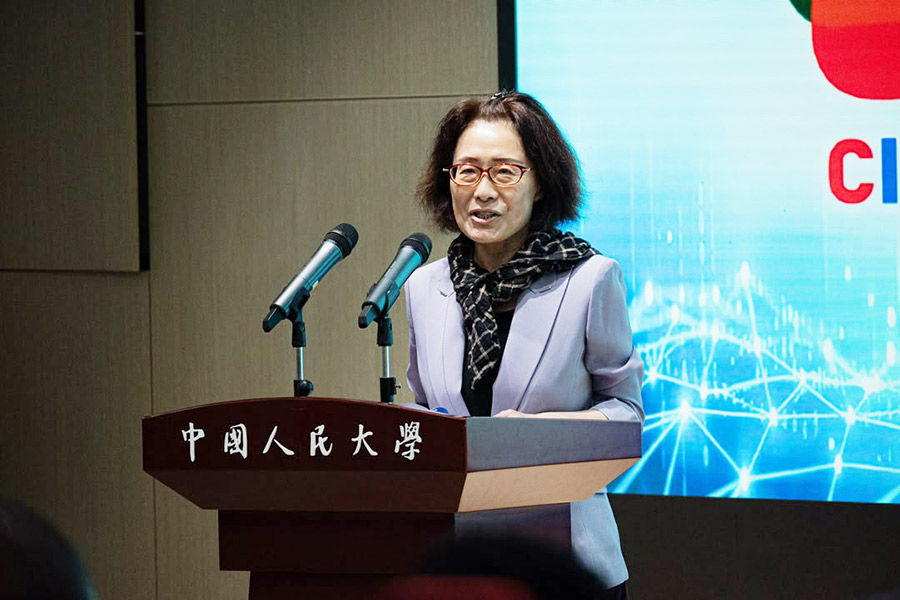
Tong Xiaoling, the Vice President of CPDA
They also want to see for themselves both the opportunities and challenges of China’s transformation.
Longyen said journalists should not simply repeat what they are told but should observe, investigate, verify, and tell stories that help audiences make sense of a changing world.
“As African journalists, we come to China with open minds, ready to learn, to engage, and to share our experiences,” he said.
For him, good journalism means promoting understanding without abandoning scrutiny, cooperation without abandoning independence, and friendship without abandoning truth.
Africa and China, he said, are increasingly intertwined in the pursuit of shared prosperity, making mutual understanding more important than ever.
He described China-Africa relations as one of the defining stories of the 21st century and noted that China’s new zero-tariff trade policy for Africa has brought the partnership into a new phase.
Across Africa, he said, Chinese-built roads, railways, telecommunications infrastructure, businesses, and educational exchanges have become increasingly visible.
China, he said, is no longer a distant country to Africans but a major economic, technological, and diplomatic partner.
At the same time, Africa is not merely a recipient. It brings resources, markets, a youthful population, ideas, innovation, and enormous development potential to the relationship.
Longyen said Africa is often presented internationally through a narrow lens of conflict, poverty, and crisis, while China can also be portrayed through simplified narratives that overlook its complexity.
He called for more African journalists to tell African stories about China and more Chinese journalists to tell Chinese stories about Africa.
Their responsibility, he said, is to report the successes, challenges, and disagreements while also telling the human stories behind China-Africa relations.
He further called for greater cooperation among Global South journalists through cross-border reporting, professional exchanges, and fact-checking partnerships.
As artificial intelligence transforms the media environment, he said journalists should embrace new technologies while protecting the core values of journalism: accuracy, independence, ethics, and public trust.
“Journalists are bridge-builders,” Longyen said.
An African journalist who learns Chinese, speaks with Chinese people, and understands Chinese history, he argued, can return home with deeper understanding. Likewise, a Chinese journalist who spends time in African communities can tell richer and more accurate African stories.
Mahendra Subedi, a journalist from the National News Agency in Nepal, described the CIPCC programme as more than a media exchange.
He called it a gateway into 5,000 years of Chinese civilization and an opportunity to observe global shifts, the emerging multipolar world, and the rising voices of the Global South.
Subedi said the platform can help advance South-South cooperation and regional integration by encouraging new narratives and critically examining existing imbalances.
He also highlighted China’s development experience, attributing it to the centralized, unified leadership of the CPC, a development path suited to China’s national conditions, reform and opening up, and a people-centered development philosophy.
He said development should remain at the center of the global policy framework, with continued attention to poverty reduction, infrastructure, education, and public health.