
Aid rations replace currency in South Sudan
"We are not on our land to plant for eating or even to make a living," Josephine Mathew told AFP.
Aid rations replace currency in South Sudan
________________
JUBA — In a market in the refugee settlement of Bazia in South Sudan, stalls are piled high with containers of aid rations. Everyone ignores the fact that they are stamped with "Not for sale".
The hundreds of thousands of people displaced by conflict in South Sudan are increasingly forced to sell part of their rations to pay for basic needs at a time when the economy has almost entirely collapsed.
Josephine Mathew picks through her 10kg bag of sorghum rations, making two piles: a small one for her children's meal, and a larger one to sell at the market to pay for anti-malaria medicine and school fees.
"We are not on our land to plant for eating or even to make a living," the mother of three told AFP.
She was forced to abandon her farm and livestock last September by fighting between government and opposition troops in Western Equatoria State.
One of the world's poorest countries, South Sudan, has been mired in corruption and civil war for much of its existence since gaining independence in 2011.
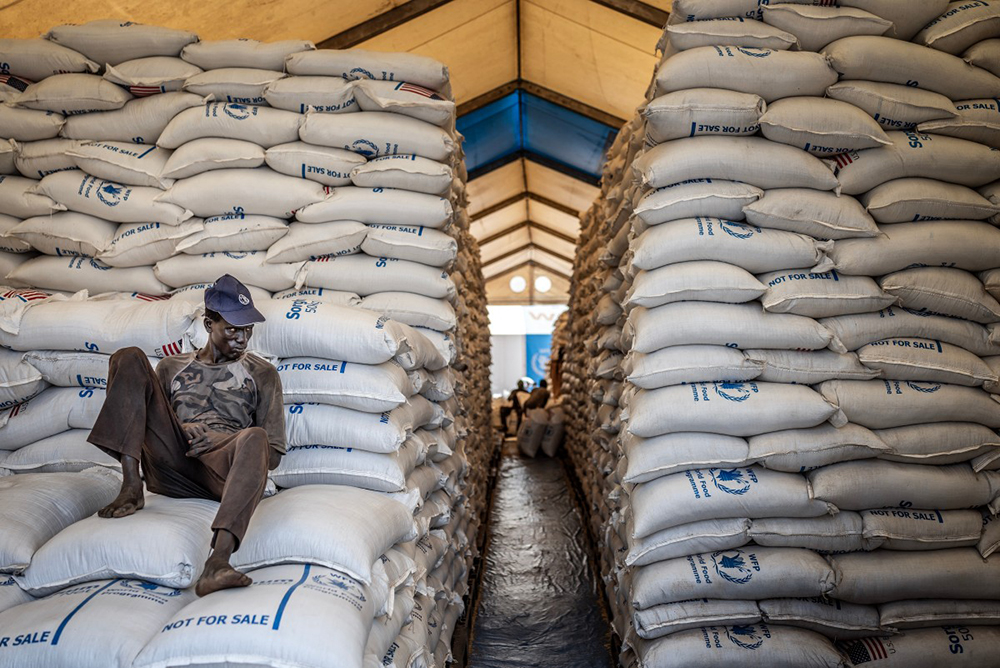
A worker sits atop sacks of food aid in a hangar where supplies are piling up because deliveries are halted due to insecurity from the conflict, at a World Food Programme (WFP) warehouse in Bor, Jonglei State, on February 13, 2026.
The South Sudanese pound is the weakest currency in Africa, according to the World Bank, and with inflation running at nearly 100 percent last year, people place little trust in it.
"Cash evaporates instantly," Mathew said.
The only thing that keeps its value for Mathew is the food aid she receives from a charity called the Mary Help Association, and she often joins others haggling at the market to sell part of her rations.
'Tools for survival'
South Sudan has substantial oil reserves, but its coffers have been systematically looted by elites, according to a recent United Nations report.
It said President Salva Kiir's personal medical unit received more funding than the entire national health system, meant to serve 12 million people.
"When recipients are given in-kind assistance that does not match their most pressing or full range of needs, they resort to selling what they receive as an act of survival," added a representative with CALP, a network of humanitarian cash experts.
When US President Donald Trump ordered the shutdown of aid agency USAID last year, South Sudan lost a huge chunk of its humanitarian support at a time when nearly two-thirds of the population -- some 7.9 million people — face acute hunger.
Even in relatively conflict-free areas around Bazia, families now receive food rations only once every two months, said Anne Thomas, a volunteer with a church-led medical programme supported by Mary Help Association — and nothing from the state.
"The government just speaks about support, but it is not done," she told AFP.
The scarcity only makes those rations more valuable.
"The maize flour and peanut butter paste can last and resist the economic situation," Gai Kuereng, a young trader at Konyo Konyo Market in the capital Juba, told AFP.
He sources his stock from his cousin in Jonglei State, a hotspot of recent fighting between government and opposition forces.
"If I have the maize and grain, I have the power," he said.