
How educators champion wildlife conservation
Addressing the media at UWEC, Musingo observed that growing urbanisation had left many young people increasingly disconnected from nature and Uganda's rich biodiversity.
David Musingo (centre), the commissioner for community conservation and ex situ wildlife services with his subordinate wildlife officers during the celebration of International day of wildlife educators at UWEC, on Thursday. (Photos by Julius Luwemba)
________________
In January this year, four rhinos were transferred to Ajai Wildlife Reserve in the West Nile region, before another four were translocated to Kidepo Valley National Park in March. Rhinos had become extinct in both protected areas following the country's past civil unrest and poaching.
On both occasions, a team of conservation educators led by Phillip Katabulawo was dispatched from the Uganda Wildlife Conservation Education Centre (UWEC) in Entebbe to support their colleagues in the regions during the conservation activities.
The team travels in a rig van fitted with LED screens that display conservation messages through audio-visual material. The vehicle makes several stops at trading centres along the way, where the educators engage communities on the importance of wildlife conservation.
The educators spend weeks interacting with communities, sensitising residents about wildlife conservation and how people can coexist with fauna within the same ecosystem. These efforts have reportedly contributed to a reduction in human-wildlife conflict cases from 6,557 in the previous financial year to 4,290, a decline of 2,267 cases.
International Day of Zoo and Aquarium Educators
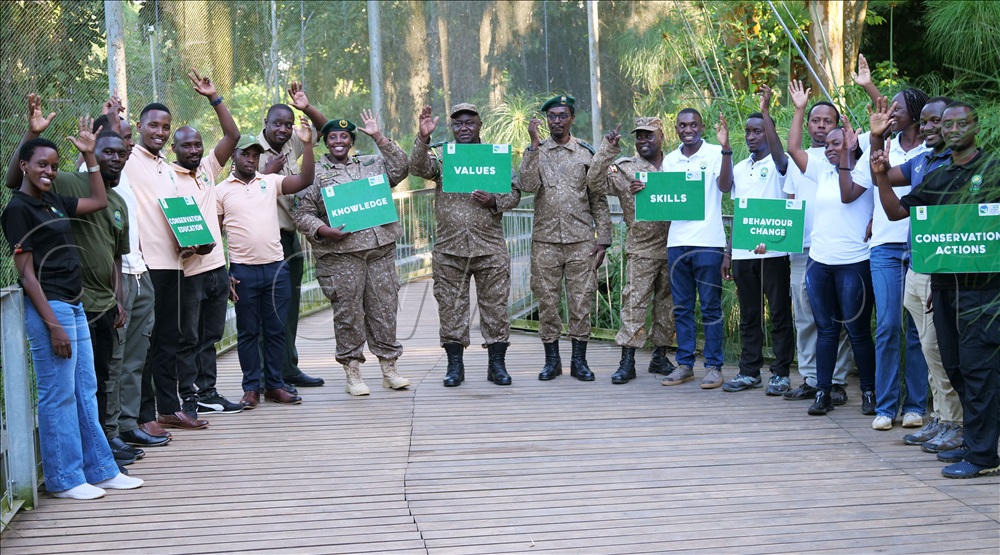
Some of the wildlife educators at UWEC during the celebration of their day on Thursday
The day was established by the International Zoo Educators Association (IZE), an organisation founded in 1972 to connect conservation educators globally. It was first celebrated in 2018.
David Musingo, the Commissioner for Community Conservation and Ex Situ Wildlife Services at the Uganda Wildlife Authority (UWA), said the day gives conservation educators an opportunity to reflect on what has been achieved and plan for what remains to be done.
"I am a former board member of the IZE and was part of the team when this day was designated to be celebrated every year. The day is important for us, as the people who empower the communities and the general public with knowledge and skills, as well as connecting people to nature," Musingo explained.
Addressing the media at UWEC, Musingo observed that growing urbanisation had left many young people increasingly disconnected from nature and Uganda's rich biodiversity.
Musingo also pointed to initiatives such as children's zoos at conservation education centres, where young visitors interact with small animals, including domestic species, to develop an appreciation of wildlife.
Vanice Mirembe, UWA's assistant commissioner in charge of conservation education and awareness, emphasised the role of conservation educators in mitigating human-wildlife conflicts.
She said conservation educators stationed across protected areas visit communities to speak to residents about conservation.
She also referred to a national conservation education strategy that tasks educators with reaching out to schools and other learning centres to nurture an interest in conservation among young people from an early age.
UWA executive director Dr James Musinguzi also highlighted the role of conservation educators, noting that they help visitors and communities connect with wildlife, understand the relationship between people, wildlife and the environment, and appreciate the value of coexistence. This, he said, leads to positive actions and responses towards conservation.
A wildlife conservation success story does not end with animals returning to their natural habitats. It also depends on whether the people living alongside them are willing to embrace their presence.
While conservationists celebrate the restoration of species, residents often worry about the potential threat to their crops, livestock and even lives. Bridging this divide has become a critical responsibility for Uganda's conservation educators, whose efforts to change community attitudes are contributing to improved human-wildlife coexistence.