
Sh700m Absa KH3 7 Hills Run proceeds to help more girls stay in school
The funds will support eight organisations working with girls and communities across Uganda to address barriers to education for the most vulnerable.
The Absa KH3 Run beneficiaries representatives pose with Absa MD David Wandera (standing-center) and other bank staff after handing them proceeds from the run at the bank. Photo by Michael Nsubuga
The sh700m raised through the 2026 Absa KH3 7 Hills Run will enable programs supporting vulnerable girls’ education to expand to more regions across Uganda.
The funds will support eight organisations working with girls and communities across Uganda to address barriers to education for the most vulnerable.
The money distributed at Absa Bank headquarters on Thursday will be used for school fees, learning materials, bicycles for girls who travel long distances, support for teenage mothers returning to school, improved water and sanitation, inclusive education for students with disabilities, counselling and mentorship, vocational and life skills training, and strengthening school support systems.
The beneficiaries are the Uganda Red Cross, World Vision Uganda, Amref Health Africa, and Plan International, each receiving sh100m. Windle International Uganda and Baylor College of Medicine Children’s Foundation-Uganda received sh90m each, while Ride-Africa and Kyaninga Child Development Centre received sh60m each. Representatives included Dr. Robert Kwesiga, National Director Jeremiah Nyagah, Dr. Patrick Kagurusi, Mane Nassiwa, Phoebe Kasoga, Andrew Omara, Steven Williams, Sam Rukidi and the Hash Master Alice Gitta Okecho.
At the handover, Absa managing director David Wandera noted that by 2024, the initiative had raised approximately sh900m and supported about 21,000 girls, marking the start of their efforts. He expressed excitement about this year’s run, which saw strong participation from corporations and over 40 organisations, collectively raising sh700m for eight partners.
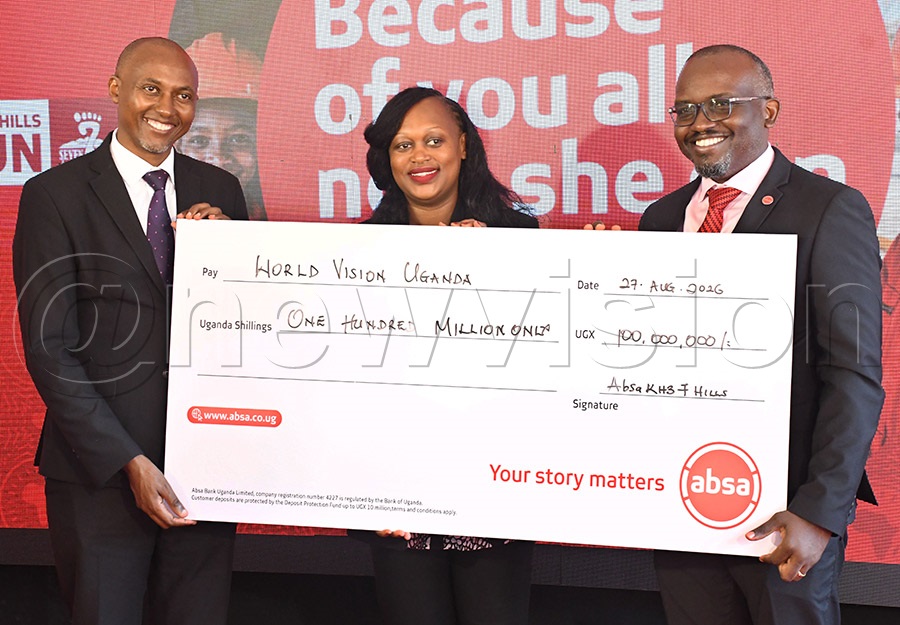
Absa Bank MD David Wandera (right) presents a sh100m cheque to the World Vision national director Jeremiah Nyangah (left) and his colleague at Absa offices, August 27, 2026. Photo by Michael Nsubuga
“They have successfully run programs, and we're happy to provide them with these funds to ensure girls can continue their education. Our goal is to address the disparity in school enrollment, where a recent 2024 study showed only an 8% enrollment rate for girls in poorer areas compared to 43% in urban areas,” Wandera said.
“We thank all our partners for their collaboration. We look forward to seeing more girls remain in school and their lives transformed. When a girl stays in school, she shapes her future and positively impacts her family, future generations, and her community. Her story matters. We are committed to ensuring that no girl's dreams are limited by lack of access to water or menstrual hygiene facilities and materials. Together, we can build a stronger community and a better society.”
The Uganda Red Cross Society will expand the Keep a Girl in School program by providing menstrual health kits to 10,000 vulnerable girls, delivering menstrual health education to 15,000 adolescents, teachers, and caregivers across 100 schools, and supporting 1,000 teenage mothers to return to school.
World Vision Uganda will improve menstrual health and hygiene management in Northern Uganda by increasing access to clean water, sanitation facilities, and safe learning environments for girls.
Windle International Uganda will support girls in refugee-hosting and hard-to-reach communities with scholastic materials, bicycles, dignity kits, counselling, and school reintegration, including for girls formerly living on the streets of Kampala who are now enrolled in schools in Napak District.
Amref Health Africa will distribute reusable sanitary pads and provide school reintegration support for teenage mothers who have dropped out in Mbale, Kibuku, and the island communities of Namayingo. Plan International Uganda will expand access to menstrual health kits, offer vocational skills training in sanitary pad production, sewing, and entrepreneurship, and supply vulnerable girls with scholastic materials.
RIDE-AFRICA will strengthen school and community support systems in Kitgum District through investments in water, sanitation and hygiene facilities, changing rooms, menstrual health initiatives, teacher training, school clubs, and life skills development.
Kyaninga Child Development Centre will support 100 girls with disabilities and help 18 schools provide more inclusive and accessible learning environments. Baylor College of Medicine Children’s Foundation-Uganda will support 1,000 vulnerable girls in Hoima, Mubende, and Fort Portal through education assistance, counselling, mentorship, vocational training, and early identification for girls at risk of dropping out. These interventions will address barriers at every stage of a girl's education, from enrollment and retention to re-entry and progression.
Uganda has made progress in expanding access to education, especially for girls, but children in poorer communities still face significant challenges.
A 2024 study by the Ministry of Education and Sports, the European Union, and UNICEF found that only 8.2% of children from the poorest households enrol in secondary school, compared to 43.1% from the wealthiest families. The study found that financial challenges are a major reason children miss school or drop out.
For girls, these challenges are often compounded by teenage pregnancy, long travel distances, gender-based violence, disability, and inadequate water, sanitation, and hygiene facilities. Over 8,000 participants joined the fourth Absa KH3 7 Hills Run in May 2026, building on an initiative launched in 2023 to support girls' education across Uganda.
Since its inception, the Absa KH3 7 Hills Run has raised a total of sh1.6 billion and helped 52,713 girls stay in school through investments in menstrual health, education access, school retention, and related interventions.