
Lugogo Sports Complex to take lion's share of sh266b NCS Capital Development Fund
The redevelopment of the complex is one of NCS's key priorities for the financial year 2027/28 and will take a large portion of the sh266b allocated for capital development.
NCS General Secretary Patrick Ogwel addresses association/federation heads during the budget conference at Lugogo. Photo by Michael Nsubuga
According to the Budget Framework Paper (BFP) presented by NCS General Secretary Patrick Ogwel at last week’s budget conference in Lugogo, the Lugogo sports complex will receive the largest portion of the 2027-28 capital development fund.
The redevelopment of the complex is one of NCS's key priorities for the financial year 2027/28 and will take a large portion of the sh266b allocated for capital development.
The redevelopment is partly intended to give the existing facilities a facelift to match international standards, while also boosting the potential economic benefits that international events can bring in terms of revenue, job creation, and investment.
The project, located in the upscale Kololo neighborhood, is expected to significantly boost non-tax revenue from sh10b annually to approximately sh80b.
According to Ogwel, Lugogo remains the historic and central operational nerve center for indoor national sports disciplines, necessitating persistent phased funding. He said resource allocation will target critical infrastructural upgrades, preliminary architectural reviews, and modernisation layouts to preserve asset value and increase commercial sustainability.
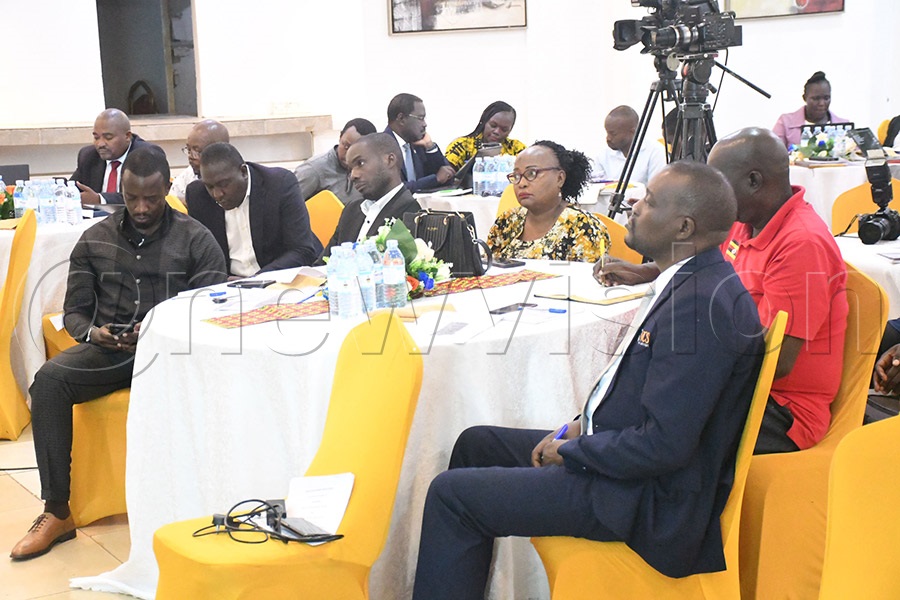
A cross section of association/federation heads during the budget conference at Lugogo. Photo by Michael Nsubuga
“We are planning significant developments at this site. We intend to establish a Global Sports Conference in the new 15,000-seat indoor stadium. The project will feature a four-star hotel with 60 rooms, a five-storey utility block, and parking facilities for 1,000 vehicles,” Ogwel said.
“Additionally, the complex will include a gymnasium with capacity for approximately 1,500 athletes, a dedicated area for national teams training, and a swimming pool. There will also be a hostel with 120 rooms for athletes, as well as a hockey pitch. The planning phase is complete, and we are now awaiting the project's conclusion,” Ogwel stated.
The other key priority areas for NCS is the ‘retooling project’ under which funding will address urgent technological and administrative infrastructure requirements within the council. This includes procuring essential ICT hardware, planning software, and specialised sports regulatory equipment needed to track performance metrics and improve institutional reporting.
Maintaining AFCON 2027 Stadia and Training Facilities is also top of the agenda. “With Uganda co-hosting the Africa Cup of Nations (AFCON) 2027, maintaining world-class infrastructural baselines is a matter of strict national compliance and pride,” Ogwel noted.
“Resources will fund preventive facility management, pitch engineering upkeep, and security systems across designated training grounds and new stadiums to ensure optimal readiness.”
He also highlighted NCS achievements in 2026-27, including registering and monitoring over 50 active national sports associations and federations and supporting national team engagements and international qualification pathways (including Uganda Cranes and Olympic/Commonwealth tracks).
NCS also monitored major infrastructural milestones, including the Phase II upgrades of Mandela National Stadium (Namboole) to 45,000 capacity, Hoima City Stadium works, and designated training facilities (Kyambogo, Wankulukuku, and Makerere).
They also executed recurrent subventions for federation administrative operations, coaching clinics, and anti-doping awareness as well as distributing sports equipment and talent-identification toolkits to regional clusters and local government structures at the grassroots.
Ogwel highlighted key challenges, including underfunding, inadequate infrastructure, weak commercialisation, and internal wage ceilings that are out of step with the expanding technical and regulatory footprint under the National Sports Act 2023, as well as escalating costs for international team travel, foreign-based player allowances, and specialised training camps.
“Severe budget shortfalls constrain international team travel, allowance disbursements, and grassroots talent pipelines, while there is limited modern, multi-disciplinary indoor and outdoor training facilities across local governments.”
“There is also low private-sector integration and monetisation of sports leagues, limiting self-sustainability for federations,” Ogwel stated.
Under the non-wage recurrent allocation of sh126b, operationalisation of Teryet National High Altitude Training Centre remains a top priority. “Translating Teryet into a fully active, high-yield elite training site requires dedicated funding for utility frameworks, elite athlete hospitality operations, track maintenance, and technical staff mobilization to tap into high-altitude conditioning advantages.”
“Activating the National Anti-Doping Organisation of Uganda (NADO-U) is an uncompromisable mandate under the World Anti-Doping Agency (WADA) compliance code. Funding ensures systemic drug testing, intelligence gathering, athlete education, and legal protection systems to safeguard Uganda from international sports bans,” Ogwel noted.
He said support to National Sports Federations and Associations will be based on regulatory performance benchmarks to assist sports governance, league sustainability, and grassroots tournaments.
“Earmarked funds will cushion the extensive operational overheads incurred by representative Ugandan clubs and national contingents qualifying for Continental and intercontinental championships and support Major International Games & Representative Clubs.
Ogwel told stakeholders that sport is a high-multiplier economic sector and a pillar of soft power; predictable funding yields high GDP returns and boosts youth engagement. He called on federations & associations to ensure compliance, transparency, and grassroots footprint as non-negotiable prerequisites for public funding.
He also urged the private sector and development partners to partner with NCS to commercialize leagues, adopt teams, and build sustainable sports infrastructure.