
US jury finds Meta, YouTube liable in social media addiction trial
The panel awarded $3 million in compensatory damages, assigning Meta 70 percent of the responsibility for the plaintiff's harm -- a $2.1 million share -- and YouTube the remaining 30 percent, or $900,000.
This photo illustration created on January 7, 2025, in Washington, DC, shows an image of Mark Zuckerberg, CEO of Meta, and an image of the Meta logo. A Los Angeles jury on March 25, 2026 found Meta and YouTube liable for harming a young woman through the addictive design of their social media platforms, ordering the companies to pay $3 million in damages and opening the door to potentially far larger punitive awards. (AFP/Files)
LOS ANGELES - A Los Angeles jury on Wednesday found Meta and YouTube liable for harming a young woman because of an addictive design of their social media platforms, ordering the companies to pay $6 million in damages, including $3 million in punitive damages.
The verdict hands plaintiffs in more than a thousand similar pending cases significant leverage -- and signals to the broader tech industry that juries are prepared to hold social media companies accountable for the mental health toll of their design choices.
The jury answered yes to all seven questions on verdict forms for both companies, finding that Meta and YouTube were negligent in the design and operation of their platforms and that their negligence was a substantial factor in causing harm to the plaintiff.
Jurors also found that both companies knew or should have known their services posed a danger to minors, that they failed to adequately warn users of that danger, and that a reasonable platform operator would have done so.
The panel awarded $3 million in compensatory damages, assigning Meta 70 percent of the responsibility for the plaintiff's harm -- a $2.1 million share -- and YouTube the remaining 30 percent, or $900,000.
In a second phase, jurors added a further $3 million in total punitive damages after finding both companies had acted with malice, oppression or fraud.
Both companies said they would appeal the verdict.
"This case misunderstands YouTube, which is a responsibly built streaming platform, not a social media site," Google spokesperson Jose Castaneda said.
A spokesperson for Meta said they "respectfully disagree with the verdict," adding that "teen mental health is profoundly complex and cannot be linked to a single app."
Nine of the 12 jurors further found that both companies had acted with malice, oppression or fraud, a finding that set the stage for the separate punitive damages.
The plaintiff, known in court documents by her initials K.G.M. and called Kaley at trial, began using YouTube when she was six, downloading the app on her iPod Touch to watch videos about lip gloss and an online kids game.
She joined Instagram at nine, getting around a block her mother had put in place to keep her off the platform.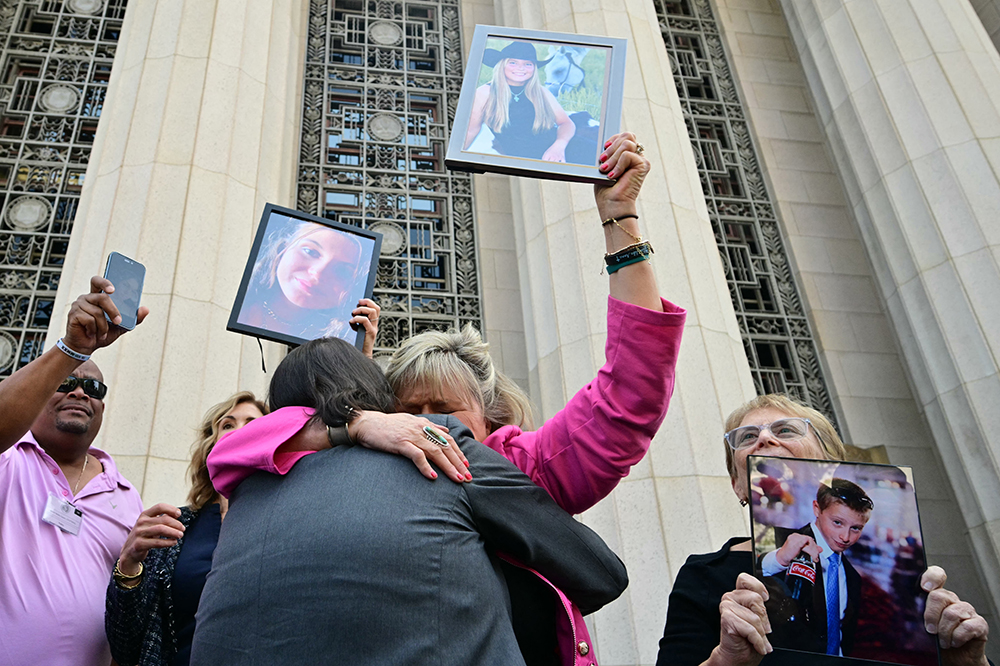
Relatives of victims, including Lori Schott (C), walk out of the Los Angeles Superior Court holding portraits of their loved ones in Los Angeles, on March 25, 2026. (Credit: AFP)
She told jurors that her near-constant social media use "really affected my self-worth," saying the apps led her to abandon hobbies, struggle to make friends and constantly measure herself against others.
In closing arguments, plaintiff attorney Mark Lanier cast the case as a story of corporate greed, saying that features like infinite scrolling, autoplay videos, notifications and like counts were engineered to drive compulsive use among young people.
'Existential' threat?
Meta and YouTube had maintained throughout the trial that Kaley's mental health struggles had nothing to do with their platforms.
Meta's lawyer pointed to her life at home and a turbulent relationship with her parents, while YouTube disputed how much time Kaley actually spent on its platform.
The jury rejected both defenses across all seven questions on each verdict form.
TikTok and Snap were originally named as defendants but settled on undisclosed terms before the trial got underway.
Two further bellwether trials are expected to follow in the same Los Angeles courthouse, with their outcomes likely to determine whether social media companies fight on or move toward a broader settlement, potentially including redesigning how their platforms work.
The penalty amounts are "a slap on the wrist for companies like Meta and YouTube, which are two of the biggest ad sellers in the world," said Jasmine Enberg of Scalable, who tracks the social media industry.
"But if these companies are forced to redesign their products, that poses an existential threat to their business models."
A separate New Mexico jury on Tuesday found Meta liable for endangering children by making them vulnerable to predators on its platforms and other dangers.
The state had sought the maximum $2.2 billion in damages, but the jury awarded a lesser amount of $375 million.