
Uganda launches National Data Strategy
The strategy targets investment in data infrastructure, governance, research, innovation and entrepreneurship, as well as the skills needed to turn data into practical solutions for national development.
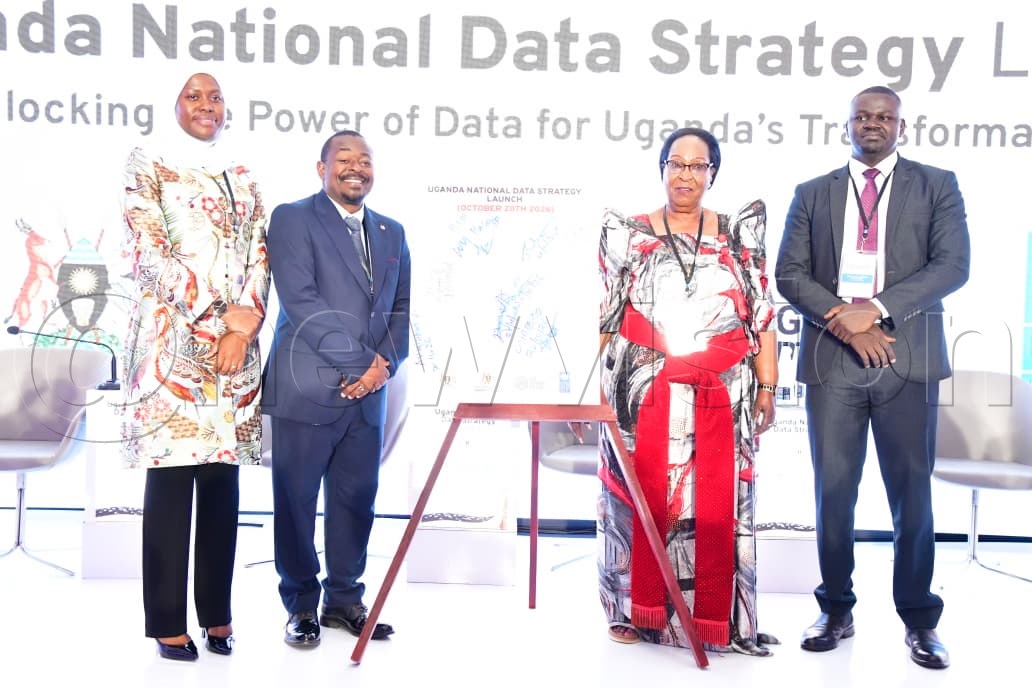
Minister of State for ICT and National Guidance Joyce Nabbosa Ssebugwawo presided over the launch of the Uganda National Data Strategy under the theme "Unlocking the Power of Data for Uganda's Transformation." (Photos: Mpalanyi Ssentongo)
The Government is looking for sh1.6 trillion over five years to implement a National Data Strategy aimed at improving data management, strengthening digital infrastructure and supporting Uganda’s ambition of growing its economy from $50b to $500b over the next 14 years.
Of the required funding, the Government expects to provide sh1.2 trillion, while sh333.6b is projected from the commercialisation of value-added data services. Development partners are expected to contribute sh55b and the private sector sh54b.
The strategy targets investment in data infrastructure, governance, research, innovation and entrepreneurship, as well as the skills needed to turn data into practical solutions for national development.
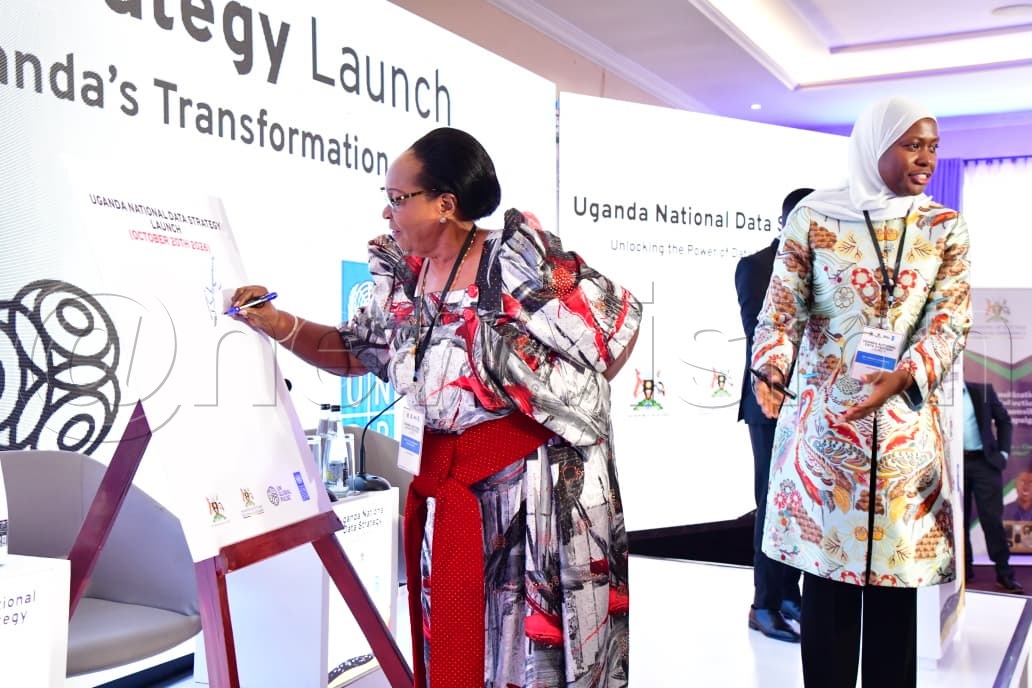
Minister of State for ICT and National Guidance Joyce Nabossa Ssebugwawo launched the strategy on behalf of the Government at Mestil Hotel in Kampala on Tuesday. The event was held under the theme, “Unlocking the Power of Data for Uganda’s Transformation”.
Dr Amina Zawedde, the permanent secretary of the Ministry of ICT and National Guidance, said the strategy was intended to improve how institutions manage and share information to support planning, public service delivery and economic transformation.
The funding framework allocates sh684.9b to data infrastructure, sh553b to data governance, sh319b to research, innovation and entrepreneurship, sh71.4b to strategic data utilisation and sh34b to people and culture.
Amos Mpungu, an assistant commissioner at the ministry, said the strategy was intended to address longstanding gaps in the availability and use of reliable data, which have made it difficult to assess the country’s development performance.
He said Uganda’s economy was growing at 6.3%, but achieving the tenfold growth ambition required better measurement of progress and more coordinated planning across key sectors.
The strategy anchors the growth agenda on agro-industrialisation, tourism development, minerals, oil and gas, and science, technology and innovation.
Mpungu said previous national development plans had faced challenges in measuring performance, not necessarily because planned activities had not been undertaken, but because adequate data was unavailable to establish what had been achieved.
“We need to be able to measure our ambition and see if we can actually achieve the tenfold growth strategy,” he said.
Connecting data across sectors
Mpungu said Uganda had already invested in data systems, but many operated independently, making it difficult for institutions to exchange information and establish links across economic sectors.
He cited agriculture as an example, explaining that increased farm production alone would not deliver the desired results if farmers lacked access to markets, transport and buyers.
Mpungu said Uganda had a foundation on which to build, including the Personal Data Protection Office and existing digital infrastructure. The priority was to improve how data was shared and used while protecting personal information.
He also pointed to a lack of common standards and limited trust between the Government and the private sector as barriers to data sharing.
Mpungu said the strategy had been developed through consultations with multiple institutions and stakeholders. He explained that the collection of ideas between May 2023 and August 2024 was followed by work on a costed implementation plan.
The intention, he said, was to create a practical working document that could inform subsequent policy development, rather than develop a policy without sufficient implementation experience.
Calls for accountability
UNDP country representative Nwanne Vwede-Obahor said Uganda’s economic ambitions required reliable data to guide public spending, attract investment and establish whether government programmes were delivering results.

Delegates share a light moment at the launch
She revealed that only 36% of Uganda’s National Development Plan IV indicators currently have data, limiting the country’s ability to measure progress towards its development targets.
“A nation with ambition on that scale deserves data to match it,” she said, referring to the target of expanding the economy from $50b to $500b.
Vwede-Obahor warned that without reliable information, the Government risked misallocating scarce public resources, missing investment opportunities and failing to determine whether interventions were achieving their intended outcomes.
She urged government institutions to move beyond collecting and reporting statistics to using evidence in planning, budgeting, implementation and evaluation.
According to her, better agricultural data could help farmers improve productivity and respond to climate risks, while integrated tourism information could reveal visitor spending patterns and show which businesses and communities benefit from the sector.
Infrastructure and investment
The strategy targets the establishment of two Tier IV data centres, increasing national data storage capacity to 10 terabytes and achieving service uptime of 99.9%.

Dr Amina Zawedde, Permanent Secretary, Ministry of ICT and National Guidance
On data quality, the Government aims to ensure that more than 90% of primary datasets are error-free. It also plans to develop a national data policy and law, harmonise key registries and strengthen safeguards for personal information.
Zawedde said reliable data would be important for the responsible use of artificial intelligence as the Government works on a national AI strategy.
“Artificial intelligence is only as intelligent and ethical as the data that feeds it,” she said.
The strategy provides for a National Data Steering Committee, chaired by the Ministry of Finance, Planning and Economic Development and co-chaired by the Office of the Prime Minister, to oversee implementation. A National Data Office within the ICT ministry will coordinate day-to-day delivery.
Coordinated implementation
Ssebugwawo said the launch marked an important milestone in Uganda’s digital transformation, stressing that the strategy was not merely a document but a shared vision for managing, sharing and using data to advance national development.

MP Andrew Oulanyah Ojok
She said data was a strategic national asset that, when properly managed and used, could improve decision-making, public service delivery and innovation while creating opportunities for the country’s growing population.
Ssebugwawo said reliable data could help local governments identify gaps in access to health facilities, schools and clean water, while enabling businesses to understand markets, improve productivity and develop new products and services.
She said the strategy was anchored on three key pillars: data governance, data infrastructure and strategic data utilisation, supported by people and culture, research, innovation and interoperability.
On data governance, she emphasised the need for responsible, secure and transparent data management, saying the protection of personal information, accountability and public trust must remain central to implementation.

UNDP Uganda Resident Representative Nwanne Vwede-Obanor
She said strengthening data infrastructure would help systems work together, minimise duplication and improve efficiency, while strategic data utilisation would ensure that information translated into practical solutions for public services, businesses and communities.
Ssebugwawo also called for greater data literacy, stronger research and innovation, and the inclusion of women, young people, persons with disabilities and other marginalised communities.
She said the Ministry of ICT and National Guidance would continue to provide leadership and coordination, working with relevant institutions and stakeholders to monitor progress and ensure the strategy delivered meaningful results.
Ssebugwawo thanked UNDP, UN Global Pulse, the Data Innovation Programme, government institutions, private sector actors, academic institutions and other stakeholders for supporting the formulation and launch of the strategy.