
Govt science bodies to adopt AI, genomic sequencing for disease prevention
The Executive Director of Uganda Wildlife Authority (UWA), Dr James Musinguzi, said the interface between wildlife, domestic animals, and humans around protected area boundaries remains a critical One Health hotspot.
Chemonges Mongea Sabilla, UWA Commissioner of Legal Affairs addressing participants during the handover of leadership of the National One Health Platform at Golden Tulip Hotel in Kampala. (Credit: Juliet Kasirye)
As the threat of emerging infectious diseases continues to grow, Government science agencies have joined forces to strengthen disease surveillance, promote research and innovation, and prevent outbreaks of diseases transmitted between animals and humans.
The Executive Director of Uganda Wildlife Authority (UWA), Dr James Musinguzi, said the interface between wildlife, domestic animals, and humans around protected area boundaries remains a critical One Health hotspot.
The shared spaces, water sources and pasture, according to Musinguzi, not only increase the risk of zoonotic disease spillovers but also antimicrobial resistance and food safety threats.
To strengthen early detection and identification of diseases such as Ebola and Anthrax, Musinguzi said the One Health Platform will promote research, science and emerging technologies such as Artificial Intelligence (AI).
“We will foster an environment that encourages operational research and the adoption of cutting-edge technologies, ranging from genomic sequencing of pathogens at the human-animal interface to the use of AI in predictive disease modelling,” explained Musinguzi.
He made the remarks during the handover of leadership of the National One Health Platform held at Golden Tulip Hotel in Kampala on Thursday (October 29). Musinguzi’s remarks were contained in his speech delivered by the Commissioner for Legal Affairs at UWA, Chemonges Mongea Sabilla.
Additionally, Musinguzi said, the platform will position the National One Health Platform as a hub for scientific excellence that informs evidence-based policy and practice. Besides that, the platform will institutionalise a structured, tiered approach to disease outbreak prevention and response.
According to UWA, approximately 75% of the new emerging infectious diseases in humans originate from animal hosts, with about 60% of these originating from wild animals.
The peaceful change of leadership of the National One Health Platform from the Water and Environment Ministry to UWA attracted representatives from the Ministries of Agriculture, Water and Environment, Health, Office of the Prime Minister, development partners and Civil Society Organisations.
The National One Health Platform is a multisectoral coordinated framework that unites key actors to prevent, detect, and respond to public health threats.
To transform the National One Health Platform from a coordinating body into a dynamic, action-oriented engine for national health security, Musinguzi, who is the new chairperson of the platform, said they will prioritise the finalisation and submission of the Pandemic Fund Proposal, widen the funding and resource base for the National One Health Platform, source new strategic partnerships, and also fast-track the development and adoption of a comprehensive One Health Policy.
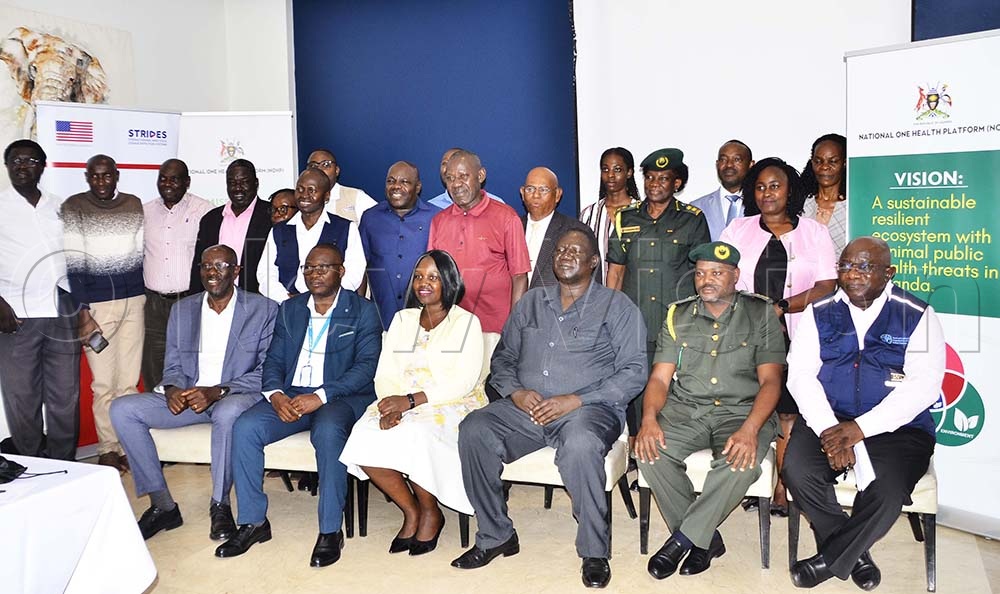
Stephen David Mugambi, Commissioner, Department of Environment Sector Support, hands over to Chemonges Mongea Sabilla, UWA Commissioner of Legal Affairs, Kyomuhendo, and other One Health platform representatives pose for a photo during the handover of leadership of the National One Health Platform at the Golden Tulip Hotel in Kampala. (Credit: Juliet Kasirye)
Regarding funding, Musinguzi noted: “We are aware that Uganda is among the 15 high-risk, high-need countries eligible for the Pandemic Fund’s fourth call for proposals, with a rolling application window from April 2026 to March 2027. During my term, I will ensure we provide the technical coordination and multi-sectoral consensus required to submit a competitive, high-quality proposal that addresses our critical gaps in pandemic preparedness.”
“We will pursue a diversified resource mobilisation strategy, engage the private sector, philanthropic organisations, and explore innovative financing mechanisms to ensure the financial sustainability of our platform,” he stated.
Interface of animals and humans
Because of increased human population, animal population and shrinking ecosystems, the UWA Commissioner for Legal Affairs (Sabilla), said there is a lot of interface between wildlife and humans.
To reduce the spread of diseases between humans and animals, Sabilla said, “We are focusing on prevention, putting fences, but also sensitising communities to keep a distance. We have also set up surveillance systems on site to increase the number of our size teams in the field for research and monitoring, and also to conduct ecological surveillance.”
To prevent, detect and respond in a timely manner to threats that might originate from neighbouring countries, the Commissioner, Department of Environment Sector Support Services at the Water and Environment Ministry, Stephen David Mugambi, said one health teams have been trained and established in over 67 districts countrywide. The protected areas such as Bwindi, Mgahinga, Queen Elizabeth and Kibaale have also joined the One Health agenda.
Mugambi, who represented the permanent secretary of Water Ministry, Dr. Alfred Okot Okidi, said some of the challenges the platform is grappling with include zoonotic disease outbreaks, which are often reported amidst limited resources.
According to Okidi, these outbreaks not only cause loss of life but also disrupt the livelihoods of communities.
“Since funding is still project-based, not government-owned, we need to secure a budget for one health. Other challenges we are grappling with include data and information sharing, and anti-microbial resistance,” Okidi concluded.