
Quenching thirst without questioning quality: Rise of ‘backyard’ water brands in Jinja
Behind the rapid growth of this industry is a growing concern among regulators, public health experts and standards authorities about the rise of unregulated or “backyard” water brands operating outside proper quality control systems.
Vicky Kakaire, the senior environmental officer for Jinja. (Credit: Doreen Musingo)
__________________
In many urban centres across eastern Uganda, including Jinja city, a small transparent plastic sachet of water has become one of the most accessible drinks on the street.
From taxi parks to construction sites, roadside stalls and markets, the small packets popularly known as “sachet water” have become a lifeline for thousands of low-income earners who cannot afford bottled water.
However, behind the rapid growth of this industry is a growing concern among regulators, public health experts and standards authorities about the rise of unregulated or “backyard” water brands operating outside proper quality control systems.
The innovation of sachet water is closely linked to urbanisation, technological innovation and gaps in public water supply.
How sachet water entered the market
The concept of selling drinking water in small plastic bags emerged in parts of Africa in the 1990s as an improvement on earlier informal water vending systems. Before sachets became popular, vendors sold drinking water using cups scooped from large containers, a method widely criticised for poor hygiene.
Later, with the introduction of simple water filtration and heat-sealing machines, entrepreneurs began packaging treated water into small polyethene bags while using plastic cups for measurements.
This innovation quickly spread across urban centres because the machines were relatively affordable and easy to operate. The model proved highly attractive in mainly urban areas for consumption, which created a market for private water vendors who could package and distribute drinking water quickly and cheaply.
Today, sachet water is widely consumed across Uganda and many African countries in Africa because it is cheaper than bottled water and easy to transport.
Why sachet water sales growth and market expansion
According to Kasim Kamugisha, a motorcyclist, sachet water has become a dominant source of drinking water in urban areas largely due to its convenience, low price and perceived safety compared to untreated water sources.
He said that for people, mainly street vendors, bodaboda riders and construction workers, among most urban dwellers, buying bottled water is too expensive for them because sachet water provides an affordable alternative since it is sold in small and single-use portions.
“Demand for sachet water continues to grow in urban areas due to convenience and affordability. Unlike bottled water, which is mainly sold in supermarkets and formal outlets, sachet water reaches customers through small kiosks, roadside vendors and mobile hawkers,” he said.
Opportunities for small-scale businesses
Davis Owino, who packs sachet water, says this has helped him create his small business where he supplies over 30 small shop outlets in Jinja city. He said setting up a small packaging operation requires relatively limited capital compared to large bottled water factories.
He said he started his business with an electric water sealing machine, which costs shillings 170,000, empty water sachets and rental space for operation at shillings 40,000 a month.
He explains that before sealing the water, he uses purifier tablets. He puts in a jerrycan of water once it settles, he starts packing, which doesn’t require access to treat the water, filtration system and trade labels among the major requirements.
Asked if he was aware of the required standards, which include hygienic conditions of the workplace, measurements, storage and certification from UNBS, he said he was not aware of the standards operator's existence.
Sense of safety
I deal in soft drinks, but for low-income earners, he says, adding that sachet water gives consumers the confidence that it is safe. She explained that consumers think sachets reduce the risk of contamination compared to traditional water vending systems, where cups were reused among customers.
“Sachet water is portable, sealed and readily available on the streets. This means workers in informal sectors who spend long hours outdoors can easily hydrate at lower costs without carrying large bottles,” she said.
She says that this “pay-as-you-drink” model, where a sachet costs shillings 100, fits well with the daily income patterns of many low-income individuals who normally can’t afford a bottle of water, which goes for 500 to 1,000.
“This water is more affordable; most of my clients prefer drinking the sachet water. If one has to drink over four litres of big bottled water costing shillings 2,000 on a sunny day, they find this expensive and prefer the sachets, which will cost less,” she said.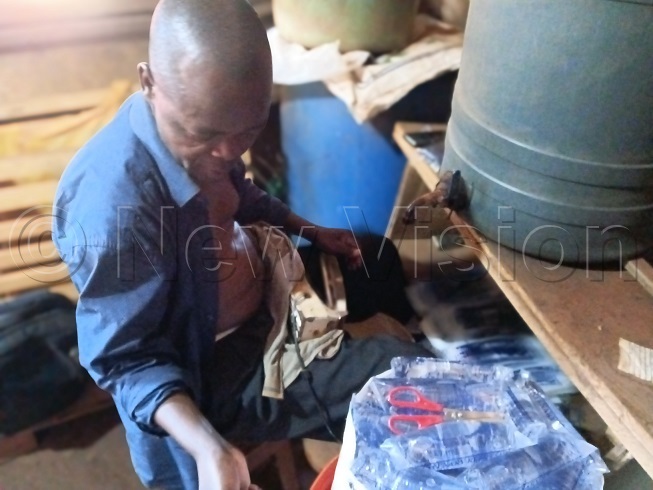
The man packing drinking water at his stall in Walukuba in Jinja city. (Credit: Doreen Musingo)
Health benefits and risks
According to Sarah Adongo, an assistant nursing officer from Buwenge Hospital, from a public health perspective, properly treated and packaged water can provide a safer alternative to untreated water sources such as wells, streams or roadside vendors.
Adongo warn that problems arise when producers operate without proper standards or testing, mainly in packaged sachet water. She explained that in most cases, small-scale producers who operate from their homes fill sachets using untreated water or operate in unhygienic environments.
“With business where people are only thinking of money, they are not bothered about treating water or boiling it. They work from unhygienic places where quality control is weak. This leaves the packed water sachets contaminated, exposing consumers to diseases,” she says.
She adds that during rainy seasons, most people just collect water from any source, which they use for packing, adding that people who drink the sachet think they are saving money, but instead they are buying for themselves water-borne diseases like Cholera, typhoid, dysentery and diarrhoea.
“It’s cheap to buy sachet water but expensive to manage the outcome of the disease. The water costs shillings 100, however, the cheapest typhoid treatment costs shillings 50,000. We kindly advise people to boil drinking water rather than using the cheap methods,” she says.
She urges public health officers, village health team officers and community own resource persons to sensitise people on the type of water and vessels (cups) to use, and how to store them and in case of any diseases, they should be reported immediately to the health authorities so that they are contained.
However, she also urges them to always carry out abrupt inspections in retail shops to establish if the sachet water is treated or boiled and certified for human consumption.
Water is highly sensitive
Patricia Bageine, the director of Standards at the Uganda National Bureau of Standards (UNBS), says the authority does not permit the production of drinking water packaged in sachets for human consumption because the process cannot be fully regulated from the source to the final product.
According to Bageine, water is highly sensitive and easily contaminated, making unregulated production a major public health risk. She adds that for the past 10 to 15 years, UNBS has maintained a clear policy that drinking water intended for certification must be bottled rather than packed in sachets.
“Bottled water production follows strict standards and codes of practice that guide the entire process, from sourcing and treatment to packaging and distribution. However, sachet water production lacks the necessary monitoring and quality control systems, making it difficult for the regulator to guarantee safety,” she says.
Bageine emphasises that UNBS carries out a wide range of laboratory tests before certifying drinking water. These tests examine chemical, microbiological and physical parameters to determine the quality of water. Key measurements include the presence of organic and inorganic substances, pH levels, smell, colour, clarity, bacterial count and mineral content. Since most drinking water originates from underground sources, these tests help determine whether it is safe for human consumption.
Certification needed
She warns that many backyard water producers operate without proper certification and often violate hygiene and safety requirements. In some cases, producers use the same water tanks for both domestic and commercial activities, which increases the risk of contamination. Others lack the financial capacity to drill boreholes or establish proper treatment systems, adding that many operators rarely clean their storage tanks and have no oversight from regulatory authorities.
She further points out that poor packaging practices increase contamination risks. Some backyard producers boil water using charcoal stoves and pack it manually in sachets, which can lead to spillage and contamination during sealing. In addition, many production sites lack proper sanitation facilities such as clean toilets, which further compromises hygiene standards.
Bageine advises individuals interested in the water packaging business to first seek sensitisation and certification from UNBS before beginning operations. She suggested that small operators could combine resources to form larger companies capable of meeting regulatory standards. Failure to comply with regulations can result in enforcement actions such as closure of premises, withdrawal of certification, prosecution and imprisonment.
Environmental degradation concerns
Jinja city senior environmental officer Vicky Kakaire raises environmental concerns linked to sachet water, saying they cannot afford the costs of abstraction permits to collect or sink boreholes for water sources.
She says the plastic packaging used for sachets often ends up as waste in streets, drainage channels and wetlands, causing blockages, flooding and pollution of water bodies.
Kakaire also highlights health risks associated with production methods such as boiling water with charcoal or firewood, which release harmful smoke that can affect respiratory health. She stresses that enforcement requires a co-ordinated approach involving public health officials, the water ministry’s Directorate of Water Development and UNBS, although regulating small backyard operations remains a challenge.
She calls for increased regulatory monitoring and Inspections involving compliance inspections, targeting and tackling illegal urban operations through a crackdown on illegal kiosks selling beverages in until authorized areas.
Moses Mulondo, the administrative secretary of the Uganda National Chamber of Commerce and Trade in Jinja city, says sachet water is not standardised by NUBS and is not fit for consumption. He adds that most of the water is of poor quality without recommended measurement.
He said sachet water isn’t cost-effective since most businesses are not certified by UNBS, thus don’t pay URA taxes, which causes losses to the city.
What others say
Joan Kalembe, a street vendor who sells chips, says she prefers the sachet water since it's cheap. She explains that while deep frying chips, the heat from the burning charcoal stove causes a lot of thirst and causes one to drink a lot of water.
Ruth Kiaskye, a food vendor, says most of her clients are low-income earners and prefer drinking sachet water because it's cheap and cost-saving