
Is Karamoja’s broken pastoralism fueling migration to cities?
In that moment, the phrase “water is life” took on a meaning far beyond words. “We live in a land of scarcity, but the disappearance of water and the worsening hunger crisis have made life even harder,” Michael Lorot, Chairperson of Lomarotoit Village, said, pausing as he gazed across the vast plains stretching towards the horizon.
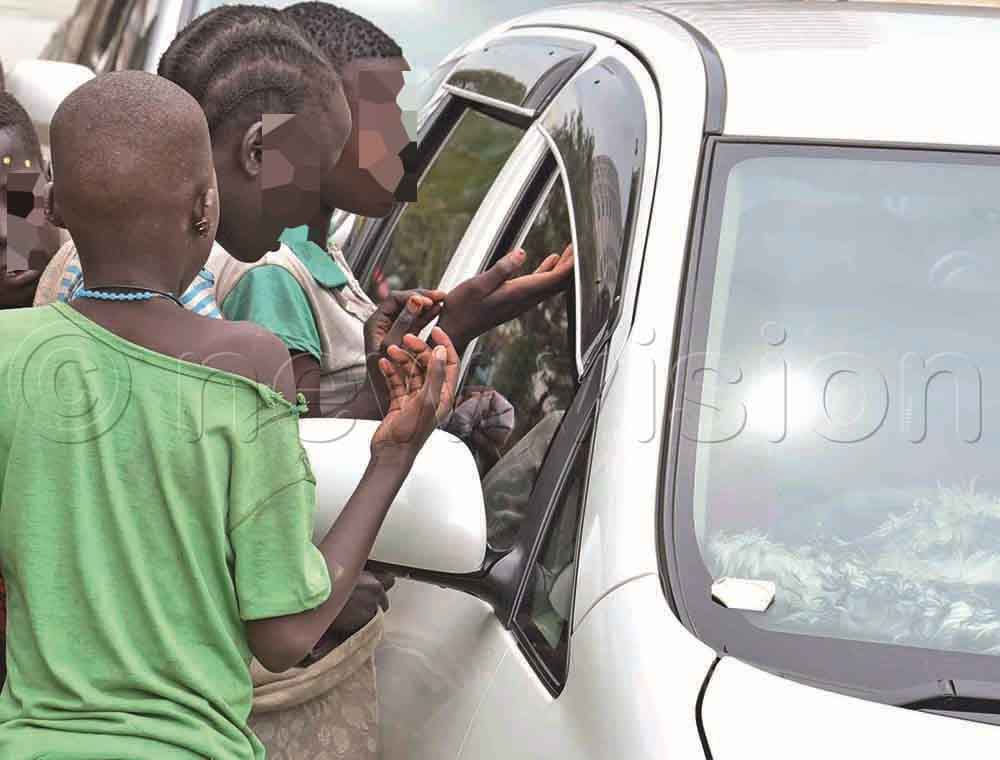
Children from Karamoja begging for money from car drivers along Kampala-Entebbe Road recently.
KARAMOJA - As dawn breaks over Kampala, Peter Lokuta is already searching the streets of Kisenyi for scrap metal. He moves through rubbish piles, construction sites, and roadside dumps, knowing every hour matters. In the city, one person’s waste has become another’s livelihood.
“It is backbreaking work,” he said. “But every drop of sweat keeps food on my table. I would rather live by the sweat of my brow than stretch out my hand to beg.”
For Lokuta, life has changed dramatically. Born into the Karimojong pastoralist community, where cattle represent wealth, security, and identity, he now searches Kampala’s streets for discarded metal instead of grazing livestock.
As Lokuta speaks, images of Karamoja’s endless plains come to mind—a harsh yet beautiful landscape shaped by resilience. He left one struggle behind only to face another. The spear has given way to a sack of scrap metal, but survival remains the battle defining his days.
His story unfolds in Kisenyi, one of Kampala’s most crowded neighbourhoods, where narrow alleys, packed homes, and daily struggles define life as residents seek survival.
In this bug-infested neighbourhood, Lokiru’s struggle reflects Kampala’s slum reality, where survival is costly, and only air seems free.
“It is not easy to find affordable food in Kampala, but this place (Kisenyi) serves meals for as little as Sh2,000,” he says. “With Sh5,000, you can eat like a king.”
However, even eating comes with expenses that many people in rural areas rarely think about.
For Lokiru, a meal brings another cost: a trip to a pay-per-use toilet, where even basic needs require money in Kisenyi.
As Lokiru went about his daily struggles, one question kept returning to mind: Why would people leave rural homes with toilets, proper drainage, and healthier surroundings for a life in the city where they are packed like sardines?
For Lokiru, life changed forever when his father was killed in a brutal raid that also stripped the family of their most valuable asset—their cattle.
In Karamoja, losing cattle can mean losing everything. Livestock is often the foundation upon which families build their lives, and without it, survival becomes uncertain.
His escape began on foot to Soroti. There, he teamed up with a group of young people bound for Kampala. Together, they travelled through Mbale and Jinja before reaching Kisenyi in Kampala.
“I know East or West, home is best,” he says. “I want to get capital for business and then settle in Mbale or Soroti or Moroto, where I can easily keep an eye on home.”
His words carry both ambition and longing. Though Kampala provides a livelihood, his thoughts remain tied to home and to a future that might one day bring him closer to it.
Seeking to understand how Karimojong migrants have adapted to life in Kisenyi, I spoke to the LC1 chairperson for Kasaato zone, Godfrey Kakande.
According to Kakande, many who arrived from Karamoja have gradually become urbanites. “We experienced a clash of cultures because many Karimojong feared using toilets, believing it would prevent them from bearing children,” said Kakande, adding that this created conflict with their neighbours.
The transition was not always smooth. Deeply held beliefs sometimes collided with the demands of urban living, creating tensions between newcomers and long-time residents.
Alongside the Karamojong immigrants, Kisenyi is home to urban refugees from Somalia. Kampala’s refugee population also includes Ethiopians and Eritreans on Gaba Road.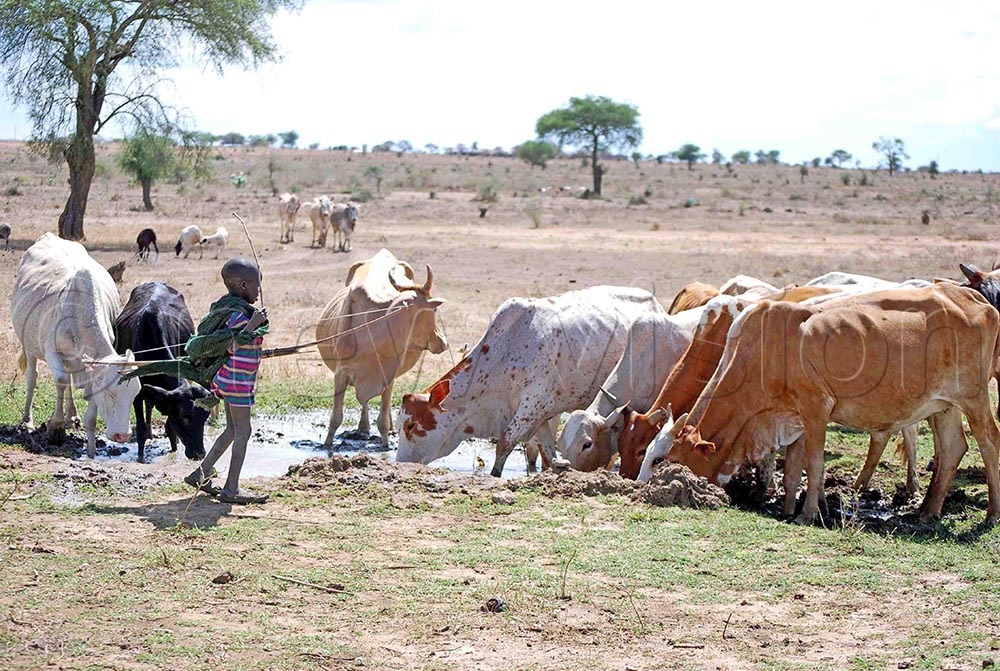
Cattle struggling to get water for drinking du to drought in Kotido district, Karamoja Sub-County, recently.
Lokuta’s roots
To understand why more people are leaving northeastern Uganda for towns and cities, I retraced Peter Lokuta’s journey to Lomarotoit Village, Iriri Sub-county, Napak, where his story began.
Napak is one of the nine districts in Karamoja. It borders Abim and Kotido to the northwest and Moroto to the north and northeast and Katakwi to the south. Nakapiripirit and Nabilatuk to the southeast, Otuke to the west, and Amuria to the southwest.
This, he said, is a land of pastoralists and agro-pastoralists, a place where livestock, agriculture, and mining coexist. Beneath its rugged surface lie some of the much-sought-after gold.
Clouds of dust swirled across the plains and followed us for miles, as if announcing our arrival. By the time I reached Iriri village, where Lokuta is regarded as a son of the soil, a thick layer of dust had settled on my clothes, turning my shirt brown.
As I settled onto a round, three-legged stool beneath the unforgiving Karamoja sun, another reality emerged. Hidden beneath the dusty landscape were deeper and more painful struggles: a persistent water crisis and growing food insecurity.
I had carried bottled water with me. After washing my face, I was suddenly surrounded by young children and desperate faces pleading for a sip. When I shared what remained, a scramble broke out around the bottle.
In that moment, the phrase “water is life” took on a meaning far beyond words. “We live in a land of scarcity, but the disappearance of water and the worsening hunger crisis have made life even harder,” Michael Lorot, Chairperson of Lomarotoit Village, said, pausing as he gazed across the vast plains stretching towards the horizon.
For a brief moment, I wondered whether he was staring at an invisible enemy. Was danger lurking somewhere in the distance? Was a rival clan preparing an attack?
“This is our land, given to us by God and passed down by our ancestors. But we face immense pressure from a hostile environment, including climate change. The modern world has arrived; mining has also come with profiteers.”
His words captured the challenge facing many communities across Karamoja—a struggle not against a visible enemy, but against forces that are steadily changing the land on which their lives depend.
Precious cattle
In this remote corner of northeastern Uganda, the relationship between people, land, and cattle runs deeper than economics.
According to Lorot, this bond is known as pastoralism, a system that has shaped generations of Karimojong families and communities.
People here do not simply own livestock. Their lives are intertwined with their animals and the land that sustains them.
Pastoralism has survived for centuries through mobility, resilience, and environmental knowledge, enabling communities to endure droughts, changing seasons, and harsh climatic conditions.
While some dismiss them as wanderers, local leaders insist their movements have always followed established patterns.
Lorot explained that seasonal migration was carefully organised and guided by elders. Communities sought consent before moving beyond their traditional territories and understood the landscape in remarkable detail.
“We used to move in the dry season and get good pastures and water,” he says, adding that they knew the landscape like the back of their hand.”
Situation analysis
For generations, these movements ensured that livestock survived harsh seasons and communities remained food secure.
According to Lorot, population growth and climate change are intensifying competition for water and pasture resources that are becoming increasingly scarce.
“It is a different ball game,” Lorot said. “When a severe dry spell or drought strikes, pastoralists are forced to move in search of water and pasture.”
As herders move into restricted areas, conflicts often follow. The result is that communities are increasingly confined to smaller spaces, limiting the flexibility that has long been the backbone of pastoralism.
According to Dr. Sidonia Angom Ochieng and the Karamoja Peace and Technology University, this growing restriction threatens far more than livestock production. “It threatens a way of life. Pastoralism is not only an economic activity. It is closely linked to cultural identity, stability, and community cohesion,” she says.
According to Isaac Kabongo, the executive director of the Ecological Christian Organisation (ECO), significant numbers of people are now leaving Karamoja for other parts of Uganda.
He notes that migration is also occurring elsewhere in the country, with communities from southwestern Uganda increasingly moving into the midwestern region.
“There are pastoralists who once moved only within Karamoja, but they are now migrating to other parts of the country,” said Kabongo.
Dr. Callist Tindimugaya, the Commissioner for Water Resources Planning and Regulation at the Ministry of Water and Environment, agrees.
“Floods, landslides, and declining resources are forcing people, including Balaalo herders, to leave homes and seek alternatives elsewhere,” said Tindimugaya.
Cross-border migration
As competition for scarce resources intensifies, migrants often encounter settled communities, creating tensions and conflict in areas such as eastern and northern Uganda.
“Climate change is affecting many areas in different ways. There are areas that are prone to the changing climate, which is behind the droughts that are becoming frequent and intense. Soil fertility has gone down. Climate change is affecting agriculture and fertility. When water is reduced, people move. Water is critical to human survival, observes Tindimugaya.
In Karamoja, Kabongo says, widespread food insecurity is increasingly pushing people into towns. “They are being displaced and are seeking livelihoods in urban areas, where there is little or no land,” said Kabongo.
The trend reflects the combined effects of climate change and the disruption of pastoralism, a system that has long provided food, employment, and wealth in the region.
"When pasture or other resources become scarce, conflicts emerge,” said Kabongo, adding that such disputes sometimes spill across national borders. “As I speak, Pokot pastoralists from Kenya have crossed into Amudat and have little respect for the territorial boundaries of other communities.”
The impacts of climate change are more severe in north-eastern Kenya than in Uganda. As a result, the Pokot and Turkana migrate into Uganda when prolonged dry spells hit the region.
Uganda’s average temperature has risen by 1.3°C since the 1960s, bringing more heat stress, longer dry spells, and recurring droughts for agro-pastoral communities, according to the World Bank.
A publication titled “From Vision to Action: Uganda Launches a Climate Resilience Initiative in the Cattle Corridor” notes that Uganda’s cattle corridor, which covers about half the country, is being hit harder by climate impacts than other regions.
Way forward
The Inter-Governmental Authority on Development (IGAD) Protocol on Transhumance supports orderly cross-border pastoral movement to reduce resource conflicts and protect livelihoods. Uganda supports the IGAD Protocol on Transhumance but has neither signed nor ratified it.
Pastoralists searching for water and pasture often clash with settled communities, triggering conflicts, says Advocates Coalition for Environment and Development Deputy Executive Director Onesmus Mugyenyi.
“Climate change forces people to move in search of alternative livelihoods. It also intensifies competition for scarce resources,” he observes.
For Mugyenyi, adaptation is the way to go. “We need to adapt because we cannot run away from climate change,” he said, adding, “It is important to respond to climate change by diversifying opportunities.”
He pointed to value addition, irrigation expansion, and strengthening resilience to climate shocks as solutions to climate change.
A study led by United Nations Framework to Combat Climate Change climate negotiator Fred Onduri informed Uganda's new migration policy to manage climate change-driven mobility.
“It came up with information regarding where people are moving. We should anticipate mobility because of climate change,” said Onduri.
And perhaps Peter Lokuta’s journey from Karamoja to Kisenyi shows how climate change is pushing vulnerable communities from shrinking pastures into cities in search of survival.