
How Watalatsu used brass band to empower Mbale youth
Most of the band members were vulnerable youth and former street children. They would perform at public functions at a fee.
The FDNC band performing at a public function in Mbale. (Credit: Sam Wakhakha)
_______________
Over the last 30 years, Samuel Watalatsu’s name has been synonymous with the NGO sector in Bugisu sub-region, having started his career in the early 1990s when most graduates were seeking employment in government offices and the private sector. Through his various charity initiatives, young people from humble backgrounds have attained livelihood skills that have enabled them to lead meaningful lives.
“He has mentored many, especially orphans and former street children who have ended up successful in their careers. Many have become successful both in Uganda and abroad, courtesy of Watalatsu’s efforts,” Richard Mangali, a resident of Mbale city, says.
Because of his work in skilling the youth, Watalatsu was among the pioneer winners of the New Vision Teachers Making a Difference competition in 2013. He has gone on to win many other international awards such as the Brass Band World Award courtesy of the late Queen Elizabeth II of the UK.
Although Watalatsu has initiated many charity projects in health, vocational skilling and community empowerment, the one that is most visible is the Foundation for Development of Needy Communities (FDNC) brass band, which always headlines most public functions in eastern Uganda.
“I am proud to have started the first private marching brass band in eastern Uganda in 2001. It was born out of passion because I loved seeing the Police, Prisons and Army bands performing. When I started it, I did not know that it would grow into what it is today. It has helped to mobilise support and impacted many lives. Some of the pioneer members have founded their own bands. Others used it to get more opportunities in Uganda and abroad,” he says.
Falling in love with bands
The first time Watalatsu watched a brass band perform was when in 1988, when he was in O’level at Nabumali High School in Mbale district.
“When I was a student at Nabumali High School, a Prisons band was invited to perform at the wedding of my teacher, John Chamberlain (from the UK) and his wife, Rose Alenyo. I loved the tunes and the manner in which the officers performed. I fell in love with bands and always looked forward to the next performance. All the brass bands that used to perform at that time were of security forces – army, Police and Prisons. The only private band in the country belonged to Kamuli Boys School,” he says.
But Watalatsu not only liked watching the bands; he also wanted to take part in what they did. In 1991, God answered his prayers.
He was the best student at Bukedi College Kachonga in A’level in 1991 and was admitted to Makerere University for a Bachelor of Arts degree on government sponsorship.
But before joining Makerere University at that time, students would be required to go to the National Leadership Institute in Kyankwanzi for patriotism training and during the pass-out, Watalatsu marched with his colleagues as the Uganda Police band performed.
“I enjoyed watching bands play at Livingstone Hall,” he says.
When he joined Makerere University, marching band performances were among the activities he enjoyed watching.
“Unlike Nabumali High School, brass band performances at Makerere University were regular, and I enjoyed watching them,” he says.
He graduated from Makerere University in 1995 and looked for a job in vain. In 1997, he secured his first job with Kotido Diocese as the coordinator for the HIV programme. However, it was short-lived because of insecurity.
“I once watched a Karimojong youth casually shoot a young man who was preparing to join the University of Edinburgh in the UK. When we buried the young man, I vowed never to return to Karamoja,” Watalatsu says.
He returned to Mbale, briefly worked with YMCA before starting his own community organisation, FDNC, in 1997.
While working in Mbale in 1999, the then UN secretary general, Kofi Annan, visited the area to open the Private Sector Development programme offices.
“One of the things that struck me most was the fact that the organisers had spent sh3m on hiring the Police band to perform. That was a lot of money at that time. I saw an opportunity here. I realised that if I could get instruments and train youths around Mbale, they would be hired for such functions at a handsome fee,” Watalatsu says.
He thus embarked on an assignment to acquire the instruments.
“There was no vendor selling brass band instruments in Uganda at that time. So I started writing emails to people I knew overseas. By the way, access to the internet at that time was not easy. In Mbale, access to internet services was only through a UN volunteer called Binoy at the Private Sector Development programme offices and another organisation known as Steno Agencies. So, I reached out to these people and sent out mails to my contacts abroad, requesting them to support us with brass band instruments,” Watalatsu explains.
“The Camberly Youth Wind Orchestra said they were willing to donate a three-set brass/ wind band instruments. Months later, British Airways committed to airlift the instruments, weighing 1,345kg free of charge to Entebbe International Airport under the social corporate responsibility arrangement. The equipment arrived in on July 10, 1999,” he says.
With the instruments in the country, another hurdle emerged – Uganda Revenue Authority demanded taxes worth sh9m before it could release them to Watalatsu.
“I was not happy with URA because I was not bringing these instruments for commercial purposes. I just wanted to use them to skill vulnerable youth to perform at functions so that we raise money to support charity activities. Here was a good intention being frustrated by a sh9m tax bill. That was a lot of money then and we did not have it,” he says.
To solve the problem, Watalatsu contacted then Mbale district LC5 chairperson Charles Walimbwa Peke, who appealed to his council to clear the taxes under the youth empowerment vote.
“The taxes were cleared, and after seven days of delays, the equipment was transported from Entebbe Airport to Mbale,” he says.
With the instruments in Mbale, the next step was the mobilisation of trainers and band members. The band was registered as the Foundation for Development of Needy Communities (FDNC) Mbale Youth Brass Band.
“Training started, and within the first two weeks, the band had mastered many songs and started performing at functions. The first performance was after two weeks. The band quickly gained popularity in the region and was being hired to perform at many functions,” Watalatsu says.
Most of the band members were vulnerable youth and former street children. They would perform at public functions at a fee.
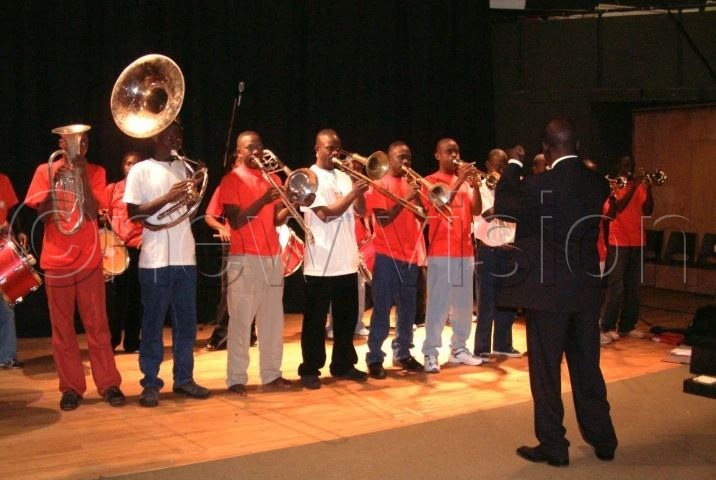
FDNC band performing in the UK. (Credit: Sam Wakhakha)
“The money would be used for paying the band members, trainers, refreshments,
transport and so forth. But my main target was empowering vulnerable youth in eastern Uganda with skills,” he says.
After some time, Watalatsu received invitations for the band to perform at national and international events.
“Between October 30 and November 14, 2005, the band visited the UK at the invitation of Care and Share Foundation based in Chepstow, Wales. The Youth Band travelled courtesy of SN Brussels Airlines. All travel costs in the UK were met by the Care and Share Foundation, John Milton Whatmore, together with other well-wishers,” Watalatsu says.
Twenty-two band members travelled after being selected from a group of 113 youth.
“The band travelled on a tight schedule, performing in various schools, churches, and public areas in Wales and England. My selection criteria for the people who travelled were very tight. And I had to ensure that none of the people who travelled escaped or disappeared in the UK,” he says.
The trip went well except one issue, which later saw Watalatsu in and out of court.
A youth who was excluded from the UK trip on the basis of bad behaviour sued Watalatsu.
“The young man was supposed to travel with the band, but I dropped him because at the time, he was facing criminal charges of defilement. He was arrested by the Police on October 24, 2005 and was released on bond on October 26, 2005. He was required to report back to the Police on October 31 at 10:00am (day of travel to the UK). I, therefore, dropped him. He, however, sued me before the Mbale Magistrates’ Court and I nearly lost my residence due to the costs that I incurred,” Watalstu says.
The magistrates’ court initially ruled against Watalatsu, but he appealed and eventually won at the Court of Appeal level after 12 years of litigation. The Court of Appeal ruled in Watalatsu’s favour on February 6, 2016.
Changing lives
Whenever the band went on tours abroad, Watalatsu would explain to the hosts that the band members were young people who needed a push in life.
“The effort paid off. Through the initiative, we were able to rehabilitate and skill many others. The work has continued to this day because we have earned the trust of the donors. They always see the impact of their donations,” he explains.
The band skilled many youth and exposed them to opportunities globally and locally. Many numbers of the young people, who were once redundant, eventually secured opportunities in other parts of Uganda and the world. Others even formed their own bands.
“With this mustard seed effect, eastern region has now not less than 24 brass bands. Through the band, over 500 young people secured opportunities abroad and in other parts of Uganda. I am grateful to all the people who made this dream a reality. Special thanks to Philip Robert Monk, a British national, who, after retirement from Royal Mail in the UK, eventually settled in Mbale, married a Ugandan. As a musician, he opted to continue with the music training programme under the Mbale Schools Band,” Watalatsu says.
Watalatsu’s Education
-Nabumali Boarding Primary School (PLE) -1984
-Nabumali High School (UCE) -1988
-Bukedi College Kachonga (UACE) -1991
-Makerere University (Bachelor of Arts) -1995
-Uganda Christian University (Masters in strategic leadership) -2007
WHAT OTHERS SAY
Nathan Namatati, Founder of Hidden People’ Home in Manafwa district:
Watalatsu has been a towering figure in the Bugisu charity sector since the early days of FDNC, which he founded while many were still seeking government jobs. His marching band became a symbol of community pride, welcoming presidents, ministers and visiting dignitaries. He has mentored countless young people in the NGO world. His charisma, agility and unwavering commitment to service have inspired many, including myself, to follow a similar path. He has also built valuable international partnerships, helping organisations and Inzu Ya Masaba access global opportunities. Sam’s legacy is one of leadership, innovation and a lifelong dedication to uplifting others.
Khainza Sylivia, resident of Matuwa village, Lukhonge sub-county, Mbale
Through his charity work, Watalatsu has enabled the youth of Bugisu to access vocational training. He has enabled many to get free health services. Through his mentorship, I started a school, which I have been managing since 2004. The school has a big number of orphans who are studying at no cost.
Seera, Shiholo sub-county in Bududa district
I have worked with Watalatsu for over 15 years. Through his charity efforts, over six sub-counties in Bududa district have been able to get motorcycle and tricycle ambulances that transport patients from remote parts of the district to health centres.
Seera, Shiholo sub-county in Bududa district
I worked with Watalatsu for more than 10 years as a health co-ordinator. Under his guidance, we did health sensitisation in Bugisu and Budaka district. I was able to visit Japan and Israel during the time I worked under him.