
Gold mining threatens Uganda-DRC elephant lifeline
“Once elephants use a wildlife corridor, then, other wild animals can use it,” Mwima told New Vision in an interview. Back to mining and its impact on Kyambura Wildlife Reserve, conservationists are increasingly troubled by the quiet pressures reshaping this fragile landscape.
Artisanal miners at work near Kasyoha-Kitomi Forest Reserve in Kyabakara sub-county, Rubirizi, recently.
MINING EFFECTS
A quiet sky hangs over Kyabakara sub-county, Rubirizi district – clouds drifting in slow passage, sunlight spilling softly across the land as though nothing beneath it is unsettled. Still, another truth persists: gold mining leaves a harsh footprint on the environment, writes Gerald Tenywa.
Sixty-year-old Nicholas Nuwe of Kyabakara village in Rubirizi district stoops over the earth, sifting for traces of gold buried in its hidden seams – a gruelling pursuit that is both livelihood and gamble, carried out in the fragile space between survival and risk.
This feeds his home, yet leaves the ground altered. Not far away, the unexpected leaves Nuwe in quiet disbelief as mining “encroaches” upon Kyambura Wildlife Reserve, a sanctuary he has long avoided.
Kyambura lies within the vast and renowned Queen Elizabeth National Park in Rubirizi.
The park also covers parts of Kasese, Kanungu, Rukungiri and Kamwenge. River Buhindagi, flowing into Lake George within Queen Elizabeth National Park, is becoming a widening frontier of extraction.
As large concessionaires push deeper into Kyambura, illegal and small-scale miners gather along its banks, turning the soil as though it conceals a secret treasure.
There, the search does not end in the earth. Portions of excavated ground are washed in the river’s current, sifted by hand and water in the hope of gold.
These unfolding scenes raise pressing questions about gold mining in Kyambura and beyond. How safe is wildlife? What has been broken in the environment? What has been restored? What future awaits wildlife?
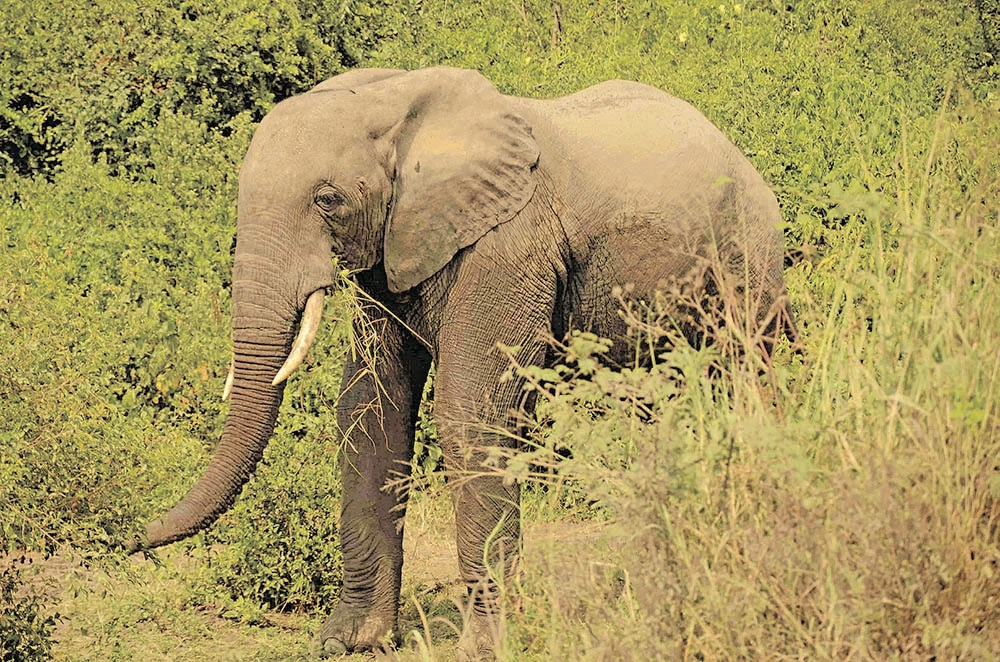
Elephants at Queen Elizabeth National Park now face a growing risk, as the once-active migratory route between Kyambura and the park comes under strain of mining.
How safe is elephant route?
An ecologist, Polycarp Mwima, says mining in places like Kyambura Wildlife Reserve is quietly tightening the noose around one of nature’s oldest journeys.
He says elephants now face a growing risk, as the once-active migratory corridor (passage) between Kyambura and Queen Elizabeth National Park comes under strain.
Around them, open landscapes, that once felt boundless, are now reshaped by the expanding human settlement, edging further into what was once untouched.
Carved by time and instinct, this passage once moved life in an unbroken chain of protected worlds: Kyambura Wildlife Reserve, Queen Elizabeth National Park, Kasyoha-Kitomi Forest Reserve, Kalinzu Forest Reserve, Kibale National Park, and across the border into Virunga National Park in DR Congo.
“The habitats have shrunk as wildlife face what they see as encroachment,” Mwima says.
“People take over land beyond protected areas, while wild animals continue to move across a landscape they do not understand; there’s no distinction between protected land and private ground.”
He says there is an important corridor between Queen Elizabeth National Park and Kyambura, which elephants would use to cross and return at night.
“Once elephants use a wildlife corridor, then, other wild animals can use it,” Mwima told New Vision in an interview. Back to mining and its impact on Kyambura Wildlife Reserve, conservationists are increasingly troubled by the quiet pressures reshaping this fragile landscape.
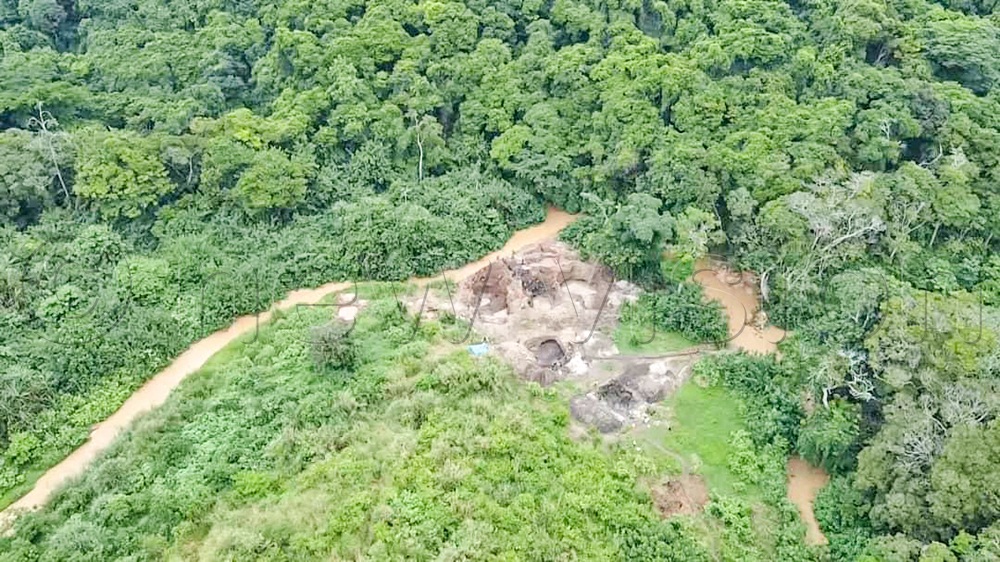
An aerial view of small mining pits (middle ground) next to Kasyoha-Kitomi Forest Reserve and the polluted River Buhindagi separating the forest and private land in Kyabakara sub-county, Rubirizi district. (Credit: Gerald Tenywa)
Dr Eric Enyel, a veterinarian and Uganda Wildlife Authority’s (UWA) former chief warden for Queen Elizabeth Conservation Area, says the wrong method of open-cast mining is used to extract gold.
“All vegetation is stripped away where the mining begins, leaving the earth exposed, unsettled. Mining takes place near River Buhindagi, and that alone carries risk of contamination of the river absorbing what it should never hold. Even more troubling is that the washing and cleaning of soil is done along the river itself,” Enyel says.
As River Buhindagi descends towards Lake George, it carries water from Kitagwenda district and Ibanda district. In Kitomi town, the residents report a growing concern as both large and small-scale mining reshape the river’s quality along its banks.
The mining has also not spared the protected areas, mainly Kasyoha-Kitomi Forest Reserve and Kalinzu Forest Reserve managed by the National Forestry Authority (NFA).
“Mining is done uphill, and the cleaning out of gold happens in the river, which drains into Lake George. They are getting extractives into the river. This is silting the river as all the soil goes there. The people living down the river get muddy water,” says an official of NFA, who preferred not to be named.
Is there any hope?
In Rubirizi district, where gold mining has left its footprint, the question remains: is restoration truly taking place or possible? Enyel says restoration efforts are ongoing within Kyambura, but the surrounding areas outside the protected park have been hit harder.
“There is no restoration in the areas outside the protected areas because the districts lack the capacity,” he says. In the district, artisanal mining – carried out with simple tools such as hoes and spades – remains largely small-scale.
“The greater damage is in the wildlife and forest reserves, which fall under UWA and NFA,” Aggrey Agaba, the Rubirizi district environment officer, says.
He adds that their district officials have been reduced to bystanders. “As the trees are cut down, we can do nothing because NEMA [National Environment Management Authority] has not shared the conditions for approval with us,” Agaba says.
Emmanuel Kibirige, the national co-ordinator of Uganda Association of Artisanal and Small-Scale Miners (UAASM), says they are keen on empowering the new miners in Rubirizi.
“We are moving around the country to ensure that small-scale miners get the support they need,” Kibirige said. He added that they have received reports about the encroachment in Rubirizi.
However, the pace of intervention by UAASM appears outstripped by the growing demand for its services across southwestern Uganda, where need is rising faster than response.
Rubirizi district excluded
As usual, where minerals have been discovered, local authorities play hide-and-seek with their counterparts in the central government. This is not an exception at Rubirizi, Agaba says.
“Gold mining is cleared by the Ministry of Energy and Mineral Development and NEMA,” Agaba says.
There are plentiful deposits of gold in Kyambura and Kasyoha-Kitomi Forest Reserve, which is sitting in four districts of Rubirizi, Buheweju, Ibanda and Kitagwenda.
Rubirizi’s Kyabakara sub-county is at the epicentre of small-scale mining, Agaba says.
Asked about the challenges that the gold mining poses, Agaba pointed to destruction of biodiversity (variety of species) contrary to the laws that govern protected areas under UWA and NFA.
“It is difficult to mine gold without destruction of biodiversity, habitats for wild animals, birds and insects, because the activity involves excavation. There is also pollution of water because the miners have to wash the earth materials, which end up in Lake George.”
“What we have seen is that areas that were once difficult to access are now open to all. While some encroachers collect firewood, charcoal and timber, many others are engaged in sand mining. As expected, negative impacts of sand mining have hit home,” Agaba says.
He added: “There has also been an increase in crop raiding, as animals — whose habitats have been disturbed — now find it easier to invade farms. There are growing complaints about wild birds and animals that have turned into vermin. Those entering the park and forest reserves are also more likely to engage in poaching because they now have access.”
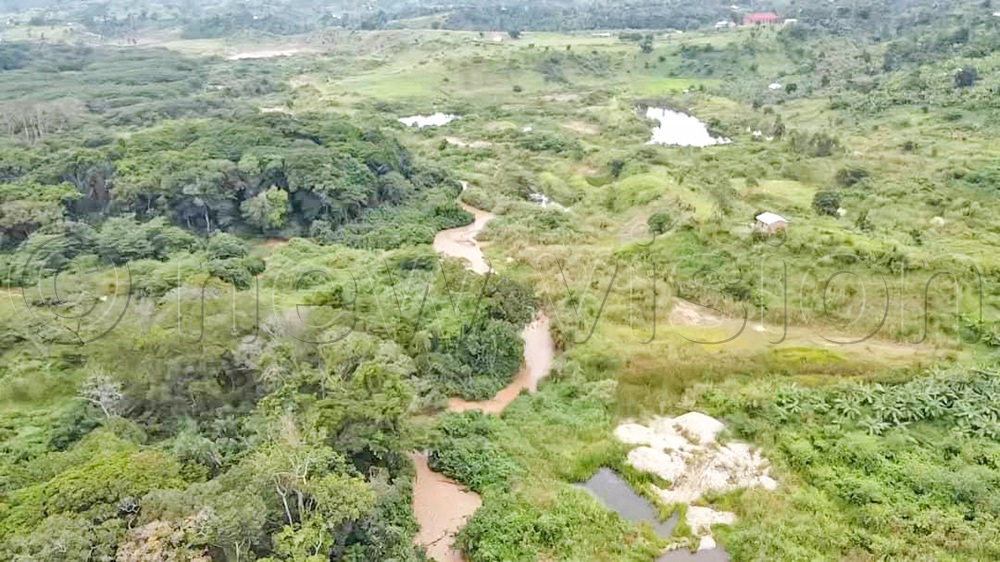
An aerial view of small mining pits (middle ground) next to Kasyoha-Kitomi Forest Reserve and the polluted River Buhindagi separating the forest and private land in Kyabakara sub-county, Rubirizi district. (Credit: Gerald Tenywa)
NEMA, UWA, NFA speak out
Aldon Walukamba, the public relations manager of the Ministry of Water and Environment, says Kasyoha-Kitomi Central Forest Reserve remains a critical ecological asset that must be safeguarded through strict adherence to Uganda’s legal and environmental frameworks.
“There must also be firm commitments to restore any degraded areas to equal or greater ecological value. In addition, any damage caused must be fully compensated,” Walukamba says.
He offered no comment on the restoration efforts of previous large-scale miners. When asked about the restoration of Kyambura, Bashir Hangi, the Uganda Wildlife Authority (UWA) spokesperson, said mining of gold was done by a private company (name withheld), which completed a year ago and “the area was restored”.
However, independent sources paint a different picture of an expansive wetland where restoration was uneven, hurried and far below the expectation, leaving a landscape only partially healed.
Dr Barirega Akankwasah, the National Environment Management Authority executive director, says: “I need to verify this and give more information about mining in Kasyoha-Kitomi.”
Regarding Rubirizi district being sidelined, Akankwasah said: “Restoration should be monitored by UWA and National Forestry Authority [NFA]. They should know if it is not satisfactory. The lead agency is UWA and NFA, the local government is a stakeholder, and the conditions of approval should be shared.”
Weak regulation
A worrisome pattern is beginning to take hold, as mining moves into reserves, says Onesmus Mugyenyi of the Advocates Coalition for Development and Environment.
“The challenge is that much of the mining is taking place under exploration licences, which is not permitted under the law,” Mugyenyi told New Vision.
He said before any extraction begins, investors are required to undertake an Environmental and Social Impact Assessment (ESIA).
Mugyenyi said some investors exploit regulatory gaps, entering protected areas under the cover of exploration permits, only to expand their operations into full-scale mining.
At the same time, small-scale miners, often operating with limited technical and financial capacity, also find their way into these restricted zones.
“We have small-scale miners who do not conduct ESIA studies,” Mugyenyi says.
Despite these challenges, Mugyenyi says protected landscapes can still be sustainably utilised. With strict adherence to environmental safeguards, human activity and conservation can co-exist.
“As long as an ESIA is approved, permission can be granted. Where there are negative impacts, mitigation measures must be clearly outlined,” Mugyenyi said.
He cited eco-tourism as an example of regulated activity that can take place in forest reserves following the ESIA approval, adding that such projects have been sanctioned by NEMA in several forest reserves and national parks.
This story has been done with the support of Environmental Defenders