
Congolese city devoured by race for critical minerals
The boundary between urban space and mining land is fading in Kolwezi, in the heart of the African copper belt.
Artisanal miners pass bags of copper ore to one another in a human chain inside the 110-metre-deep mine shaft in Kolwezi, DR Congo on September 27, 2026. (AFP)
________________
KOLWEZI - From his yard, Chibang Kasump sees the comings and goings of the miners who dig for copper and cobalt, day and night, deep below his small, brick home in the southern Democratic Republic of Congo.
The 47-year-old has lived for more than a decade in the Musonoi area of Kolwezi, the country's mining capital, which sits atop coveted deposits at the centre of a global race for critical minerals.
"I bought this house because it was quiet, close to the city centre and near the lake," he told AFP.
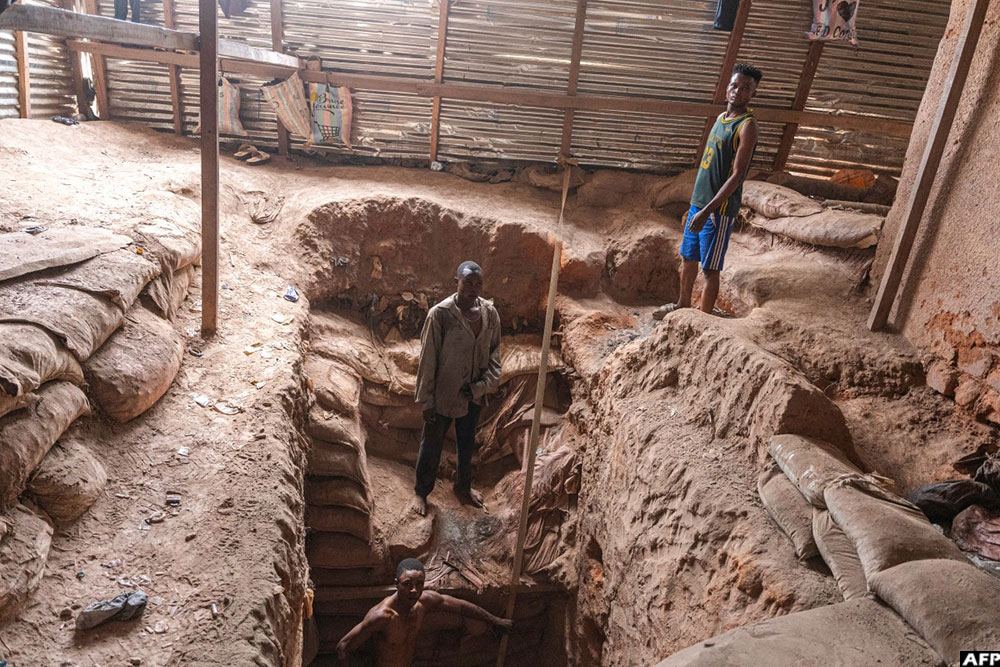
Artisanal miners wait for bags of copper ore to be brought to surface from the 110-metre-deep mine shaft in Kolwezi
"I didn't know there were minerals beneath my feet," he said. "Now I live with a well in my yard."
The vast central African nation produces around 70 percent of global cobalt output -- key for making electric batteries and in defence technology -- and holds some of the world's richest deposits of copper, a metal in growing demand as countries expand electrical networks to harness renewable energies.
Mining companies and foreign investors have stepped up their expansion efforts, explorations and asset acquisitions.
The next few years are expected to bring exponential growth in demand for critical metals that are indispensable to global industry.
China has been investing in the DRC for two decades.
The United States signed a strategic partnership deal with the Congolese government in December, hoping to shore up supplies for its high-tech industry.
Kasump's plot lies within the Tondo Mining Company's concession.
The Congolese firm holds the operating licence for the site, which is next to the vast copper and cobalt deposit of the Chinese company Commus.
Ahead of an industrial mining operation being set up, artisanal miners -- known as diggers -- have moved into the area -- right up to Kasump's yard.
The boundary between urban space and mining land is fading in Kolwezi, in the heart of the African copper belt.
Open-pit mines are gradually eating away at neighbourhoods, while concessions are piling up on top of one another.
In Musonoi, the houses have numbers spray-painted on them.
"All the houses are identified for relocation," Kazadi Roger, a local administrative official, said.
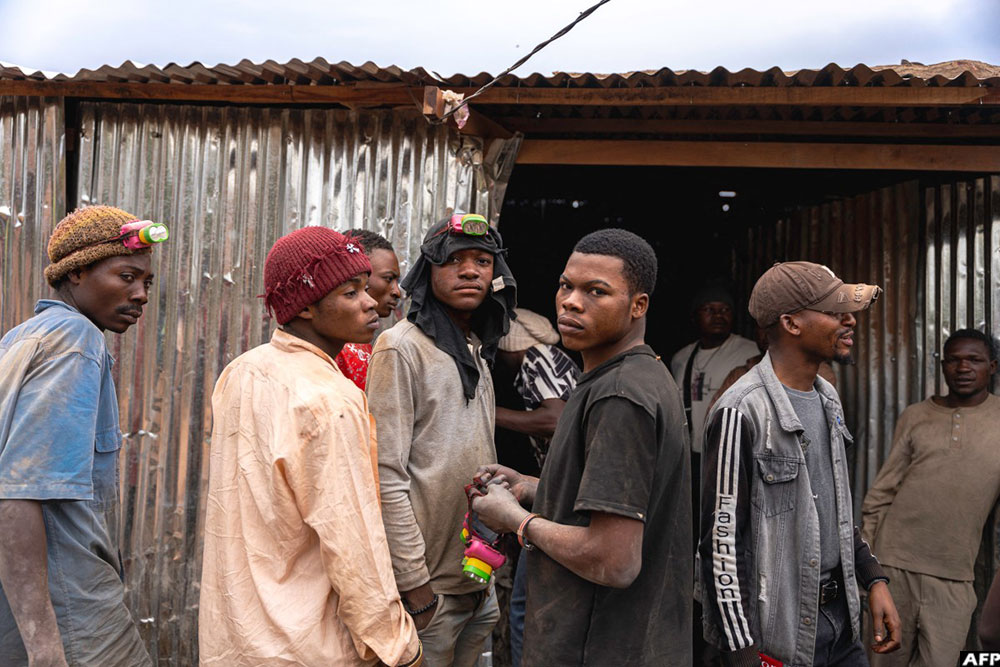
Some diggers earn around $500 (sh2 million) a month, others much less, depending on how much ore they have recovered and its quality.
"The mining company is going to provide compensation, but people still don't know when they'll be leaving," he added.
Under Congolese mining law, a land title does not confer any rights over the minerals present in the subsoil.
But a mining title also does not cancel out the rights of the occupants of a plot, who must be compensated in the event of expropriation.
Kasump initially refused but said "with the pollution, the explosions linked to the extraction, I ended up saying 'yes'".
He does not know how much he will receive or where he will move to, though.
Behind him, dumper trucks rolled by, nonstop, along the road carved out by the neighbouring Chinese industrial mine.
The dust settles on the rooftops and rainwater seeps into houses that have cracked as a result of the mining.
A pump hummed softly, sending oxygen to those who had descended into the darkness.
At a depth of around 100 metres (328 feet), some 30 men hacked away at the rock with pickaxes, filling sacks.
Using a rope, a human chain carried the ore -- mostly copper -- to the surface.
Risking lives to dig
"We follow the vein," one of the diggers said. "When we see the grade is good, we stop."
The timber lining the walls acts as a support but even the slightest collapse can prove fatal.
Some diggers earn around $500 (sh2 million) a month, others much less, depending on how much ore they have recovered and its quality.
All the artisanal stakeholders interviewed complained that the artisanal mining zones (ZEA), which are provided for by law, were insufficient.
"Everywhere, concessions have already been granted," Sylvestre Petit-Petit, the artisanal miners' local representative, grumbled.
"The state has not given enough space to the diggers," he added.
As a result, they work in private concessions, often without authorisation.
Some break into large industrial mines, risking their lives.
"Over there, they're shooting at us," one of them said, adding he had lost "several friends" that way.
The extracted ore is washed, sold to traders who are often Chinese, and then undergoes initial processing before being exported.
"The mines advance; the city retreats," said Aaron Niumbi, a young resident of another Kolwezi neighbourhood.
He, too, faces having to move out due to the expansion plans of China's Commus.