
Bugoma chimp habitat hangs in the balance
Chimpanzees hold territory to ensure access to food, water, and nesting sites, covering approximately 50 square kilometres.
A chimpanzee in Bugoma Forest Reserve. The apes have turned to raiding crop gardens as forest cover shrinks. (File)
_________________
SHRINKING TERRITORY
In a campaign to conserve Bugoma Forest Reserve, which is under threat, New Vision decided to find out who is behind the cutting down of trees, destroying the habitat for wild animals, especially chimpanzees. After about three months of investigations, Gerald Tenywa exposes how powerful people have taken over Bugoma forest, and brings you the story in a three-part series. Below is the second part of the series.
The chimpanzees in Bugoma Forest Reserve are suffering as ongoing destruction takes a toll on wildlife, threatening both tourism and local communities.
The grass and leaves still dripped from the morning rain, but the day was slipping away, and it was time to find food.
The leader of the chimpanzees made pant hoots, a sharp vocalisation used to communicate excitement and group cohesion. Shortly after, it was clear that the message was a signal to move.
Not far away, another group of chimpanzees was gathering for their morning meal, their leader’s calls echoing through the forest, summoning the others to the “dining table”.
Nazario Asiimwe, a tour guide, paused intently, listening to the sounds around us. Then he turned to me and asked: “Did you hear that? Do you know what it means?”
“Trouble is inevitable because chimpanzees live in social groups and fiercely defend their territory as a community,” he explained.
Chimpanzee communities operate on a social system called “fission-fusion,” meaning they routinely split into smaller temporary groups (fission) and then reconvene later (fusion). This is normal daily behaviour, not a permanent split of the entire community.
Asiimwe took advantage of the wet forest trails to move swiftly, soon disappearing from my sight behind towering trees where most of the chimps had built their nests for the night. When I caught up with him, he instructed me to proceed carefully to avoid startling the chimps.
Asiimwe’s deep understanding of chimpanzee behaviour has earned him their trust, allowing him to approach them as if he were part of their clan.
He can interpret their language and gestures, predicting their next moves with remarkable accuracy. He knows most of the chimps in the tourism group by name. Charlie is the alpha male of the habituated group for tourism, while Solomon is a low-ranking male. Mukulu is the oldest male, estimated to be 35 years old. Charlie defends the group in the face of adversity.
The life expectancy of chimps is 40 years in the wilderness. In captivity, they live up to 60 years as they get medical treatment and food on a silver platter.
Habituation
Chimpanzee habituation is a gradual, long-term process through which these primates become used to the presence of humans for research, conservation monitoring and sustainable eco-tourism. Eco tourism refers to responsible travel that conserves the environment and improves the well-being of local people.
As eco-tourism to generate revenue and employment, an influx of charcoal burners, illegal loggers and expanding maize and sugarcane farms are rapidly encroaching on the forest. These destructive activities are spreading from the southern part of Bugoma towards the northern areas, where eco-tourism is emerging.
Amuson Gumisiriza, a tourism supervisor under the National Forestry Authority, said the two groups of chimpanzees have been habituated to support research and eco-tourism in Bugoma.
Charlie leads a group of about 60 chimps that have been reserved for tourism. He is now battling another group of chimps, which have been habituated for research.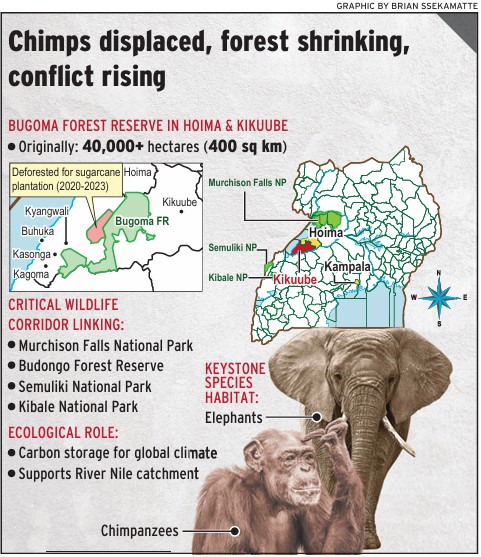
Group displaced
Consequently, the research group of chimps estimated at 100 in population and originally residing in Nyairongo, located in the southern part of Bugoma, has been displaced. This group has since moved to Nyakabale and subsequently, Mwera, where they now face competition with other chimpanzees over territory.
Wild gifts in Bugoma
Before the massive encroachment, Bugoma forest covered 41,144ha of lush forest, woodlands and wetlands.
This store of rich biodiversity is situated in the districts of Hoima and Kikuube. It is one of the largest forests in the catchment of Lake Albert. Bugoma is drained by the River Nkusi.
“We have a vast forest that, if properly protected, can continue to support chimp populations,” Dr Barirega Akankwasah, the National Environment Management Authority executive director, said.
Displaced chimpanzees can return to Bugoma once the area encroached upon is restored.
“We must work together to safeguard them and preserve their habitat,” Akankwasah said.
He called upon the Uganda Wildlife Authority to take the lead in securing the area.
“The chimps are fighting territories with plenty of food,” Gumisiriza said, adding that there is increased competition between the newcomers and the habituated group that has been resident at Mwera. “It is a matter of life and death as the chimps fight over a suitable territory,” Gumisiriza said.
He added: “In some instances, chimpanzees are beaten to death; the situation is that difficult. Over the past three years, chimpanzees in Mwera have been engaged in territorial disputes.”
Gumisiriza said he has witnessed five big fights ever since the research group of habituated chimps crossed into Mwera.
The fights are between the research group and the tourism group. The victors take over territories of food and also capture sexually active females, who become part of the group.
Why do chimps fight
Chimpanzees are very territorial by nature; they define their space and protect it aggressively, Peter Apell, a wildlife veterinarian, said.
“The males establish patrol groups and unleash terror on intruders,” he said. “The food is scarce because each chimp requires at least two square kilometres of the forest area with food.”
Apell added that there is no place in Uganda where the chimpanzee population has declined faster than Bugoma.
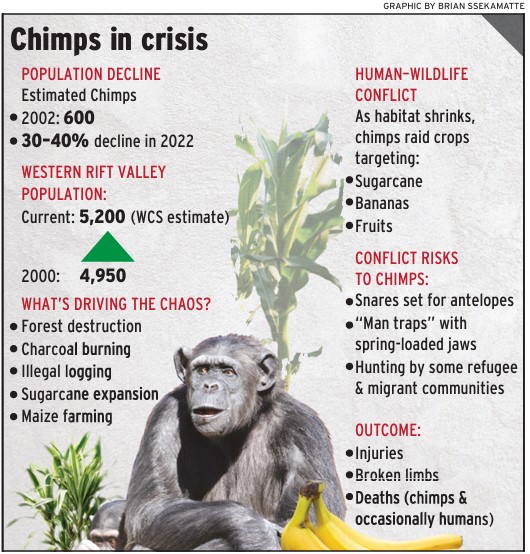
“We did a chimp census in 2002 and a rapid appraisal in 2022. The population of chimps is stable in most of the forest reserves, meaning that growth has been curtailed by deforestation,” he said.
The chimpanzee population in the western arm of the Rift Valley is currently estimated at 5,200. The population was 4,950 in the year 2000, according to the US-based Wildlife Conservation Society.
In Bugoma, there has been a loss of between 30% and 40% of the chimps, with the population estimated at 600 in 2002, Apell said. This was the third-highest population after Kibale National Park and Budongo.
The destruction of Bugoma has also affected what the veterinarian referred to as the conservation strategy to secure 75% of the population of chimps. This was relying on the largest forests, namely Kibale, Budongo, Bugoma, Kalinzu and Kashoya-Kitomi. “With Bugoma being lost, we have to find another way out for chimps,” he said.
In the most recent confrontation, which occurred about two months ago, one of the big males in the tourism group lost several teeth.
“From a distance, we can still see him feeding despite most of his teeth missing,” Solomon Owuta, a chimp tracker, told New Vision.
“Many of the trees that provide food for the chimps have been cut down.”
This disruption is forcing the habituated group to move deeper into the forest in search of areas with abundant food.
“The research group, with about 100 chimps, is stronger than the tourism group and is gradually taking over its territory,” Owuta said.
As the fights rage on, Gumisiriza said the time taken to trace the tourism chimps has tripled because the research group is taking over their territory.
As charcoal burners continue to cut down trees, hunters are also venturing deep into the forest, setting snares to catch antelopes. The traps end up catching primates, including chimps.
Chimpanzees hold a territory, which is a large home range, to ensure access to food, water and nesting sites. This could cover up to 50 square kilometres, which is critical for their survival and reproductive success.
The home range is always between five and 50 square kilometres, depending on the size of the families of chimps.
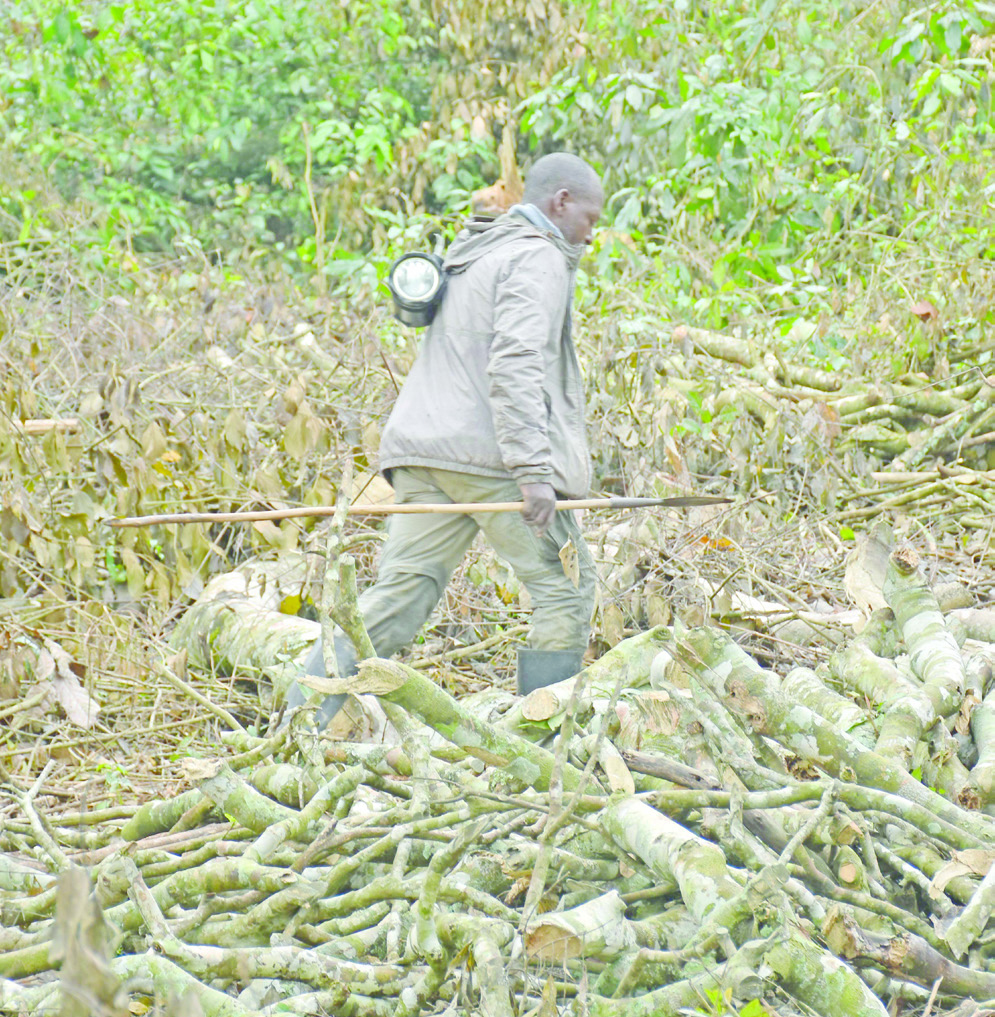
Asiimwe walking past logs prepared for charcoal making. (Courtesy)
Asiimwe witnessed, with great distress, the widespread felling of trees for timber and charcoal. As the trees in Nyakabale were cut down, the chimpanzees lost their home.
“I had encounters with chimps sitting on trees that had been cut down,” he said.
In areas with abundant year-round food sources, such as dense tropical rainforests, communities need less space. In contrast, those in drier, less resource-rich habitats, like woodlands and savannahs, may require home ranges of 100 to over 200 square kilometres to find enough food, with some extreme cases reaching 560 square kilometres.
As a survival strategy, Gumisiriza said some of the chimpanzees are resorting to crop raids, further intensifying human-wildlife conflicts.
“When destruction of forests occurs, and there is loss of food, the chimps start stealing food from farmlands near the forest boundaries,” he said, adding that Bugoma has seven chimpanzee groups, but they are monitoring only two.
Chimps are human relatives
Chimpanzees share 98.4% of their genes with humans. With mountain gorillas, they are referred to as non-human apes living in diverse African rainforests and savannahs.
The chimps and gorillas form complex social groups, building nests and using tools such as sticks, to get termites out of anthills as well as rocks to crack nuts. They eat fruits, leaves, insects, and sometimes, meat. They are crucial seed dispersers but face severe threats from habitat loss, hunting and disease, pushing many species towards extinction.
Their closeness to humans creates a stiff competition for food. As Bugoma fails to provide enough supplies, the chimpanzees will keep escaping and sharing what is found on the human farmland.
Human-Wildlife conflict
The chimpanzees are responding to a long-standing rule: “Every action has an equal and opposite reaction.”
As Bugoma shrinks, chimpanzees that prefer quiet areas away from human disturbance are moving out of the forest to survive. As chimps go out to find food, they inflict losses on the neighbours of Bugoma. This sometimes leads to fatalities among people and animals.
“I have seen chimps coming back to Bugoma with rich harvests of sugarcanes and fruits from our neighbours’ gardens. I think they do that to avoid being ambushed or caught by the owners of the crops,” Gumisiriza said, adding that in some cases they are chased back to the forest.
However, the chimps are facing risks of traps set by some of the farmers. The traps will snap and lock once the chimp steps on them.
“The chimp will either get stuck in the trap or break its leg or hand as it fights to break free,” Gumisiriza said.
The apes are also facing new threats from hunting communities that eat them. This threat comes mostly from communities of refugees from DR Congo and immigrants from West Nile who hunt them for meat, he said.
“There are communities from tribes who eat chimps and baboons that have settled in parts of Kaseta, Nyakabale and Kigungu, as well as Kisaaru,” he said, adding that some refugees around Kyangwali Refugee Settlement are almost finishing the troops of baboons.
The areas around forests were not usually occupied by the local people (Banyoro). However, the influx of refugees and oil prospects attracted newcomers, leading to population increase.
Can restoration help?
While forests are facing a lot of pressure, they are also resilient, according to conservationists. This is because forests can bounce back. However, this depends on the number of chimps and the quality of the habitat.
The destruction of Bugoma not only destroys Uganda’s economy but also the global economy. This is because Bugoma is a carbon sink and a water catchment that contributes to the River Nile.
Peter Apell, a veterinarian, said even the private sector agents who are destroying the forest stand to lose.
“There is no way you can grow sugarcane in a forest with chimps and make money,” he said.
In a move to end the conflicts over Bugoma Central Forest Reserve, the lands ministry yesterday relaunched the boundary demarcation exercise of Bugoma forest.
Lands minister Judith Nabakooba presided over the exercise, which will take one week.