
What Munyagwa-Bigirwa fall out means for 'young' political parties
While Munyagwa maintains that the suspension was a constitutional decision by the party's National Executive Committee (NEC), Bigirwa has challenged the decision and threatened legal action, raising questions about the party's internal cohesion and future direction.
Munyagwa (R) clarified that Bigirwa (L) had not been expelled from the party and would be given an opportunity to defend himself before the disciplinary committee
KAMPALA - The fallout between Common Man's Party (CMP) president Mubarak Munyagwa and his secretary general, Moses Bigirwa, has raised questions about party democracy, accountability and the ability of young political parties to maintain organisational unity beyond election campaigns.
The disagreement, which culminated in Bigirwa's indefinite suspension on November 5, 2026, followed weeks of reported tensions over party administration, the functioning of executive structures and the responsibilities of senior leaders.
While Munyagwa maintains that the suspension was a constitutional decision by the party's National Executive Committee (NEC), Bigirwa has challenged the decision and threatened legal action, raising questions about the party's internal cohesion and future direction.
The dispute, political analysts said, is particularly significant because the two leaders campaigned under the same political platform during the January 2026 general elections, with Munyagwa contesting for president and Bigirwa seeking parliamentary representation in Kamuli Municipality.
“What is happening with the Common Man’s Party is more or less a common problem which has been affecting young parties. I remember even during the election period, it was the same problem with the NEED Party led by Joseph Kabuleta, when a section said they had suspended him and he also claimed that he had suspended all of them,” John Kakande, a veteran journalist and political commentator, said.
Leadership conflict
Addressing reporters after an extraordinary party National Council meeting at Makerere University Guest House earlier in the week, Munyagwa recounted his political relationship with Bigirwa, saying it had never been influenced by tribal or religious considerations.
He accused Bigirwa of being self-centred, alleging that during the 2021 general elections, he wanted Munyagwa and the party to concentrate their efforts on securing his parliamentary seat at the expense of other party candidates.
At the council meeting, Munyagwa also announced changes in the party leadership, saying they had been endorsed by the NEC in the wake of Bigirwa’s indefinite suspension.
Proscovia Ropan was appointed acting secretary general in charge of research, while Asadullah Semmindi was designated acting secretary general responsible for administration and party liaison. Cornelius Kagoro was named overall deputy secretary general in charge of general duties
The announcement marked a significant departure from the political partnership publicly presented in July 2025, when Munyagwa and Bigirwa stood alongside other leaders to unveil CMP following the rebranding of the Uganda Economic Party (UEP).
During the unveiling, the leaders shared rice and meat (pilau) around a platter, portraying solidarity and unity within the new political formation.
Munyagwa, a former Kawempe South MP in the 10th Parliament, was presented as party president, while Bigirwa became secretary general.
At the time, the two leaders portrayed CMP as an alternative political platform intended to champion the interests of ordinary Ugandans and challenge the established political order.
Their public relationship appeared cordial during preparations for the 2026 general elections.
Munyagwa contested for the presidency under the party ticket, receiving 31,666 votes, representing approximately 0.29% of the valid votes cast, according to published presidential election results.
Munyagwa described Bigirwa as an important political figure in Busoga, saying his contribution to the region's politics could not be ignored.
Bigirwa, on his part, pledged to use his parliamentary bid to advance the interests of ordinary people, particularly through youth employment and grassroots development.
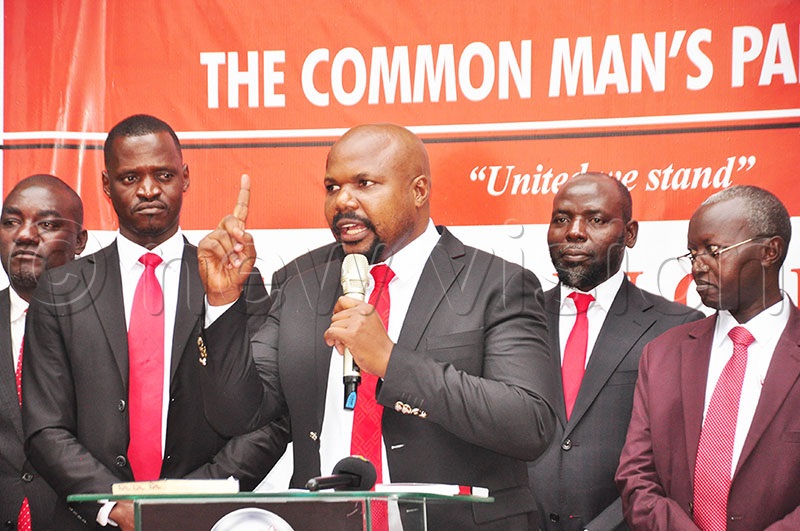
Mubarak Munyagwa And Moses Bigirwa
However, the relationship has since deteriorated, with disagreements over party administration escalating into a formal leadership dispute. Munyagwa and key members of his administration have accused Bigirwa of political conmanship.
The party officials also accused him of associating CMP with foreign groups allegedly promoting same-sex relationships, claims Bigirwa has vehemently denied
Genesis of fall-out
The disagreements became public when Bigirwa questioned Munyagwa's prolonged absence from the party headquarters following the January elections.
Through the media, Bigirwa claimed that although the party president had taken leave after the elections, he had failed to return and resume his responsibilities.
He alleged that attempts to reach Munyagwa through telephone calls, WhatsApp messages and intermediaries had been unsuccessful.
"He went for leave, which was acceptable and normal. But unfortunately, since he went on leave, he never came back to do his work," Bigirwa said.
He also questioned the party's internal decision-making arrangements, claiming that the NEC had not convened a formal meeting since January 2026.
His concerns extended to the management of the party headquarters, particularly disagreements over the premises near Kasubi Tombs and the Jakaranda premises in Rubaga Division, Kampala
The public criticism was followed by an extraordinary NEC meeting on November 5, which resolved to suspend Bigirwa indefinitely pending investigations into allegations of substantial misconduct.
The decision was subsequently communicated to the Electoral Commission in a November 6 letter.
Munyagwa defended the decision, saying it followed a petition by four NEC members who had raised concerns about Bigirwa's conduct.
"The secretary general was suspended by the NEC, not by the party president," Munyagwa said.
He maintained that the party constitution empowers the NEC to discipline its members, including the president, and insisted that the meeting had been properly constituted.
Munyagwa also rejected allegations of irregularities in the decision-making process, saying all members who attended the meeting had personally signed the attendance register.
He clarified that Bigirwa had not been expelled from the party and would be given an opportunity to defend himself before the disciplinary committee
"Once he's exonerated, a report will be brought back to you. Once he's found liable, a report will still be brought back to you to discuss," Munyagwa told the party National Council.
However, the party's formal notification to the Electoral Commission did not provide a detailed breakdown of the alleged misconduct, leaving questions about the precise charges to be investigated.
Bigirwa has rejected the suspension and threatened to challenge it through legal channels, according to reports on the dispute.
Young party syndrome
For Kakande, the CMP dispute reflects deeper organisational weaknesses among emerging political parties, particularly their failure to establish democratic structures and clear leadership processes.
He argued that some parties are formed without sufficient attention to internal democratic procedures, making disagreements difficult to resolve when they emerge.
“Some of the people who join these parties are after money. They are looking for how to get money. Most young parties fall apart before even a year passes,” Kakande said.
However, Dr Yusuf Sserunkuma, a scholar at the Makerere Institute of Social Research (MISR), argues that CMP's troubles should not be viewed as an isolated problem affecting young political formations.
He said the challenges extend across Uganda's political landscape, including established parties such as the ruling National Resistance Movement (NRM).
“It is a national condition of all political parties,” Sserunkuma said.
As of November 2026, Uganda has 27 registered political parties, ranging from established formations such as NRM, Democratic Party (DP), Uganda People's Congress (UPC), the Forum for Democratic Change (FDC) to newer entrants such as the National Unity Platform (NUP), Alliance for National Transformation (ANT), Common Man's Party (CMP), Democratic Front (DF), among others.
However, in the 2026 general elections only eight of the parties participated in the Presidential race including NRM represented by President Yoweri Museveni, NUP, Robert Kyagulanyi, FDC – Nathan Nandala Mafabi, ANT (Gregory Mugisha Muntu.
The other parties were the Revolutionary People's Party (RPP), whose candidate was Frank Bulira Kabinga; National Peasants' Party (NPP), with Robert Kasibante; Conservative Party (CP), with Elton Joseph Mabirizi; and Munyagwa’s CMP.