
MP Namara granted leave to table bill seeking election of LOP
Tayebwa said the mover had ticked, was Rule 132 of the Rules of Procedure issued in May last year, which bars any motion, bill or amendment from being moved as long as it poised at established one-party rule.
Buyaga West MP Dennis Namara during plenary on Wednesday, July 8, 2026. (Courtesy: X/@Parliament_Ug)
__________________
Parliament of Uganda has granted leave to Buyaga West MP Dennis Namara to introduce a private member’s bill seeking to allow independent lawmakers and opposition members to collectively elect a Leader of the Opposition.
Which, if passed, shall rescind the current arrangement where the leadership of the largest opposition party handpicks the person to occupy the office.
Legislative procedure
Steering the proceedings on Wednesday, July 8, deputy speaker Thomas Tayebwa explained that the motion had met the prerequisites required for such a proposal. He said Parliament had to assess the draft to ensure that it does not contravene Article 93, which bars members other than the Government from introducing legislation that imposes a charge on the consolidated fund.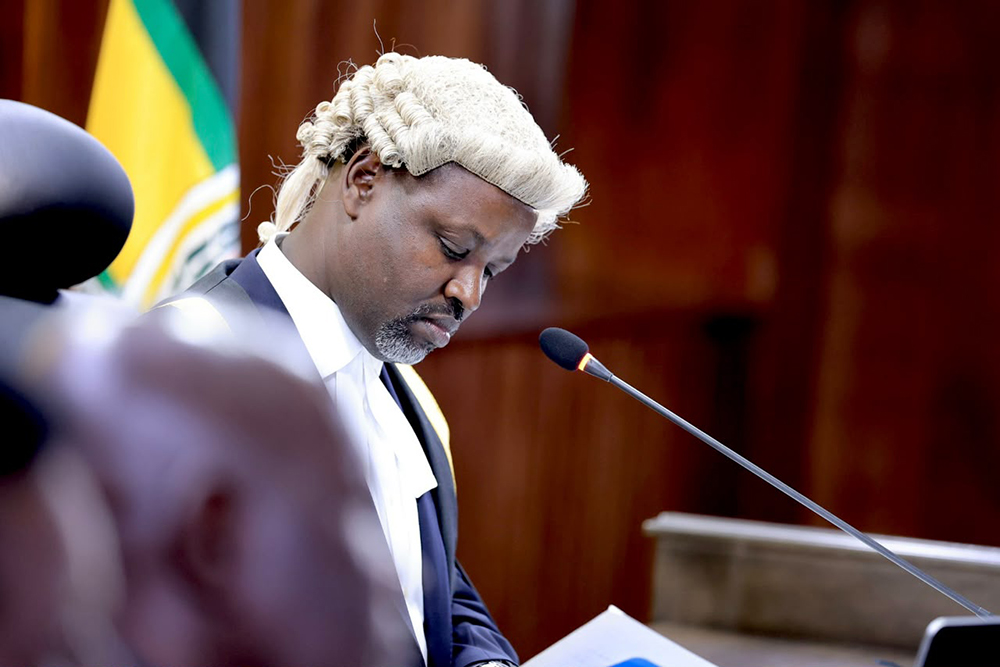
Deputy speaker Thomas Tayebwa. (Courtesy: X/@Parliament_Ug)
The other consideration, Tayebwa said the mover had ticked, was Rule 132 of the Rules of Procedure issued in May last year, which bars any motion, bill or amendment from being moved as long as it poised at established one-party rule.
It is worth noting that Article 75 of the constitution stipulates that “Parliament shall have no power to establish a one-party state”.
“If you don’t offend those provisions, now, as presiding officers, our hands are tied. Now the next phase will be the House to decide as to whether the member proceeds with a private member's bill or not,” Tayebwa guided.
Steering the proceedings, Tayebwa explained that the motion had met the prerequisites required for such a proposal. He said Parliament had to assess the draft to ensure that it does not contravene Article 93, including provisions that impose a charge on the Consolidated Fund, infringe on non-derogable rights, or violate Rule 123 by establishing a one-party state.
Paving the way for Namara to formally introduce the bill for first reading. This will also require him to obtain a certificate of financial implication from the Ministry of Finance, as enshrined under Section 76 of the Public Finance Management Act (PFMA).
Once introduced, the bill will be referred to the relevant committee, which in this case is the Committee on Legal and Parliamentary Affairs for stakeholder consultations before returning to the House for the second and third readings. After which it can become law upon enactment.
Regurgitation of old bills
However, even before Namara takes further steps, some opposition lawmakers, including Patrick Nsamba Guma-Oshabe (Kassanda North, NUP), have criticised the proposal.
Arguing that it is a regurgitation of a similar bill which was tabled by former Mityana South MP Richard Lumu in the last parliament.
But hit a dead end after the bill was disowned by the majority of political parties, including the ruling National Resistance Movement (NRM).
“The clarification I want to hear from you, Rt Hon. Speaker, is whether this parliament will proceed properly on a matter of political parties where they made their statements, and whether Ugandans will take us seriously anyway. Where political parties put their issues and made their positions clearly known, and it is on record of this house,” Nsamba inquired.
He was joined by Kalungu West member of parliament (MP) Joseph Gonzaga Ssewungu, who asked whether this was the most pressing concern of his constituents.
“I was also in this house in the eleventh parliament, and in Australia, there is a type of hunting done by the people in Australia using what they call a boomerang. When you are using a boomerang, you throw a stick to kill a bird in the air. At the end of the day, when you don’t catch that bird, the boomerang comes back to you,” Ssewungu alluded.
He added that he had been following the bill mover’s X (formerly Twitter) page, which had been inundated with backlash over the proposal.
However, Tayebwa counselled that it was premature to debate the merits of the motion before hearing its contents.
“A private member has a right to move a bill here, and I don’t think any member has a right to be told how his constituents will react because he knows the constituency he represents. And the issues we are talking about border on a motion which has not been presented,” Tayebwa ruled.
Adding that the argument that the bill had previously been tabled does not apply since Namara was not part of the house at the time.
“He doesn’t know why the member (Richard Lumu) withdrew, or the arguments which were provided, and the same political parties are here. They can make those same arguments, and you convince members it's not for me to decide but for you, honourable colleagues,” he argued.
Justification
That notwithstanding, Namara, while moving the motion, pushed back against the criticism.
Accusing the opposition of being escapist. Speaking on the floor, Namara argued that the bill, once tabled, would strengthen democratic checks and balances.
Saying that the prevailing Administration of Parliament Act, 2006, does not provide sufficient grounds for the removal and selection of the Leader of the Opposition.
“Democracy cannot only be on the side of the National Resistance Movement (NRM). It should be on two sides. The maxim of equity says those who seek equity must come with clean hands. When you say Government must be accountable, even on your side you should be accountable,” said Namara.
Adding that “if every minister of the Government of Uganda can be censured because they draw money from the consolidated fund. How come there are no checks and balances on the side of the leader of opposition who draws money from the consolidated fund?”