
G.Bissau votes 'yes' in referendum for new constitution
Guinea-Bissau is the latest example of an African nation's leaders seeking to amend or overhaul its constitution to extend term limits, remove age restrictions or expand executive powers, following in the footsteps of Zimbabwe, Guinea, Togo, Uganda and Chad in recent years.
An official from the National Electoral Commission (CNE) shows a marked ballot at a polling station in Bissau, on August 30, 2026 after Guinea-Bissau voted in the constitutional referendum. Ballot counting began in military-run Guinea-Bissau as voting ended in Sunday's referendum, which could give the president more powers ahead of a general election meant to restore civilian rule later this year. Security was stepped up at strategic points in the capital, with members of the national guard and the police stationed at key locations. Voting booths closed as planned at 5:00 pm local time (1700 GMT), with the first provisional results due on Tuesday. Idrissa Djalo, executive secretary of the National Electoral Commission, told a press briefing Sunday evening that turnout had "exceeded" 55 percent. (Photos by AFP)
________________
BISSAU — Guinea-Bissau voters approved a referendum on a constitutional change that will give the president more powers, the country's electoral commission said Tuesday, ahead of a general election meant to restore civilian rule later this year.
The referendum vote, held Sunday, came less than 10 months after a coup in which the military seized power in the impoverished West African country and just months ahead of the December 6 presidential election.
Guinea-Bissau is the latest example of an African nation's leaders seeking to amend or overhaul its constitution to extend term limits, remove age restrictions or expand executive powers, following in the footsteps of Zimbabwe, Guinea, Togo, Uganda and Chad in recent years.
According to results announced by the country's National Electoral Commission on Tuesday, the "yes" camp prevailed with 70 percent of the vote.
The junta says the change will stabilise institutions before the elections designed to hand power back to civilians.
But the political climate is tense in the coup-prone coastal nation, and the opposition had urged voters to boycott the referendum "in a context of restrictions on public freedoms".
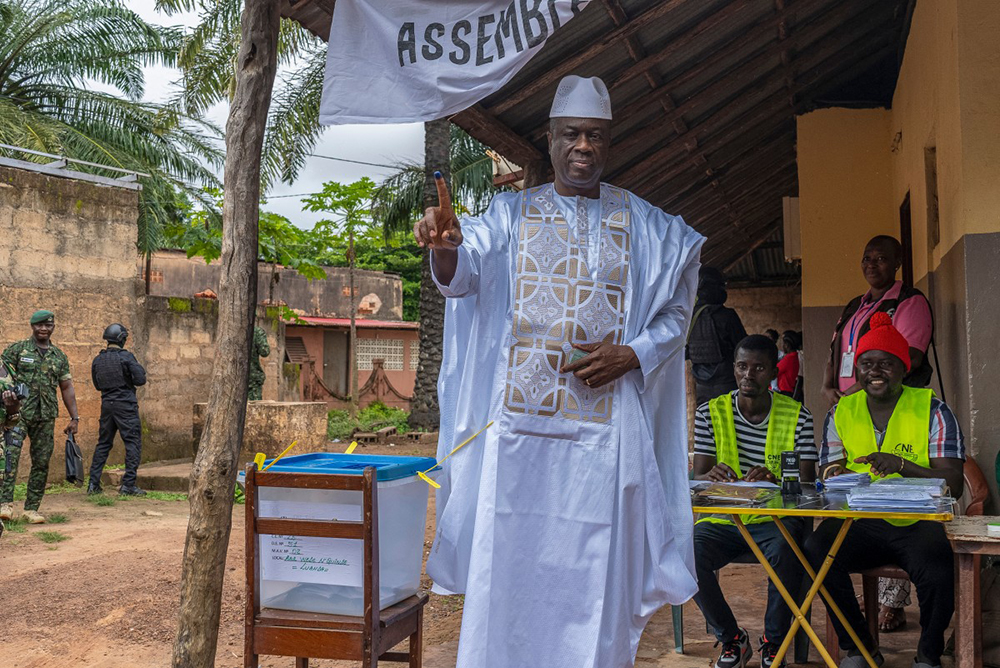
Guinea-Bissau's transitional president General Horta N'Tam shows his ink-stained finger after casting his ballot at a polling station during the country's constitutional referendum in Bissau, on August 30, 2026.
Under the transitional charter he upholds, the general is barred from running for election.
Final results of the referendum are expected to be announced in the coming days by the Supreme Court, which has not received any legal challenges over the vote so far.
Coup-prone
It will also allow the head of state to appoint and dismiss the prime minister and members of the government, and to dissolve parliament.
Segments of the political class and civil society vehemently opposed the sweeping constitutional rewrite by an unelected transitional government.
However, Carmen Izaura Lobo, chairperson of the National Electoral Commission, described the vote as a success, due to the "organisational capacity, professionalism and dedication" of teams on the ground.
She praised the "transparency" and "credibility" of the referendum process, although the vote failed to generate much enthusiasm among the electorate, with turnout across the country appearing sporadic.
In five Bissau polling stations visited by AFP in the afternoon, voters turned up irregularly in small numbers. Intense rain in the morning had dissuaded some.
The army took power in Guinea-Bissau last November just days after a presidential election, overthrowing then-president Umaro Sissoco Embalo and suspending the electoral process.
Guinea-Bissau, one of the world's poorest countries, has experienced five coups and a series of attempted coups since 1974.