
FDC wants govt to prioritise boda boda medical insurance amid rising crashes
The party says the boda boda industry has become one of the biggest employers of Uganda's unemployed and underemployed youth, yet most riders are left exposed when they are involved in a crash.
FDC deputy president for western Uganda, Robert Centenary Franco, addressing the press conference at FDC Headquarters Najjanankumbi in Kampala on Monday, August 17, 2026 (Photo by Isaac Nuwagaba)
_________________
The Forum for Democratic Change (FDC) has called on the government to urgently prioritise a national medical insurance scheme for boda-boda riders, warning that accidents in the sector are increasing while riders continue to work without a safety net.
The party says the boda boda industry has become one of the biggest employers of Uganda's unemployed and underemployed youth, yet most riders are left exposed when they are involved in a crash.
“Riders are dying and paying from their pockets. When a rider is knocked, the hospital bill stops their income the same day,” FDC deputy president for western Uganda, Robert Centenary Franco, said.
Addressing a press conference at party headquarters in Najjanankumbi, Kampala, on Monday, August 17, 2026, Centenary noted that with thousands of motorcycles on Ugandan roads daily, accidents have become common.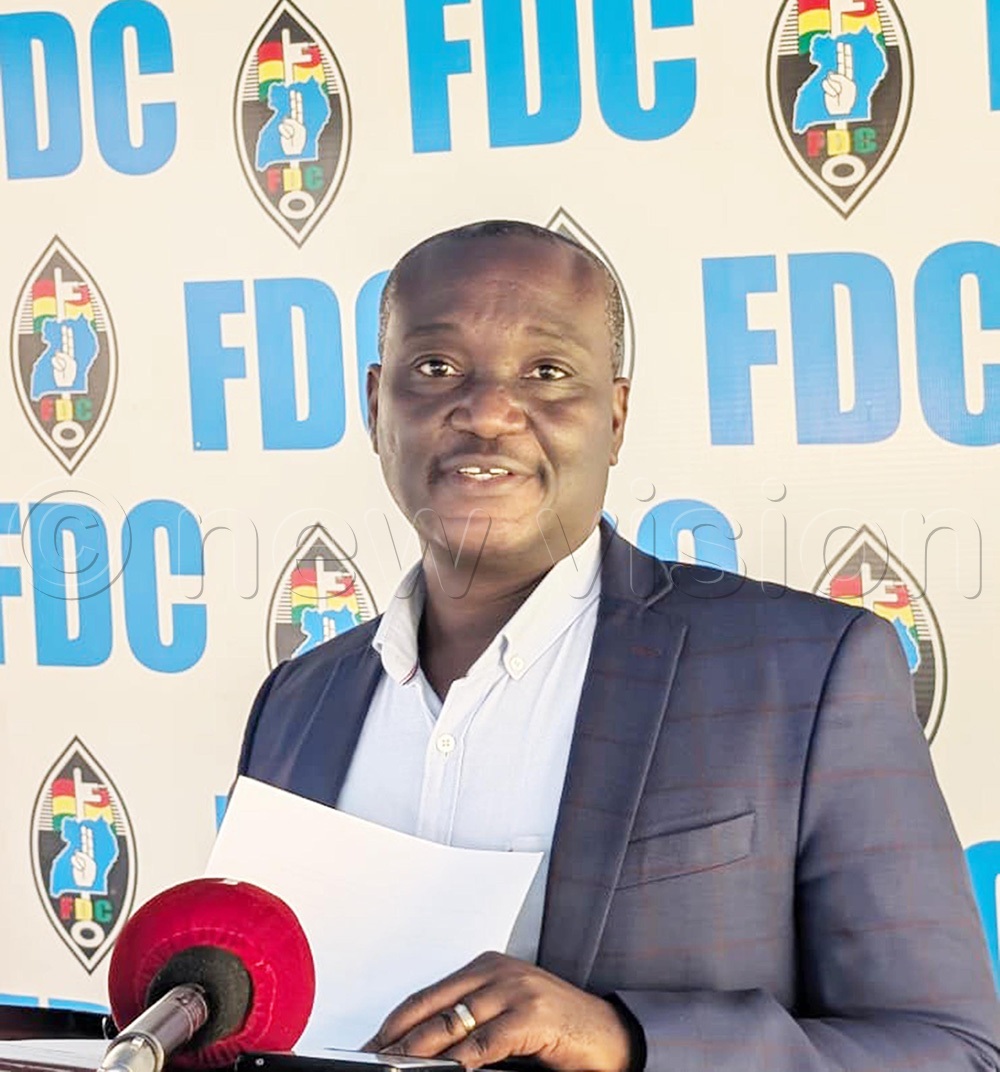
FDC deputy president for western Uganda, Robert Centenary Franco, addressing the press conference at FDC Headquarters Najjanankumbi in Kampala on Monday, August 17, 2026 (Photo by Isaac Nuwagaba)
“Most riders have no health insurance; treatment costs often push them and their families deeper into poverty. There is no compensation, no insurance, no pension and this calls for the government to intervene,” Centenary observed.
“FDC is urging the Ministry of Health and Ministry of Works to fast-track the establishment of a Boda-Boda Savings and Protection Cooperative Scheme. Under the proposal, riders would contribute small amounts to access medical cover for accidents and treatment.
If the loan repayment per day is sh15,000, for instance, sh12,000 should be given out to repay the loan and sh2000 to cater for medical insurance,” he argued.
“Every day we lose young men to crashes, and others to debt because they cannot pay hospital bills,” Centenary observed. “A medical insurance scheme will give riders dignity and give the government a database to regulate the sector properly.”
Boda-bodas remain the main form of transport and employment for youth in towns and villages. But the sector operates largely in the informal economy, with most riders acquiring motorcycles on hire-purchase and earning just enough to cover daily instalments.
Dr Nicholas Kamala, a physician and former Kabale Municipality Member of Parliament (MP), said increasing accidents without insurance are a public health and economic crisis.
Kamala, who also linked the lack of cover to rising crime, noted that some riders who lose their bikes after an accident and cannot pay hospital bills end up with no legal source of income.
Govt response needed
“We are not asking for handouts,” FDC said. “We are asking the government to prioritise the lives of Ugandans who wake up every morning to move this economy."
“End the hire-purchase trap. Let the government create a fund where these youth can access soft loans at a cheap interest rate with a few thousand shillings to cater for medical insurance,” Centenary said.
According to FDC, the boda-boda economy has become a primary destination for Uganda's unemployed and underemployed youth, absorbing large numbers of people whom the formal job market has no room for.
“Almost none of these riders own their motorcycles outright when they start,” Centenary noted. “They acquire them through asset-financing companies and micro-credit firms on hire-purchase terms: a deposit, followed by weekly or daily instalments.”
The party says the model collapses the moment a rider misses payments, leading to his family losing its source of livelihood with no hope of survival.
“Until they fail to pay and have the motorcycle repossessed over a final shortfall of a few hundred thousand shillings, wiping out nearly everything they had already paid. When the bike is taken, the rider's income stops the same day. Some, unable to reacquire a motorcycle, turn to crime.”
FDC attributes this to one core problem: poor access to affordable credit. “Ugandans turn to moneylenders because they are accessible while formal credit does not reach them,” the statement reads.