
DP wants Benedicto Kiwanuka honoured for role in Uganda's independence
“DP's sacrifice of agreeing to a fresh election in April 1962, just 9 months after winning a 5-year term in March 1961, was the ultimate act of patriotism that made October 9th, 1962 possible. If DP had insisted on serving its full 5-year term, Obote would not have become Prime Minister in April 1962 to receive instruments of independence in October.”
A line of DP leaders who have shaped their history with the Minister of Justice and Constitutional Affairs, Norbert Mao, leading the queue as the current leader of the oldest opposition DP at Balintuma Road Headquarters in Rubaga Division, Kampala. (Credit: Isaac Nuwagaba)
KAMPALA - As Uganda prepares to celebrate 64 years of Independence from Britain, the Democratic Party (DP) has demanded that Uganda correct what it calls a “64-year historical injustice” against Uganda's first Prime Minister, Benedicto Kiwanuka, and recognise his role in the country's journey to independence on October 9, 1962.
The official Independence Day national celebrations, military parade and presidential address will be held at Kololo Ceremonial Grounds in Kampala on Friday, October 9, 2026.
Addressing a press conference at the DP headquarters on Balintuma Road in Kampala on Tuesday (October 6), DP electoral commission chairperson Kennedy Mutenyo said it was time for Uganda to officially honour Kiwanuka, not only as a former chief justice but also as the political leader who opened the door to independence.
Mutenyo said the DP wants Parliament Avenue renamed Benedicto Kiwanuka Avenue and March 1 declared Benedicto Kiwanuka Day, in recognition of “self-rule” similar to Kenya's Madaraka Day.
“That is the day the Africans regained real power from the British. That’s when Kiwanuka was elected Prime Minister before he handed over peacefully to pave the way. It was a trial to rule ourselves (self-rule day). That’s when they went to Lancaster House to agree on the day, which became October 9, 1962,” he said.
“Much as we have Ben Kiwanuka Street named after him in the city centre, our leader was not a businessman, and he deserves the right place with the power of influence that he handed over peacefully. That is the Parliamentary Avenue,” he observed.
“DP's sacrifice of agreeing to a fresh election in April 1962, just 9 months after winning a 5-year term in March 1961, was the ultimate act of patriotism that made October 9th, 1962 possible. If DP had insisted on serving its full 5-year term, Obote would not have become Prime Minister in April 1962 to receive instruments of independence in October.”
Taking journalists through what he described as the forgotten journey to independence, Mutenyo said Uganda was proclaimed a British Protectorate on June 18, 1894, and for 68 years the British were Uganda's masters.
He said the decisive moment came at the Uganda Independence Talks held at Lancaster House in London from September 18, 1961, to October 9, 1961, a conference convened to determine Uganda's political future, including independence from Britain.
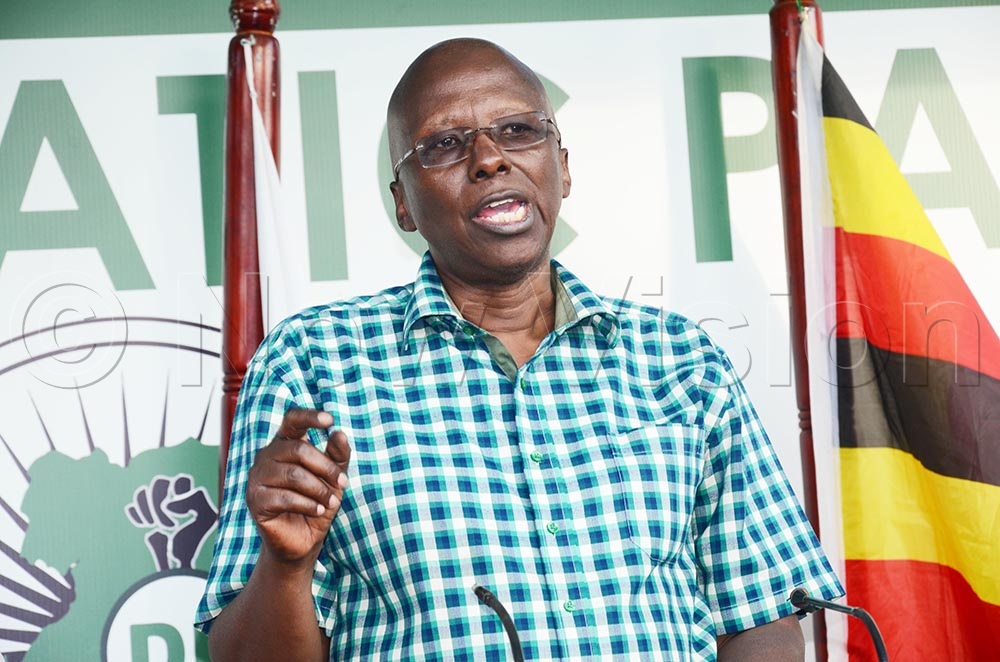
DP electoral commission chairperson, Kennedy Mutenyo addressing the press conference at DP Headquarters Balintuma Road on the Independence Day celebrations. (Credit: Isaac Nuwagaba)
Mutenyo told the press that the conference was broadly attended. Districts that sent delegations included West Nile, Madi, Acholi, Lango, Karamoja, Teso, Bugisu, Bukedi, Busoga, Bunyoro, Tooro, Ankole and Kigezi.
“Urban centres that attended included Kampala and Jinja. Two political parties attended to shape the political future. These were the Democratic Party led by Prime Minister Benedicto Kiwanuka as the sitting government after winning the 1961 elections with 44 parliamentary seats out of an 82-seat parliament, and the Uganda People's Congress (UPC) led by then Leader of Opposition Milton Obote.”
“One of the major reasons for the conference was to set the agenda for Uganda's independence, which was set for October 9, 1962. This agreement was reached when DP put Uganda first and accepted to have another election only after 9 months in power, yet they had won a 5-year term,” Mutenyo said.
He emphasised that Benedicto Kiwanuka and the DP had just entered government on March 1, 1962, a day that Uganda does not mark up to now.
In Kenya, the day that country got self-rule from Britain on June 1 is celebrated as Madaraka Day, a public holiday. Mutenyo asked why Uganda does not celebrate March 1, the day Benedicto Kiwanuka was handed the reins of government.
Mutenyo noted that the Judiciary in Uganda recognises Benedicto Kiwanuka, the former chief justice, with a memorial lecture every September, the month in which he disappeared in 1972 after being abducted from the High Court.
He added that Kampala Archdiocese also holds an annual memorial Benedicto Kiwanuka lecture to remember a great Catholic every September.
“Why can't Uganda's politics, where he served as the country's first Prime Minister, a political office, celebrate the 1st of March, the day he ascended to power, which is, in my opinion, a positive reminder? The church remembers him. The Judiciary remembers him. But the political system that he led to independence has forgotten him,” Mutenyo lamented.
He said failure to recognise March 1 has created a generation of Ugandans who think independence was handed over by the British to Obote alone, yet the groundwork was done by Kiwanuka.