
Tenywa’s pen fights for the environment
His stories took him into forests, wetlands, fishing villages, dusty cattle corridors and fragile ecosystems that rarely make front page headlines, but determine whether future generations will eat, drink clean water and breathe healthy air.
Gerald Tenywa posing with one of his awards. (File photos)
________________
For decades, while many reporters chased politics, scandals and the daily noise of power struggles, Gerald Tenywa quietly chose a different battlefield.
His stories took him into forests, wetlands, fishing villages, dusty cattle corridors and fragile ecosystems that rarely make front page headlines, but determine whether future generations will eat, drink clean water and breathe healthy air.
It was not always fashionable work. In fact, when Tenywa began writing about environmental issues at the Vision Group flagship newspaper New Vision, the environment beat in other publications in the country was often treated like an afterthought — something squeezed into a small corner of the paper after the “important” stories had taken their share of space.
But Tenywa had a stubborn belief that would guide his career: the environment is not a side story. It is the foundation of every story.
Turning point
By 2012, Tenywa had already spent years writing about forests, wildlife and wetlands. However, that year, he produced a story that made readers across Uganda pause, scratch their heads and look at something they had always taken for granted: how they bury their dead. The headline was unusual for an environmental story — “Concrete Graves Killing the Environment.”
It didn’t sound like the typical report about disappearing forests or polluted rivers. But that was exactly the point.
Tenywa has a talent for spotting the hidden connections between daily life and the health of the land. In the story, he described a striking scene that many Ugandans could easily picture.
A wealthy 56-year-old man had been buried in a polished mahogany casket, placed inside a large concrete tomb lined with bright white tiles.
Mourners gathered around the grave admiring the expensive structure. To them, it symbolised respect, dignity and modern success.
However, Tenywa gently turned the moment on its head. What happens, he asked, to the nutrients that should return to the soil after death?
Concrete burial
walls When a body is sealed inside thick concrete walls, the natural cycle of life is broken. The soil receives nothing back. The quiet partnership between humans and nature — what he called the
“I-feed-you-you-feed-me” cycle — is suddenly interrupted. He observed how this modern style of burial had spread rapidly across Uganda. Even families living in simple mud-and-wattle houses were increasingly insisting on cement graves.
It felt more modern. More respectful. More permanent. Yet beneath that permanence lay an environmental cost many had never considered.
The statistics were sobering. Uganda, researchers estimated, could lose nearly 2,000 acres of farmland to burial grounds between 2010 and 2017 alone. In the cattle corridor districts such as Nakasongola, scientists were already seeing troubling changes in the soil.
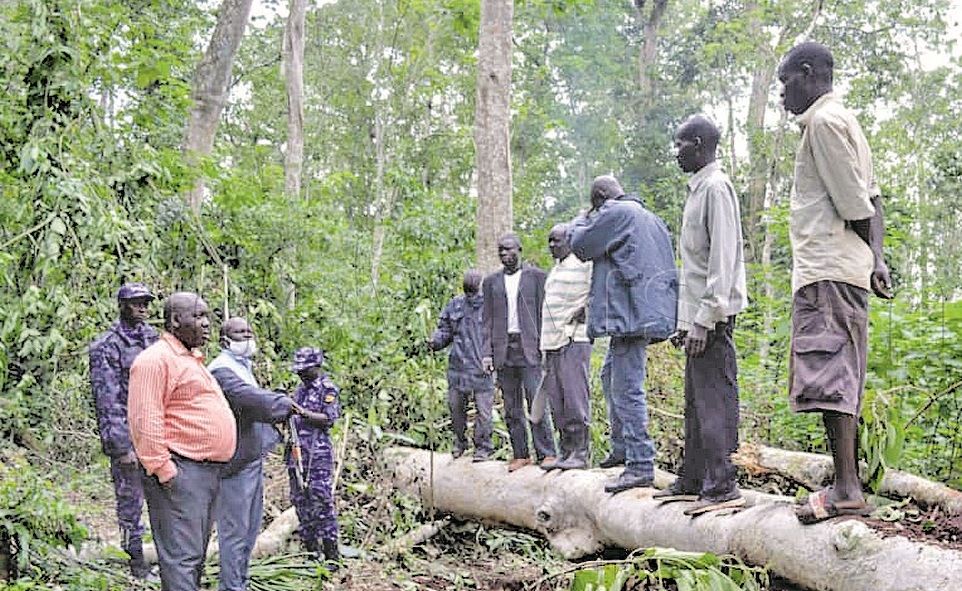
Forest and security officials confronting some of the suspected illegal loggers who had cut down trees in Mabira Forest for timber. Tenywa spent two weeks inside Mabira Forest with a photographer and a team of guides and forestry officials who unearthed degradation occurrences
Termites were multiplying and destroying grass and trees because the land was losing the organic nutrients that once came from natural burials.
Tenywa supported the story with expert voices, quoting officials from the National Environment Management Authority (NEMA) and researchers from Namulonge Agricultural Research Institute (NARI). Then he reached even further back into history.
Bodies were wrapped in cloth and placed directly into the earth, allowing nature to complete its cycle. Even today, Tenywa wrote, nomadic pastoralists in Karamoja often cover their dead with straw before moving on with their herds, leaving almost no permanent mark on the landscape. The story carried a deeply personal touch as well.
Tenywa reminded readers that his mentor, the late environmental journalist, Ndyakira Ntamuhiira Amooti, had once left a simple instruction in his will: he wanted to be buried naturally, without a coffin or concrete tomb — just returned to the soil he had spent his life defending. The article struck a nerve.
It forced Ugandans to think about something cultural, emotional and deeply personal. Suddenly, the environment was no longer just about distant forests or wildlife reserves.
It was about the very ground beneath family graves. The impact was immediate. In 2012, the story earned Tenywa the environment category of the CNN Multichoice African Journalist Award. The judges praised the piece for tackling an environmental issue through culture and everyday life.
Inside Mabira forest
Rather than rely on rumours or official statements, Tenywa and the newsroom decided to do something unusual.
At the time, the managing editor of New Vision, William Pike, was worried that readers might doubt the story. After all, New Vision was often viewed as the Government newspaper.
Critics might assume the paper was supporting the plan. So, Pike proposed an unusual challenge.
“Walk through the forest. From one side to the other,” he told Tenywa.
No hotels. No guest houses. Where night fell, they would pitch camp. And so Tenywa set off into Mabira with photographer Matthias Mugisha and a small team of guides and forestry officials.
They started from Vuvunya and crossed the Kampala–Jinja road, heading deep into the forest toward Griffin Falls and, eventually, a place called Waswa. For two weeks they walked under towering trees, documenting everything they saw.
What they discovered surprised them. Contrary to claims that Mabira was degraded, the forest was very much alive. Birds called from the canopy. Monkeys leapt through branches. Streams ran clear through the undergrowth.
Along the way, they encountered local communities living in enclaves — small settlements surrounded by forest where families had lived for generations. Many of these residents feared the forest would disappear.
A forestry officer named Leo Twinomuhangi heard about the expedition and joined the team. By the time the team emerged from Mabira two weeks later, they had enough material to fill a newspaper.
And that is exactly what happened. When the story finally appeared in New Vision, it was unlike anything readers had ever seen.
Eight full pages. Starting from the front page. The series documented the forest’s biodiversity, its ecological importance and the danger posed by converting it into sugar plantations. The coverage did not stop there.
For months afterward, the newspaper published story after story about Mabira — nearly a hundred in total. Each one educated the public about forests, conservation laws and the doctrine of public trust.
The concept was simple but powerful: natural resources like forests are not owned by the Government. They are held in trust for the people of Uganda. Journalism, in this case, became a classroom. Civil society organisations picked up the debate.
Environmental activists organised campaigns. Ordinary citizens began asking difficult questions. Eventually, demonstrations erupted in Kampala. Thousands marched in protest, demanding that Mabira be saved.
Graveyard that refused to die
Kampala might be cleared to make way for development. The first article about it appeared in the newspaper without much fuss. But when Tenywa examined the issue more closely, he realised something bigger was at stake.
The graveyard was not just a burial ground. It was one of the few remaining green spaces in the city. Kampala was urbanising at breakneck speed.
Trees were disappearing. Wetlands were being reclaimed. Concrete was swallowing everything. But graveyards, by their very nature, remained quiet sanctuaries. Birds roosted in their trees. People rested in their shade. The land breathed.
“A graveyard is a breathing space for the city,” Tenywa argued.
When the story ran, reactions flooded in from Ugandans abroad — particularly in Canada and the UK, where relatives of people buried there still lived.
The pressure worked. The graveyard was spared. And today, despite towering buildings around it, the resting place remains intact — a small patch of green in a city running out of air.
Then came the bribes he refused. Environmental journalism often brings journalists face-to-face with powerful interests. Logging companies. Developers. Politicians. Investors. Sometimes the pressure comes in subtle ways. Other times it arrives in envelopes. Over the years, Tenywa says, one piece of advice from William Pike has stayed with him.
“That is dirty money,” Pike told him. “Never touch it. You will choke on it.” Today, environmental journalism in Uganda is stronger than it once was. More young reporters are taking up the beat. Campaigns to protect forests, lakes and wildlife now reach millions across newspapers, television, radio and digital platforms.
The Mabira envelope
The story of Mabira began almost like a whisper. Rumours had started circulating that Mabira Forest Reserve, one of Uganda’s largest remaining natural forests, had quietly been allocated to Sugar Corporation of Uganda Limited for sugarcane growing.
At first, the idea sounded absurd. Cut down a massive tropical forest for sugarcane? Even seasoned journalists struggled to believe it.
Then one day, someone called Tenywa with a strange message. The source insisted on anonymity and refused to meet him. Instead, he promised to send information. Not long afterward, a messenger walked into the reception at New Vision carrying an envelope addressed to the newsroom. Inside was a statement. It indicated that the Government had indeed approved plans to give away part of Mabira Forest Reserve to a sugar company.
That envelope marked the beginning of one of the biggest environmental stories Uganda had ever seen.
“I did not know the weight of the story until it ran,” Tenywa later recalled. When the article appeared in the newspaper, the reaction was explosive. Phone calls poured in.
People debated the issue in offices, markets and homes. Ugandans abroad joined the discussion. Suddenly, the fate of Mabira Forest had become a national conversation.
Alarm on Lake Victoria
Tenywa set his sights on a big story — one that touched the lives of millions across East Africa. In 2013, New Vision launched an ambitious campaign called “Save Lake Victoria.”
At the heart of the campaign was Tenywa’s powerful article titled “Lake Victoria Could Soon Be History.”
The story opened with a chilling vision of the future. Imagine the year 2050, he wrote. The taps in Kampala run dry. Hospitals struggle with water-borne diseases. Families queue desperately for clean water in the capital city.
The source of the nightmare? The slow death of Lake Victoria. Tenywa quoted environmental experts, including Dr Tom Okurut, the former executive director of NEMA, who warned that the world’s second-largest freshwater lake was under serious threat. Yet the risks remained real.
If there is one story that captures Tenywa’s courage and persistence, it is his relentless reporting on the fate of Bugoma Forest Reserve.
On one assignment deep in the forest, he and fellow journalist Ismael Kasooha narrowly escaped danger while documenting chainsaws roaring through the jungle and fires spreading across freshly cleared land.