
We will not keep quiet on land ownership rights — women activists
“Securing women’s land rights is not a favour to women. It is a fundamental human right,” Birungi said, urging stakeholders to move beyond conference resolutions and take practical action.
Margaret Rugadya (centre), the Coordinator, Senior Program Officer, the Land and Forest Tenure Facility Fund, with other participants at the 4th Women Land Rights Conference on October 15, 2026. (Photos by Nicholas Oneal)
________________
Women’s rights activists have vowed to intensify their campaign for women’s land ownership and inheritance rights, saying they will not remain silent while cultural practices and weak enforcement of existing laws continue to deny women control over property.
The activists made the commitment during the Fourth Women’s Land Rights Conference, held to mark the International Day of Rural Women under the theme “From Demand to Action”.
They called on the Government, cultural leaders, men and development partners to turn legal protections into tangible gains for women.
The conference was held at Hotel Africana on Thursday and attracted women leaders from different parts of the country.
Francis Birungi, executive director of the Uganda Community Based Association for Women and Children’s Welfare (UCOBAC), said Uganda had made progress in establishing legal protections, but many women still struggled to access, inherit or control land.
Birungi, who coordinates the Stand for Her Land campaign in Uganda, said the initiative was established in 2022 to address the gap between the rights guaranteed by law and women’s experiences in their homes and communities.
She said grassroots women needed support to participate in land governance, understand their rights and seek justice when those rights were violated.
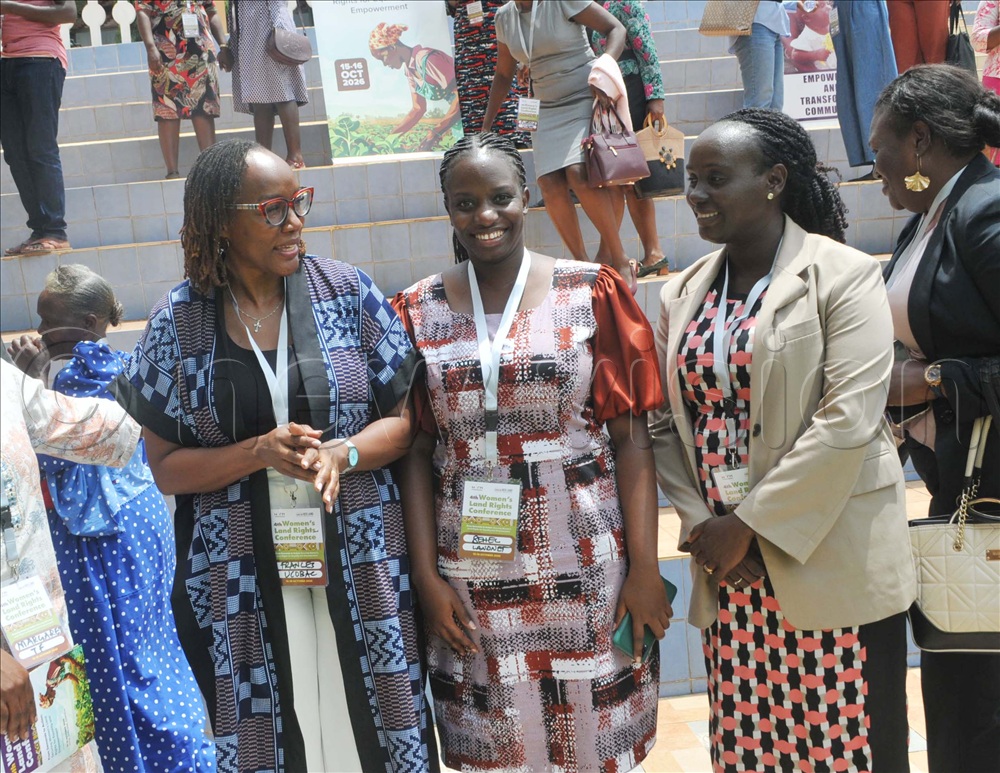
(L-R) France Birungi, the Executive Director of the Uganda Community Based Association for Women and Children's Welfare, with Bethel Kisaarwot, Director Women's Land Rights Movement and Martha Mugarura, the Commissioner of Lands, at the 4th Women Land Rights Conference on October 15, 2026.
“Securing women’s land rights is not a favour to women. It is a fundamental human right,” Birungi said, urging stakeholders to move beyond conference resolutions and take practical action.
The campaign works with civil society and community-based organisations to challenge discriminatory practices, improve legal awareness and amplify women’s voices in decisions concerning land.
Karima Lanyero Obina, a board member of the Acholi Religious Leaders Peace Initiative, said women needed to be confident in asserting their rights rather than accepting exclusion as a cultural norm.
She encouraged women to formalise their land ownership where possible, noting that documents such as Certificates of Customary Ownership could help them defend their claims when disputes arose.
However, Dr Margaret Rugadya, chief programme officer at the Tenure Facility Fund, cautioned that issuing land documents was only part of the solution.
She said women needed to be able to exercise the rights recognised in those documents, benefit from the resources they controlled and protect their investments from interference by relatives or other people.
Rugadya urged women to organise themselves into groups and associations to defend their interests, participate in land administration and develop income-generating activities using land and other natural resources.
The activists noted that the challenges were particularly severe for women affected by displacement.
Charles Sevume, protection coordinator at the Norwegian Refugee Council, said refugees and other displaced people often faced challenges such as lost documentation, insecure tenancy arrangements and limited access to legal assistance.
He called for affordable legal services and accessible dispute-resolution mechanisms, particularly for widows, women with disabilities and women heading households.
Laura Isabel Schwiertz, programme coordinator for the GIZ Civil Peace Service, said women’s land rights were also central to peacebuilding, as excluding them from decisions about natural resources could deepen tensions within families and communities.
She urged stakeholders working in Karamoja, Acholi and Teso to continue supporting gender-transformative approaches to natural resource management.
Government and parliamentary representatives acknowledged that legal protections alone were insufficient to guarantee women’s land rights.
Martha Mugarura, an assistant commissioner at the Ministry of Lands, Housing and Urban Development, called for practical solutions to improve land documentation and address harmful customary practices.
Kyankwanzi MP Patrick Bingi Nyanzi urged participants to identify the specific factors contributing to women’s exclusion, including cultural attitudes, unequal power relations and weaknesses in the implementation of existing laws. He also called on men to participate in efforts to protect women’s rights.
Uganda’s Constitution guarantees equality and protects property rights, while Section 27 of the Land Act invalidates customary decisions that deny women land rights in violation of constitutional protections.