
Vice President Alupo advocates for stronger UN fiscal capacity
Alupo emphasised that critical among the numerous obstacles confronting nations is the limited fiscal space and increasing debt burdens.
Vice President Jessica Alupo meets a European Commission delegate in New York on September 22, 2026. (Courtesy)
________________ Vice President Jessica Alupo, Minister of Foreign Affairs Adonia Ayebare and Minister of Health Dr Chris Baryomunsi attend the opening of the 81st United Nations General Assembly on September 22, 2026. (Courtesy)
NEW YORK — Developing countries have persistently faced numerous challenges which have impeded the implementation of the 2030 agenda and its seventeen sustainable development goals (SDGS), Vice President Jessica Alupo has said.
While in New York, on Tuesday, September 22, Alupo emphasised that critical among the numerous obstacles confronting nations is the limited fiscal space and increasing debt burdens.
“Many of our countries spend a sizeable share of our revenues on paying off debt rather than investing in critical infrastructure and public services. In this respect, we call for the urgent reform of the International Financial Institutions (IFI) to grant developing countries a strong voice in decision making,” Alupo said while addressing Delegates High-Level Reflection on the Pact for the Future session on the sidelines of the 81st United Nations General Assembly.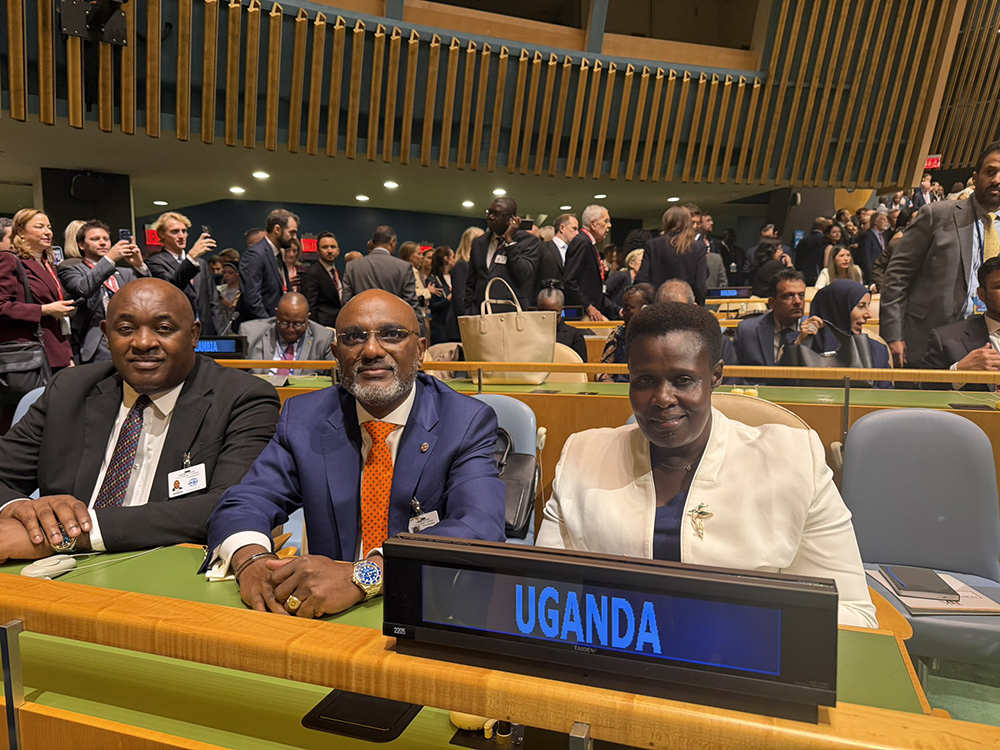
The session was the High-Level Reflection on the Pact for the Future, co-hosted by Namibia and Zambia alongside the United Nations Economic Commission for Africa (UNECA), the African Union, and senior UN officials.
“This convention will enable curb illicit financial flows and profit-shifting by large companies and provide fair global tax rules to strengthen domestic resource mobilisation in our countries,” she said.
A media handout from her office states that Alupo added that Uganda welcomed the establishment of the platform for borrower countries on April 15, 2026, in line with the Sevilla Commitment, to close the funding gap for SDGs.
She further emphasised that the implementation of the core action of the Pact on the reform of the United Nations Security Council is paramount in addressing the historical underrepresentation of Africa on this Council.
The members of the Committee of Ten (C-10) Heads of State and Government are engaging constructively to champion the Common African position as enshrined in the 2005 Ezulwini Consensus and the Sirte Declaration.
The C-10 Coordinator (Sierra Leone) submitted the African Model on the reform of the UN Security Council to the Co-chairs of the UN Intergovernmental Negotiations.
She reiterated Uganda’s commitment to fully implement the Pact for the Future and its annexes and called upon the international community to support its full implementation in this regard.
The African Union and the United Nations have a long-standing partnership in the implementation of multilateral commitments, including the Pact as with the African Union blueprint, Agenda 2063.
The vice president told delegates that Uganda welcomes the emphasis placed on Africa's strategic priorities by the Pact, namely, Peace and Security, particularly the reform of the United Nations Security Council; Accelerating the achievement of sustainable development goals; Reform of the international financial architecture, to better support developing countries; Ensuring secure and inclusive development of science, technology and innovation; and empowering the youth.
Alupo highlighted that galvanising the means of implementation for the Pact for the Future is key to advancing the 56 core actions across these five pillars.
“Africa has the world's youngest population. To tap this demographic dividend and secure future generations, the implementation of the Pact is central to unlocking meaningful commitments to investments in education, technology, and skills development for quality jobs and digital expansion,” she said
The 81st session of the United Nations General Assembly (UNGA 81) opened on September 8, 2026.
With the highly anticipated High-Level Week running from September 18–28, the summit is running under the official theme for this session is "Restoring trust, managing transformation: A United Nations that delivers for all."